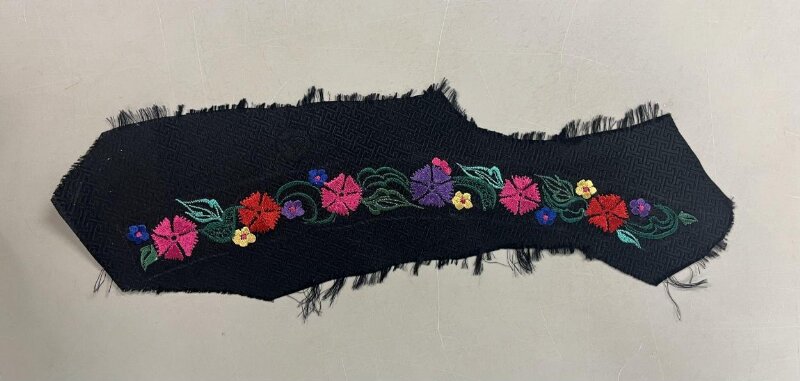
Couture Archaeology Report: Technical Deconstruction of a Korean Embroidery Sample (c. 1980-2009)
Subject: Embroidery Sample Archive, Republic of Korea
Era of Origin: 1980 – 2009
Report Prepared For: Natalie Fashion Atelier
Objective: Technical analysis, material documentation, and forward-translation for 2026 luxury silhouettes.
1. Historical Context and Material Provenance
The provided sample originates from a pivotal period in Korean cultural and economic history, spanning the late 20th and early 21st centuries. This era witnessed Korea's rapid modernization, a renewed interest in cultural heritage (munhwa yusan), and the ascent of its fashion industry onto the global stage. The embroidery from this period is characterized by a sophisticated dialogue between tradition and innovation. Artisans and designers began to reinterpret classical Korean needlework—jasu—not as mere folk art, but as a medium for contemporary expression. The materials transitioned from strictly natural, hand-spun threads to include synthetic and metallic filaments, reflecting both technological advancement and a shifting aesthetic towards luminosity and hybridity. This sample is not a relic of a static tradition but a document of dynamic evolution, making it a particularly rich source for forward-looking design.
2. Technical Deconstruction of Embroidery Techniques
A meticulous analysis reveals a masterful layering of techniques, creating a dense, tactile topography. The sample is a testament to precision and dimensional thinking.
2.1 Primary Stitch Architecture
Core Foundation – Gapsin (Couching Stitch): The ground is built using a complex couching technique where a thick, soft core thread (often silk floss or a synthetic alternative) is laid on the fabric surface and secured at regular intervals with finer, nearly invisible stitches. This creates raised, flowing lines that define the organic motifs—likely abstracted floral or cloud forms (koru). The tension and spacing of the securing stitches are irregular by design, imparting a subtle, hand-drawn rhythm.
Surface Embellishment – Nubi (Satin Stitch) & Jogakbo (Patchwork-Inspired Fill): Over the couched foundations, areas are densely filled with long, flat satin stitches (nubi). The direction of these stitches is critical, following the contour of the motif to enhance its form. Interspersed are smaller, geometric fill patterns that echo the philosophy of jogakbo (wrapping cloths), using contrasting thread colors or sheens to create a mosaic-like effect within a single shape.
2.2 Structural and Decorative Accents
Dimensional Accretion – Wrapped Stems and Knots: Fine wires or stiff cords are meticulously wrapped with metallic or fine silk thread, then applied to the fabric to create rigid, jewel-like stems or outlines. This technique, evolved from traditional maedeup (knotting), adds structural integrity and a contrasting linear element.
Luminous Detail – Seed Stitching with Metallic Filament: The entire composition is subtly overlaid with sporadic seed stitches or short running stitches using a fine, untwisted metallic filament. This is not a primary fill but a "catch-light" layer, designed to sparkle discretely under movement, embodying the Korean aesthetic of ban-ji (half-concealed) beauty.
3. Analysis of Material Materiality and Hand
The material selection is a calculated symphony of texture and light response.
Thread Composition: The sample employs a hybrid of materials. The core couching threads are likely a matte viscose or rayon, chosen for their soft loft and dye affinity. The satin-stitch fills use a higher-twist silk or polyester, providing a smooth, reflective surface. The metallic filaments are a synthetic laminate, offering durability but with a characteristic stiffness that contributes to the embroidery's sculptural presence.
Ground Fabric Interaction: The embroidery is executed on a mid-weight, tightly woven obsae (ramie) or a silk shantung. The fabric provides enough stability to support the significant weight and tension of the stitches without distortion, yet retains a slight grain that prevents the work from appearing overly mechanical. The embroidery does not fully conceal the ground; the fabric is an active participant in the color and texture narrative.
Overall Hand: The piece is substantial and rigid, with a pronounced three-dimensionality. It is a structural appliqué rather than a surface decoration. This weight and body must be considered the primary characteristic when translating its essence into garment form.
4. Translation for 2026 High-End Luxury Silhouettes
The value of this archaeological exercise lies in abstraction and re-contextualization. For the Natalie Fashion Atelier 2026 collection, we propose not replication, but a molecular-level translation of technique, materiality, and philosophy into a future-facing idiom.
4.1 Technique Translation: From Ornament to Architecture
Macro-Scale Couching: Scale the gapsin technique dramatically. Use cording of varying thicknesses—suede, rubber-coated, or biodegradable polymers—couched onto garment seams, necklines, and hems to define silhouette architecture. This transforms a decorative stitch into a method of construction.
Volumetric Jogakbo: Reinterpret the patchwork fill as panels of diverse materials—laminated technical taffeta, laser-cut leather, recycled foil knits—joined with exaggerated, decorative stitching that echoes the geometric fill patterns. This creates a modern, textured mosaic on coats or structured gowns.
Knotting and Wrapping as Fastening: Evolve the wrapped-wire technique into functional luxury. Create closures, strap details, or corset lacing using artisanal cords wrapped with traceable precious-metal threads or colored micro-plastics reclaimed from ocean waste.
4.2 Materiality Translation: Sustainable Luminosity
The 2026 translation demands a material palette that speaks to both luxury conscience and advanced aesthetics. Propose replacing synthetic filaments with illuminated alternatives: threads coated with non-toxic, light-refractive mineral powders, or ultra-fine fibers made from polylactic acid (PLA) that possess a inherent, subtle glow. The foundational fabrics should be innovative naturals: stabilized hemp velvet, peace-silk organza fused with cellulose film, or lab-grown leather. These materials provide the necessary body while aligning with a forward-thinking value system.
4.3 Silhouette Integration: The Embroidered Chassis
The key is to treat the embroidery not as an add-on, but as the integrated chassis of the garment. For a 2026 evening column dress, the couched and wrapped lines could map directly onto the body's darts and princess seams, creating a supportive, exoskeleton-like effect under sheer georgette. For outerwear, entire panels of a tailored coat could be built using the dense, quilted effect of the satin-stitch jogakbo fill, rendering the fabric itself impervious to wind, thus marrying couture technique with performance.
Conclusion
This Korean embroidery sample is a masterclass in weighted elegance and structured ornament. Its translation for 2026 lies in deconstructing its layered techniques and re-engineering them as both the visible language and hidden armature of luxury silhouettes. By transposing its principles of dimensional layering, hybrid materiality, and semi-concealed luminosity onto a sustainable, technologically advanced material palette, Natalie Fashion Atelier can create a collection that is deeply resonant with history yet unequivocally of the future—a true couture archaeology realized.