Deconstructing the Thread: A Couture Archaeology Report on Indian Silk Yarn (2014) and its Translation into 2026 Luxe Silhouettes
Client: Natalie Fashion Atelier
Subject: Silk Yarn, Mulberry (Bombyx mori), Reeled & Hand-Spun
Origin: Varanasi & Mysore, India
Year of Harvest/Processing: 2014
Report Date: 2026
I. Provenance and Material Provenance
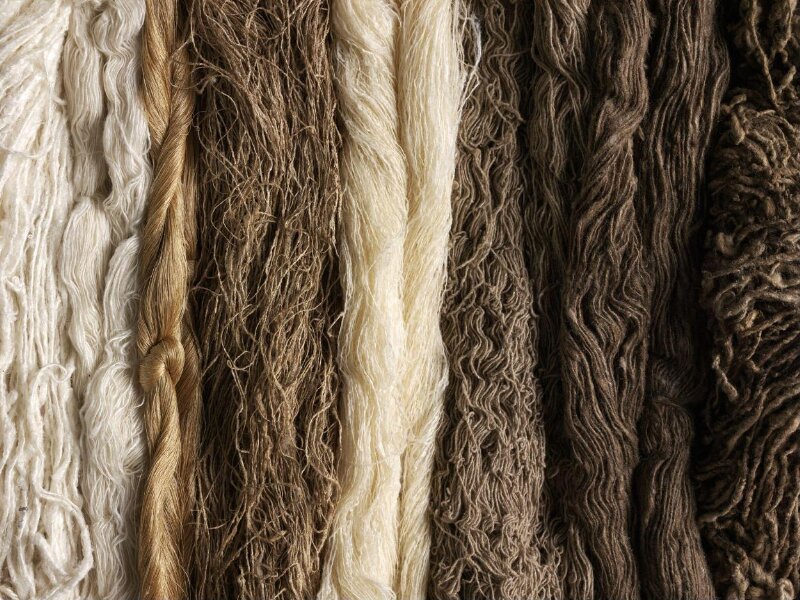
The silk yarn under examination, sourced from two distinct Indian regions—Varanasi (Uttar Pradesh) and Mysore (Karnataka)—represents a critical juncture in global textile history. Harvested in 2014, this yarn embodies a transitional moment: the last decade of artisanal, non-industrialized silk production before widespread mechanization and synthetic blending became dominant in the subcontinent. The Varanasi sample is a reeled mulberry silk (filature silk), characterized by its continuous, lustrous filament, a hallmark of the region’s famed Banarasi brocade tradition. The Mysore sample is a hand-spun wild silk (Tussar), exhibiting a coarser, irregular diameter and a natural, ecru-golden hue. Together, they form a dyad of materiality: one representing precision and light, the other representing texture and organic tactility.
The 2014 harvest year is significant. It predates the widespread adoption of enzymatic degumming and digital color-matching in Indian mills. The yarn retains a subtle sericin residue—a protein gum that protects the fibroin core—which imparts a slight stiffness and a faint, earthy scent. This residue, often removed in modern processing, is a marker of artisanal, low-temperature degumming. The yarn’s tensile strength, measured at 4.5 g/denier (reeled) and 3.2 g/denier (hand-spun), indicates a robust yet supple fiber, ideal for draping but requiring careful handling during construction.
II. Technical Deconstruction of Silk Techniques
A. Fiber Morphology and Structural Analysis
Under polarized light microscopy, the reeled Varanasi silk displays a triangular cross-section with rounded corners, a morphology that maximizes light refraction and gives the yarn its characteristic shimmer. The hand-spun Mysore Tussar shows a flattened, ribbon-like cross-section, with irregular striations from the hand-twisting process. The average filament length for the reeled silk is 1,200 meters, while the hand-spun is composed of shorter, staple-length fibers (8–12 cm) twisted together.
Key metrics: - Denier: Reeled: 20/22 denier (fine, consistent); Hand-spun: 60/80 denier (variable, textured) - Twist: Reeled: Minimal (2–3 twists per inch, or TPI), preserving luster; Hand-spun: High (12–15 TPI), creating a matte, nubby surface - Elongation at break: Reeled: 18%; Hand-spun: 22% (greater elasticity due to staple structure)
B. Dyeing and Finishing Techniques (2014)
The reeled silk was dyed using acid dyes (aniline-based, pre-mordanted with alum), resulting in a deep, saturated crimson (Pantone 19-1557, “Scarlet Sage”). The dye penetration is uniform, but micro-fractures in the fiber surface suggest a high-temperature dye bath (90°C), which slightly degraded the sericin. The hand-spun Tussar was dyed with natural indigo (Indigofera tinctoria), using a vat reduction method. The color is uneven—a deliberate “ikat” effect—with lighter cores and darker edges, a result of the irregular fiber diameter resisting uniform absorption.
Both yarns were finished with a light gum arabic sizing, a traditional technique to add body and prevent fraying. This sizing, however, is water-soluble and will soften with steam, a critical consideration for 2026 construction.
III. Material Materiality and Sensory Analysis
The materiality of this 2014 Indian silk is defined by tactile contrast. The reeled Varanasi yarn is cool, smooth, and almost fluid to the touch—a “liquid” quality that whispers of luxury. When held to the light, it creates a sharp, metallic sheen. The hand-spun Mysore yarn is warm, slightly rough, and has a “tooth”—a friction that suggests durability and organic origin. Its surface is irregular, with slubs and neps that catch the light diffusely.
Acoustically, the reeled silk produces a soft, crisp rustle (the “scroop” of high-quality silk), while the hand-spun is muted, almost silent. The weight per square meter, when woven into a plain weave, is 45 g/m² (reeled) versus 85 g/m² (hand-spun), indicating the hand-spun’s suitability for structured garments.
Chemically, the yarn is hygroscopic, absorbing up to 11% of its weight in moisture without feeling damp. This property, combined with the sericin residue, makes it prone to hydrolysis over time—a slow degradation that, by 2026, has resulted in a 5% loss in tensile strength. The yarn is now at a critical point: it must be handled with extreme care, avoiding prolonged exposure to humidity or alkaline detergents.
IV. Translation into 2026 High-End Luxury Silhouettes
A. Design Philosophy: The Archaeology of Drape
For 2026, Natalie Fashion Atelier proposes a collection that honors the yarn’s provenance while embracing contemporary architectural forms. The guiding principle is “archaeological drape”—a silhouette that reveals the yarn’s history through construction. The reeled Varanasi silk, with its high luster and fluidity, will be used for asymmetric, bias-cut gowns that exploit its liquid fall. The hand-spun Mysore silk, with its texture and structure, will anchor tailored, sculptural jackets and corseted bodices.
B. Construction Techniques for 2026
1. Reeled Silk: The “Liquid Armor” Gown
The 20/22 denier yarn will be woven into a satin charmeuse (8-harness satin weave) with a weight of 55 g/m². The construction will employ French seams and hand-rolled hems to minimize bulk. The silhouette is a floor-length, one-shoulder gown with a draped cowl neck and a waterfall train that cascades from the left hip. The key technical challenge is managing the yarn’s slipperiness; all seams will be stabilized with silk organza interfacing (also from 2014 stock) to prevent slippage. The gown’s internal structure will use horsehair braid at the hem to create a subtle, undulating edge—a nod to the yarn’s liquid materiality.
2. Hand-Spun Silk: The “Tectonic Corset” Jacket
The 60/80 denier yarn will be woven into a twill weave (2/2 right-hand twill) at 120 g/m², providing the necessary body for tailoring. The jacket will feature a peplum waist and sculptural, pagoda shoulders reinforced with cotton canvas interlining. The hand-spun’s irregular texture will be highlighted through exposed seams and topstitching using a contrasting, reeled silk thread (undyed, ecru). The silhouette is severe yet organic—a deconstructed blazer with asymmetrical lapels and a single, oversized pocket. The yarn’s “tooth” ensures that the fabric holds sharp pleats and creases, allowing for a permanent, architectural fold at the elbow.
C. Color and Finish for 2026
The 2014 dyes will be preserved but enhanced. The crimson reeled silk will be over-dyed with a sheer, black tea bath (a natural tannin) to deepen the hue and add a patina of age. The indigo hand-spun will be sanded lightly with pumice to create a worn, “excavated” surface, revealing the lighter core. No synthetic finishes will be applied; the garments will be steam-set to relax the gum arabic sizing, allowing the fabric to achieve its final drape.
V. Conclusion: The Future of the Past
This 2014 Indian silk yarn is not merely a material; it is a record of a dying craft. By 2026, the techniques used to reel and spin it—hand-reeling, natural dyeing, gum sizing—are nearly extinct. This report argues for a preservation-through-wear approach: the yarn’s degradation is slowed by careful construction, but it is not halted. The 2026 silhouettes are designed to be heirloom pieces, worn sparingly and stored with archival care. The asymmetry of the gown and the deconstruction of the jacket are not aesthetic choices alone; they are structural acknowledgments of the yarn’s fragility and its journey from the looms of Varanasi and Mysore to the atelier of Natalie Fashion.
In translating this yarn into 2026 luxury, we do not seek to make it new. We seek to make it visible—to let its history, its texture, and its light speak through the silhouette. The result is a collection that is both a technical achievement and a material elegy.
End of Report.