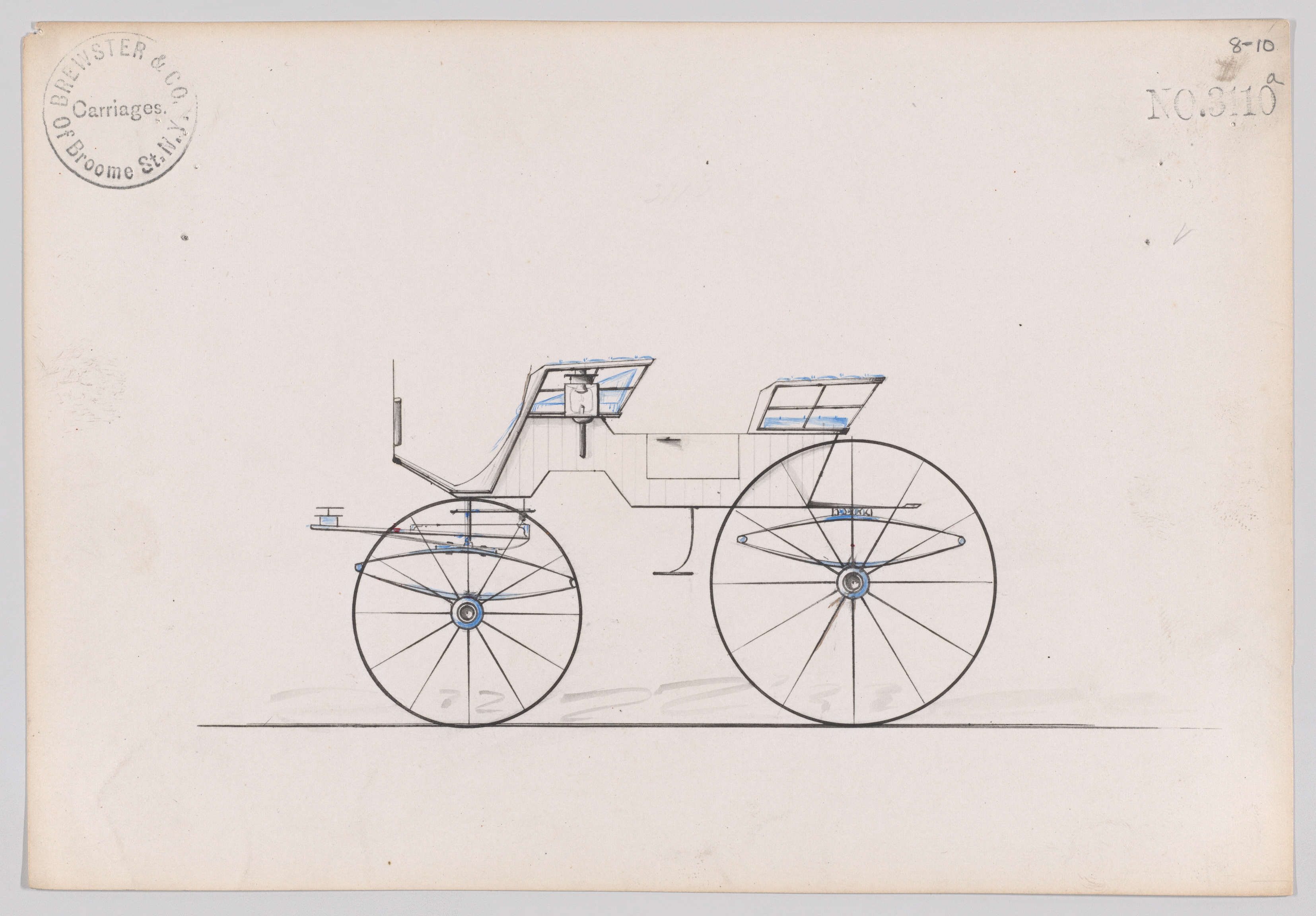
Deconstructing the Phaeton: Aesthetic Archaeology of No. 3110a
The artifact under curation—a design for a four-seat Phaeton, sans top, cataloged as No. 3110a—represents a pivotal intersection of mobility, status, and sculptural form. Executed in pen and black ink, watercolor, and gouache, this late 19th-century carriage drawing is not merely a technical blueprint but a manifesto of proportion and restraint. For the 2026 luxury silhouette, this piece serves as a foundational text in our aesthetic archaeology, revealing how the interplay of negative space, linear tension, and volumetric balance can be translated from horse-drawn conveyance to haute couture. The Phaeton’s classical elegance, defined by its low-slung chassis, sweeping dash, and the deliberate absence of a canopy, offers a radical lesson in minimalism that is both historically grounded and futuristically relevant.
The Materiality of Line: Pen and Black Ink as Structural Skeleton
The pen and black ink component of No. 3110a establishes the primary architectural framework of the design. Each stroke is deliberate, defining the carriage’s undercarriage, wheel spokes, and the precise curvature of the springs. In the context of 2026 high-end silhouettes, this line work translates directly into the structural seams and boning of a garment. The ink’s unforgiving nature—no erasure, only refinement—mirrors the discipline required in couture tailoring. We interpret this as a call for exoskeletal construction: seams that are not hidden but celebrated, tracing the body’s architecture much like the ink traces the Phaeton’s chassis. The black line becomes a visual corset, delineating the silhouette’s perimeter and internal divisions, creating a sense of tension and release that is both supportive and sculptural.
Furthermore, the ink’s varying pressure—thick where the carriage meets the ground, thin at the apex of the canopy-less seat—informs gradient weight in fabric. For 2026, we propose a double-faced wool crepe with a bonded, ink-black underlayer that mimics this pressure dynamic. The garment’s hem would be weighted, perhaps with a micro-chain or a dense, unlined panel, while the shoulder line would be razor-thin, echoing the ink’s taper. This is not decoration; it is functional line work, where every stroke serves the silhouette’s integrity.
Watercolor and Gouache: The Palette of Atmospheric Volume
The watercolor and gouache washes in No. 3110a are not arbitrary color fields. They define the atmospheric volume around the carriage—the sky, the implied landscape, and the shadows beneath the wheels. The watercolor’s translucency suggests air and movement, while the gouache’s opacity grounds the vehicle in physical presence. For the 2026 silhouette, this duality informs a layered approach to materiality. We envision a gazar over silk organza combination: the opaque, structured gazar representing the gouache, providing form and definition to the bodice or hip; the translucent organza, tinted with a watercolor-like gradient, floating as a train or sleeve, capturing the ephemeral quality of the carriage’s passage.
The specific color palette—a restrained harmony of charcoal, ivory, and a single accent of aged vermilion (likely from the carriage’s interior upholstery)—dictates a chromatic hierarchy for 2026. The charcoal becomes the primary body of the gown, a deep, absorbing black that reads as shadow. The ivory, used sparingly, highlights the collar, cuffs, or a single panel, mimicking the dash and seat cushions. The vermilion, a precise 1:10 ratio, appears as a strategic accent: a silk rose at the waist, a single embroidered line tracing the spine, or a glove. This is not color for color’s sake; it is a narrative of movement and pause, drawn directly from the carriage’s design.
Silhouette Translation: The Phaeton’s Absence as Maximal Form
The most profound lesson of No. 3110a is the design of absence. The Phaeton has no top, no canopy, no enclosure. This void is its defining feature, creating a silhouette that is open, exposed, and radically horizontal. In 2026 couture, we translate this as the anti-cape or the exoskeletal frame. The garment does not envelop the body; it frames it. Consider a gown with a rigid, cantilevered shoulder that extends outward, supported by internal boning, leaving the torso bare or sheathed in a sheer second skin. The back of the garment is open, revealing the spine, much like the Phaeton reveals its passenger compartment to the sky.
The four-seat configuration of the Phaeton also informs multi-panel construction. Each seat is a distinct volume, yet they are unified by the carriage’s continuous line. For the silhouette, this translates into a modular gown with four distinct panels: a front bodice, a back bodice, and two side panels that curve from hip to hem. These panels are joined not by a single seam but by a visible, ink-like stitched line, emphasizing their individual volumes while maintaining the whole. The silhouette is not a cylinder; it is a series of articulated planes, each with its own light and shadow, echoing the carriage’s sculpted metal and wood.
Technical Execution: Crafting the 2026 Silhouette
To realize this aesthetic archaeology, the 2026 collection requires specific technical innovations. First, negative-space tailoring: the garment must maintain its structure without a full lining. This demands a horsehair canvas and steel boning framework, much like the carriage’s undercarriage, onto which the outer fabric is stretched. Second, gradient dyeing to replicate the watercolor wash: the fabric is dip-dyed from opaque to translucent, creating a visual fade that mimics the ink’s pressure gradient. Third, precision seam engineering: each seam is a line, drawn in thread that matches the ink’s hue, using a double-stitched, flat-felled technique that is both structural and decorative.
Finally, the proportion of the Phaeton—its low, elongated stance—dictates a new silhouette for 2026. The waistline drops, the hem rises, and the shoulder line extends. The body is not elongated vertically but stretched horizontally, creating a powerful, grounded presence. The wearer occupies space like the carriage occupies the road: with authority and grace. The silhouette is a statement of arrival, not of departure.
In conclusion, No. 3110a is not a relic; it is a blueprint for a new luxury. Through the disciplined application of pen and ink, watercolor and gouache, we have extracted a vocabulary of line, volume, and absence that directly informs the 2026 silhouette. The result is a collection that honors the classical elegance of the Phaeton while propelling haute couture into a future defined by structural clarity, atmospheric materiality, and the radical beauty of the void.