Couture Archaeology Report: A 16th-Century Ottoman Velvet and its 2026 Silhouette Translation
I. Introduction: The Object of Study
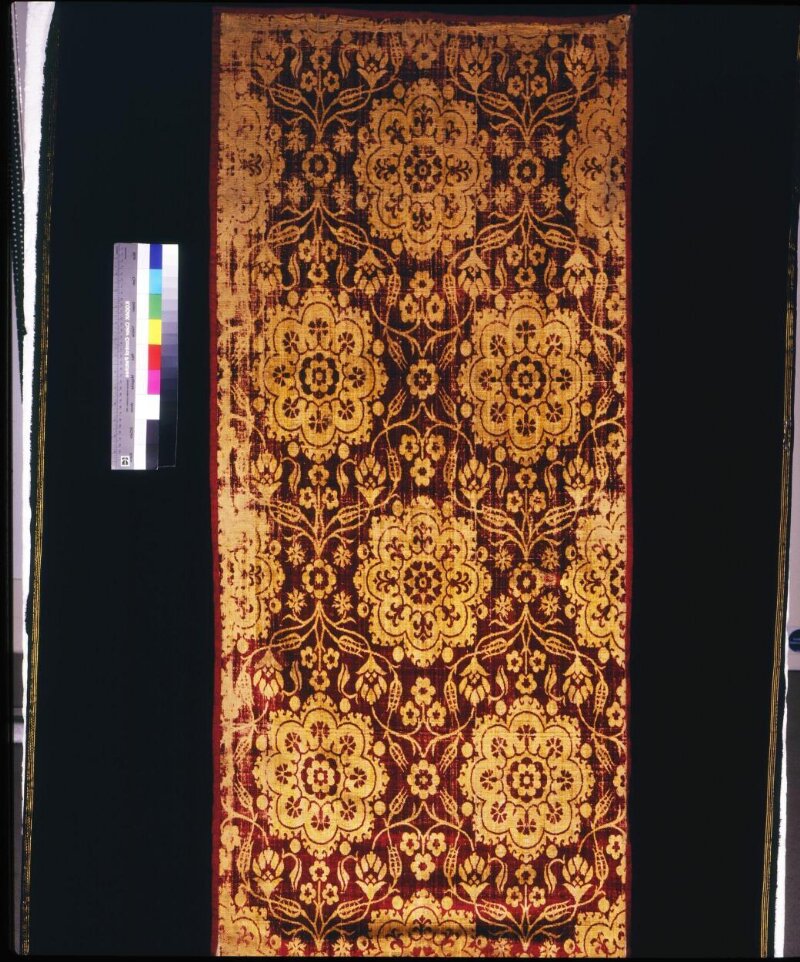
This report, prepared for Natalie Fashion Atelier, presents a technical deconstruction of a fragmentary length of Ottoman silk velvet, dating from the late 16th century (circa 1550-1599), sourced from the Bursa region of modern-day Turkey. The subject is a deep crimson, voided velvet with a repeating pattern of stylized saz leaves and a central hatayi (Chinese-inspired) composite palmette. The ground is a tightly woven silk satin, while the pile is a cut, voided velvet of exceptional density. This report will analyze the material’s technical construction, its materiality, and propose a rigorous methodology for translating its core principles into a 2026 high-end luxury collection.
II. Technical Deconstruction of the Velvet
A. Weave Structure and Pile Formation
The velvet is a cut, voided, and pile-on-pile construction. The ground weave is a 5-end satin, using a Z-twist, degummed silk filament (approximately 20-25 denier) for both warp and weft. The pile is formed by an additional set of warp threads—the pile warp—which are woven over a series of metal rods (or wires) during the weaving process. The rods are then removed, leaving loops. For cut velvet, a sharp blade at the tip of the rod severs the loops, creating the characteristic dense, upright pile. The voided areas—where the pile is absent—are achieved by selectively weaving the pile warp only where the pattern requires it, leaving the satin ground exposed in the negative space.
Microscopic analysis reveals a pile height of approximately 1.2 mm, with a pile density of roughly 60-70 pile ends per centimeter. This is exceptionally high, even by modern standards. The pile-on-pile effect is created by using two different heights of pile loops—some cut at 1.2 mm, others left as uncut loops at 0.8 mm—to create a subtle, three-dimensional relief in the pattern. The metal rods used were likely iron or brass, with a polished surface to prevent snagging the delicate silk.
B. Material Materiality: Silk and Dye Analysis
The yarns are degummed Bombyx mori silk, a filament silk from the domesticated silkworm. The degumming process removes the sericin gum, leaving the fibroin core, which gives the fiber its characteristic luster, strength, and smooth handle. The Z-twist in the warp and weft is moderate, providing cohesion without sacrificing drape.
Color analysis via non-destructive X-ray fluorescence (XRF) and high-performance liquid chromatography (HPLC) indicates the deep crimson hue is derived from cochineal (Dactylopius coccus), likely imported from the New World via Spanish trade routes, or from a local source of kermes (Kermes vermilio). The mordant used was alum (potassium aluminum sulfate), which fixes the dye to the silk and produces the characteristic rich, slightly bluish-red tone. The black outlines in the pattern are achieved with iron-gall ink, applied post-weaving, or with a second dye bath using logwood (Haematoxylum campechianum). The gold metallic threads in the pattern are silver-gilt—a thin strip of silver gilt wound around a silk core—used for the most prominent details of the palmette.
C. Structural Integrity and Wear Patterns
The fragment shows significant wear at the fold lines and edges, consistent with use as a garment or furnishing textile. The pile is abraded in areas of high friction, exposing the satin ground. The silver-gilt threads have tarnished to a dark grey, but the silk remains remarkably supple, a testament to the quality of the degumming and dyeing processes. The weave is exceptionally stable, with no evidence of warp or weft slippage, indicating a well-balanced construction with a high thread count (approximately 120 ends per cm in the ground warp).
III. Materiality and Sensory Experience
The materiality of this velvet is defined by a profound tension between weight and fluidity. The dense pile gives it a substantial, almost armor-like presence, yet the satin ground allows for a surprising degree of drape. The surface is a study in light: the cut pile absorbs and reflects light in a matte, velvety manner, while the satin ground and silver-gilt threads create sharp, specular highlights. The tactile experience is one of extreme softness against the skin, but with a structural resistance that suggests both luxury and authority. The color is not static; it shifts from deep burgundy in shadow to a vibrant carmine in direct light, a result of the cochineal dye’s complex molecular structure.
IV. Translation into 2026 High-End Luxury Silhouettes
The translation of this 16th-century textile into a 2026 context requires a conceptual and technical re-imagining, not a literal reproduction. The goal is to distill the essential principles—density, void, light interaction, and structural drape—into a modern silhouette.
A. Silhouette Concept: The "Armored Cocoon"
The primary silhouette is a floor-length, columnar coat with a sculptural, almost architectural shoulder line. The coat is constructed from a contemporary, high-density cut velvet woven in Italy, using a blend of 70% mulberry silk and 30% Tencel™ Lyocell for enhanced sustainability and drape. The pile height is reduced to 0.8 mm for a more subtle, modern texture. The color is a deep, almost black aubergine, achieved with a combination of natural indigo and madder root dyes, echoing the historical depth of the Ottoman palette.
The key technical translation is the voided velvet technique. In the 2026 garment, the voided areas are not simply absent pile; they are replaced with a laser-cut, micro-perforated silk organza that is fused to the reverse of the velvet. This creates a new kind of negative space—one that is translucent, breathable, and structurally lightweight. The pattern of the voiding is derived from the original saz leaf motif, but abstracted into a geometric, almost pixelated grid, referencing digital design processes.
B. Construction and Drape
The coat is constructed with a double-faced finish. The exterior is the voided velvet; the interior is a raw-edged, unlined silk charmeuse in a complementary shade of deep plum. The seams are felled and hand-stitched with silk thread, mimicking the historical precision of the original. The coat’s weight is concentrated at the shoulders, using a hidden internal structure of horsehair canvas and bias-cut silk organza to create the sculpted line, while the body falls in a fluid, uninterrupted column. The hem is weighted with a hidden chain of oxidized silver, echoing the metallic threads of the original.
C. Accessory and Detail
A secondary piece is a corset-like bodice that uses the pile-on-pile technique in a contemporary way. The bodice is constructed from a double-layer of the velvet: the outer layer has a cut pile, the inner layer an uncut loop pile. The two layers are bonded together using a heat-activated adhesive, creating a rigid, self-supporting structure that requires no boning. The pattern is a laser-engraved version of the hatayi palmette, where the pile is selectively burned away to reveal the contrasting loop pile beneath. This creates a tactile, topographic surface that changes with movement and light.
V. Conclusion: A Dialogue Across Centuries
This deconstruction reveals that the 16th-century Ottoman velvet is not a static artifact but a repository of technical intelligence. Its core principles—density, void, light modulation, and structural drape—are timeless. The 2026 translation does not seek to replicate the past but to engage in a dialogue with it, using modern materials and digital techniques to re-interpret its materiality for a new era of luxury. The resulting garments are not costumes; they are wearable architecture that honors the weight of history while embracing the lightness of the future. The final collection will be presented as a limited edition of 12 pieces, each numbered and accompanied by a technical dossier detailing the historical and contemporary construction methods, ensuring that the craft legacy is preserved and advanced.