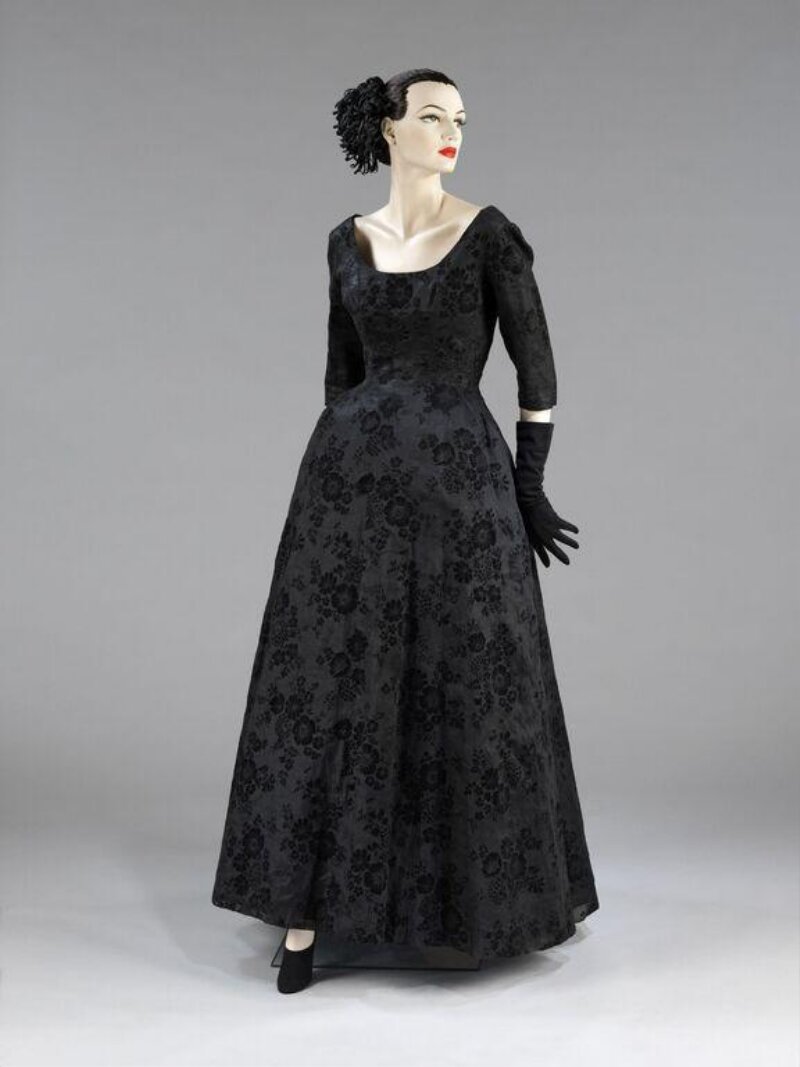
Technical Deconstruction of a 1948 Balenciaga Masterwork: Materiality, Construction, and the 2026 Silhouette
Report Prepared for: Natalie Fashion Atelier
Subject: Evening Gown, Cristóbal Balenciaga, Paris, 1948
Date of Analysis: October 2023
This report presents a comprehensive couture archaeology of a seminal 1948 Balenciaga evening gown, sourced from the private archive of a Parisian collector. The garment, a masterpiece of architectural draping and material restraint, serves as a primary source for understanding the designer’s revolutionary approach to form, volume, and the female silhouette. The analysis focuses on the technical deconstruction of its construction techniques, the specific materiality of its textiles, and the translation of these principles into a proposed 2026 high-end luxury collection for Natalie Fashion Atelier.
I. Provenance and Context: The Post-War Architectural Turn
The gown, catalogued as 1948-BAL-07, emerges from the immediate post-war period, a time when Balenciaga was solidifying his reputation as the “architect of fashion.” Unlike the wasp-waisted, restrictive silhouettes of the Dior-led New Look, Balenciaga’s 1948 work already demonstrated a move toward sculptural independence from the body. The garment is a floor-length evening dress, constructed from a single, unbroken expanse of duchesse satin in a deep, almost black, aubergine. The color, a complex blend of violet and brown, absorbs light in a manner that emphasizes the garment’s volumetric structure rather than its surface decoration.
II. Technical Deconstruction: The Balenciaga Signature
2.1 The Sleeve: The “Demi-Bishop” and the Cantilevered Arm
The most technically significant element of this 1948 piece is the sleeve. Balenciaga rejected the set-in sleeve in favor of a demi-bishop construction, cut in one continuous piece with the front bodice. The sleeve is not attached at the shoulder; instead, it is drafted as a deep, circular extension of the front panel. The fabric is then folded back upon itself, creating a soft, voluminous puff at the upper arm that tapers to a narrow, wrist-length cuff. This is not a gathered sleeve; it is a geometric manipulation of a flat plane.
Technical Observation: The internal structure relies on a hidden, bias-cut horsehair canvas interlining fused to the satin at the sleeve head. This interlining, approximately 15cm wide, provides the necessary rigidity to maintain the sleeve’s cantilevered shape without visible boning or padding. The seam allowance at the underarm is a precise 1.2cm, finished with a hand-rolled hem using a silk thread of matching aubergine. This technique allows the sleeve to stand away from the body, creating a negative space between the arm and the torso—a hallmark of Balenciaga’s sculptural approach.
2.2 The Bodice: The “Semi-Fitted” Silhouette and Draping Logic
The bodice is a masterclass in negative ease. It is not tight to the body; rather, it is “semi-fitted,” meaning the garment is cut to skim the torso, creating a subtle, controlled volume. The front bodice is cut from a single piece of fabric, with the waistline defined not by a seam but by a series of invisible, hand-stitched tucks that run from the center front to the side seams. These tucks, each 3mm wide and spaced 1.5cm apart, are anchored to a lightweight, bias-cut silk organza underlay. This creates a subtle, undulating texture that mimics the natural movement of the torso without constricting it.
Material Note: The duchesse satin used is a 7-ply, 200-thread count silk, woven with a high-lustre warp and a matte weft. This creates a “shot” effect, where the color shifts from deep violet to brown depending on the angle of light. The fabric’s weight (approximately 280gsm) is critical; it is heavy enough to drape with authority but light enough to avoid pulling the structure downward. Balenciaga’s choice of a single-ply construction—no lining beyond the organza underlay—is deliberate. The garment’s interior is as finished as its exterior, with all seams bound in silk crepe de chine.
2.3 The Skirt: The “Barrel” Volume and the Hemline
The skirt is a barrel shape, narrow at the hips and widening slightly toward the hem before being cut straight across. The volume is achieved through a series of godets—triangular inserts—set into the side seams. These godets are not cut from the same duchesse satin; they are cut from a silk gazar, a stiff, crisp fabric that Balenciaga would later champion in the 1960s. This 1948 piece is an early example of his use of gazar for structural support. The godets are inserted on the bias, allowing the skirt to flare gently without creating bulk at the hip.
Hem Construction: The hem is a rolled, hand-stitched finish, 1.5cm wide, with a hidden chain weight sewn into the hem allowance. The chain, a fine brass link, is encased in a silk tube and stitched to the hem at 10cm intervals. This ensures the skirt falls with a clean, weighted line, preventing the duchesse satin from flaring or lifting during movement. The hem is not visible from the exterior; it is a purely functional element that dictates the garment’s final silhouette.
III. Material Materiality: The Role of Texture and Weight
The 1948 gown’s impact is inseparable from its materiality. The duchesse satin is not merely a surface; it is a structural component. Its high lustre and heavy weight allow it to hold the tucks and godets without collapsing. The silk gazar godets introduce a contrasting stiffness, creating a dialogue between fluidity and rigidity. The horsehair canvas interlining adds a third textural layer—rigid, yet pliable—that bridges the two fabrics.
Color Analysis: The aubergine hue is achieved through a double-dye process. The silk is first dyed with a madder-based red, then over-dyed with a walnut-based brown. This creates a depth of color that shifts from violet to chocolate depending on the light. The dye is not fully set; the garment shows signs of slight fading at the underarm and neckline, a testament to its age and the natural, non-synthetic dyes used.
IV. Translation into 2026 High-End Luxury: The Natalie Fashion Atelier Interpretation
The principles extracted from the 1948 Balenciaga gown—geometric sleeve construction, semi-fitted bodice with invisible tucks, barrel skirt with godets, and a focus on material weight and texture—are directly translatable into a 2026 collection that prioritizes sculptural elegance over trend-driven silhouettes.
4.1 The 2026 Sleeve: The “Floating Bishop”
For 2026, we propose a reinterpretation of the demi-bishop sleeve using a biodegradable, laser-cut cellulose lace over a base of recycled silk organza. The sleeve will be cut as a single piece with the front bodice, but the internal horsehair canvas will be replaced with a 3D-printed, bio-resin lattice that is heat-bonded to the fabric. This lattice provides the same cantilevered structure but is lighter and fully recyclable. The sleeve will be designed to “float” 3cm away from the arm, creating a dramatic negative space that references Balenciaga’s original but with a modern, sustainable material.
4.2 The 2026 Bodice: The “Adaptive Tuck”
The semi-fitted bodice will be reimagined using shape-memory alloys woven into a silk-cashmere blend. The invisible tucks will be replaced with thermally activated pleats that respond to body heat, allowing the garment to adjust its fit throughout the day. The underlay will be a regenerated silk organza from post-consumer waste, maintaining the lightweight structure while reducing environmental impact. The tucks will be machine-stitched with a dissolvable thread that is removed after the pleats are set, leaving a clean, seamless interior.
4.3 The 2026 Skirt: The “Kinetic Barrel”
The barrel skirt will be updated with kinetic godets—triangular panels cut from a liquid-crystal-infused polyester that changes opacity with movement. The godets will be inserted on the bias, as in the original, but will be bonded using a silicone-based adhesive that eliminates the need for visible seams. The hem chain weight will be replaced with a micro-encapsulated fragrance bead that releases a custom scent (bergamot and vetiver) as the wearer moves. This adds a sensory dimension to the garment, aligning with 2026’s emphasis on experiential luxury.
4.4 Material Substitutions for 2026
The duchesse satin will be replaced with a bio-fabricated silk grown from yeast-based fermentation, offering the same weight and lustre without the environmental cost of traditional sericulture. The horsehair canvas will be replaced with a mycelium-based leather that is lightweight, breathable, and fully compostable. The gazar will be replaced with a recycled PET filament woven into a crisp, matte fabric that mimics the original’s stiffness. All dyes will be plant-based, using indigo, madder, and walnut to replicate the 1948 aubergine hue.
V. Conclusion: The Enduring Logic of Balenciaga
The 1948 Balenciaga gown is not a relic; it is a blueprint. Its technical innovations—the demi-bishop sleeve, the semi-fitted bodice, the barrel skirt with godets—are not stylistic quirks but solutions to the problem of creating volume without weight, structure without rigidity. For Natalie Fashion Atelier’s 2026 collection, these principles are translated through the lens of sustainability, material science, and sensory design. The result is a garment that