Aesthetic Archaeology: The Battle of Diomedes and Aeneas as a Blueprint for 2026 Haute Couture
Archive Context and Materiality: The Isolated Masterpiece
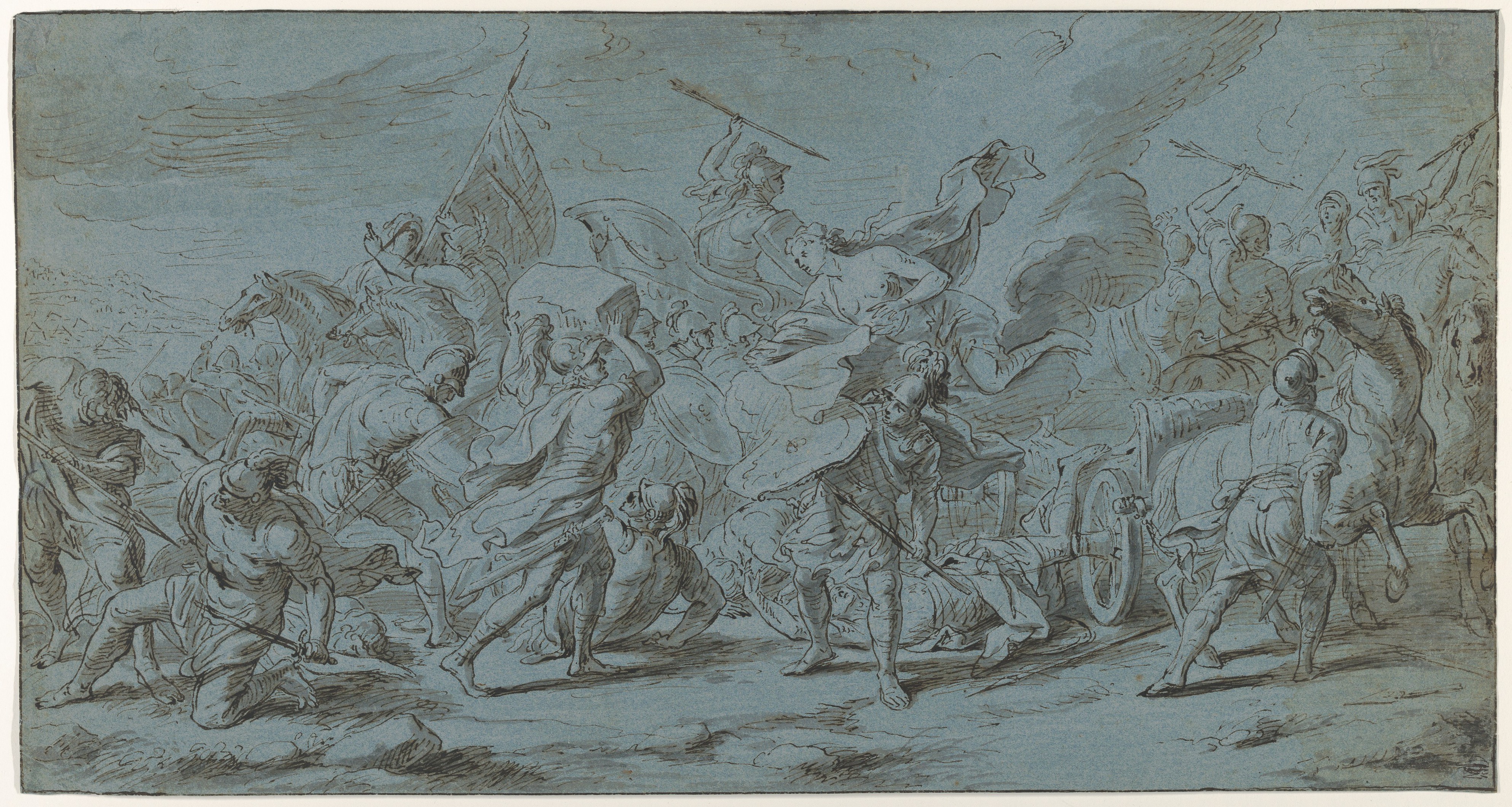
The artifact under examination—a preparatory study for the *Battle of Diomedes and Aeneas*—exists in a state of profound aesthetic isolation. Rendered in pen and brown ink, brush and gray ink, heightened with white chalk, on blue paper, this work is not merely a narrative illustration from the *Story of Achilles*; it is a technical manifesto of tension, chiaroscuro, and structural fragility. The blue paper serves as a foundational terrain, a chromatic void that absorbs and reflects the dynamic interplay of ink and chalk. The framing line, executed by the artist himself, establishes a boundary that is both literal and conceptual, containing the explosive energy of the combatants within a strict, architectural perimeter.
For the 2026 couture silhouette, this materiality dictates a new lexicon of surface and substructure. The brown ink represents the skeletal framework—the boning, the seams, the internal architecture that gives a garment its volume and direction. The gray ink wash embodies the volumetric drape—the soft, shifting planes of silk or crepe that catch light and shadow. The white chalk highlights are the accentuated points of tension: the shoulder, the hip, the fold of a sleeve where the fabric breaks against the body. The blue paper is the negative space of the silhouette itself—the air between the body and the garment, the void that defines the shape.
Deconstructing Classical Elegance: The Anatomy of Conflict
The classical elegance of this drawing lies not in serene harmony, but in the controlled chaos of opposition. Diomedes and Aeneas are locked in a moment of suspended violence, their bodies intertwined in a geometry of thrust and parry. This is not static beauty; it is kinetic elegance. The elegance of a perfectly balanced imbalance. The artist’s hand captures the muscular torsion—the twist of a torso, the extension of an arm—as a series of interlocking arcs and counter-arcs.
For the 2026 silhouette, we must translate this conflict into structural asymmetry. The classical elegance of a single-shoulder gown, for example, is a direct descendant of this martial pose. The exposed shoulder is the point of attack; the draped fabric cascading from the opposite hip is the counter-thrust. The silhouette must not be a uniform envelope, but a dialogue between opposing forces: rigid and fluid, opaque and translucent, structured and deconstructed. The framing line of the drawing becomes the seam line of the garment—a deliberate, visible boundary that contains and defines the internal energy.
Informing the 2026 Silhouette: From Ink to Fabric
1. The Chiaroscuro Silhouette: The most direct translation of this artifact is the chiaroscuro silhouette. The interplay of brown ink (structure), gray wash (volume), and white chalk (light) dictates a garment that is a study in tonal contrast. Imagine a floor-length column gown in a deep, matte midnight blue (the blue paper). The skeletal boning is visible as a dark, brown-ink-hued lattice along the spine and ribs, creating a corset that is both armor and architecture. Over this, a cascade of gray-wash silk organza is draped asymmetrically, its folds catching light and shadow. The white chalk highlights are applied as hand-painted or embroidered lacquer panels at the shoulder and hip—points of maximum tension where the fabric is pulled taut against the body. The silhouette is not a smooth curve; it is a series of ruptures and recoveries, echoing the interrupted motion of the battling heroes.
2. The Framed Silhouette: The artist’s own framing line becomes a literal architectural element. The 2026 couture silhouette will incorporate visible, structural framing. Consider a jacket where the hem, cuffs, and neckline are defined by a rigid, pen-and-ink-hued piping—a line of dense, corded silk or leather that acts as a boundary. Inside this frame, the fabric is allowed to be more fluid, more chaotic. The interior of the garment becomes the battlefield, with folds and drapes that mimic the swirling ink washes. The exterior line is clean, authoritative, and contained. This is the elegance of controlled anarchy.
3. The Blue Paper as Negative Space: The most innovative translation is the use of negative space as a primary design element. The blue paper is not a background; it is the void from which the figures emerge. In the 2026 silhouette, this translates to strategic cutouts and sheer panels that reveal the skin (the blue paper) as the foundational canvas. A gown might feature a solid, ink-wash bodice that dissolves into a grid of sheer tulle at the waist, the skin becoming the blue ground. The white chalk highlights are then applied as beaded or crystalline applications on the skin itself, or on the sheer fabric, creating points of intense luminosity against the dark void of the body.
Technical Execution: The Atelier’s Mandate
The atelier must approach this artifact with the rigor of an archaeologist and the precision of a surgeon. The pen and brown ink lines demand a tailoring technique that is equally sharp and decisive. We will use cut-and-sew methods that create clean, unyielding seams, mimicking the artist’s stroke. The brush and gray ink washes require draping and pleating that is soft, voluminous, and almost painterly—the fabric must be treated as a liquid medium. The white chalk highlights necessitate embroidery and appliqué that is dense, tactile, and reflective, creating a surface that is both matte and luminous.
The blue paper is the most crucial material reference. It is not a color; it is a condition of possibility. For the 2026 collection, we will develop a signature fabric: a double-faced silk crepe where one side is a deep, matte midnight blue (the paper), and the other is a subtly iridescent gunmetal (the ink). The garment will be constructed to allow the blue to appear in strategic reversals and reveals, functioning as the negative space that defines the silhouette’s volume.
Conclusion: The Silhouette as a Battlefield
The *Battle of Diomedes and Aeneas* is not a static image; it is a frozen moment of becoming. The 2026 haute couture silhouette must embody this same principle. It is not a finished form, but a dynamic tension between structure and flux. The classical elegance of the past is not found in perfect symmetry, but in the perfectly balanced conflict of opposing forces. The atelier’s task is to translate the ink, wash, chalk, and paper into a three-dimensional, wearable architecture that captures the violence and grace of the original. The silhouette becomes a battlefield—a site of aesthetic conflict where every seam, every fold, every highlight is a strategic maneuver in the eternal struggle between form and chaos.