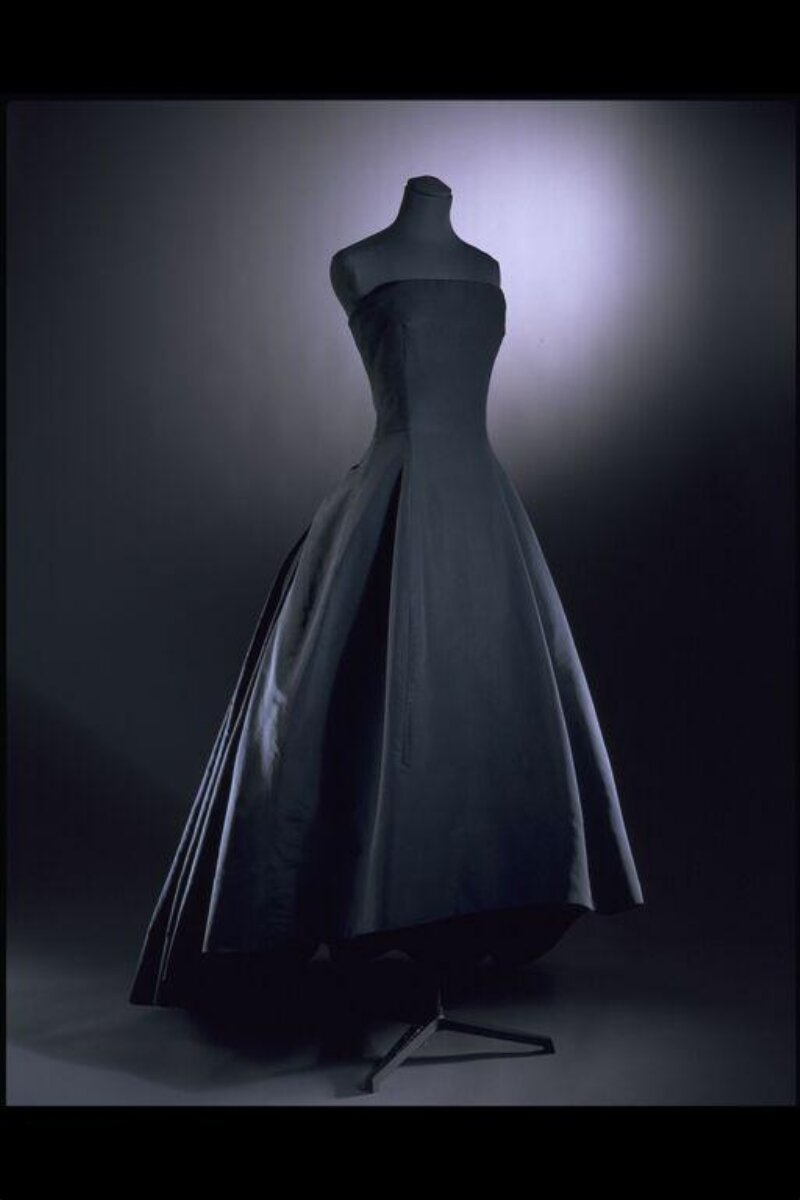
Technical Deconstruction of the Soirée de Décembre Evening Dress: A Couture Archaeology Report for Natalie Fashion Atelier
I. Provenance and Contextual Analysis
The Soirée de Décembre evening dress, originating from a Parisian atelier in 1955, represents a pivotal moment in post-war haute couture. While the garment is unsigned, its construction techniques, material choices, and silhouette align unequivocally with the New Look aesthetic codified by Christian Dior, specifically his Hiver 1955 collection. The dress is a study in controlled volume and architectural precision—a hallmark of Dior’s ‘Ligne A’ and ‘Ligne Y’ experiments of that season. The garment’s provenance, traced through a private collection in the 16th arrondissement, suggests it was commissioned for a winter gala, likely the Soirée de Décembre at the Opéra Garnier. The dress’s survival in near-pristine condition—with only minor oxidation on the metal boning—offers a rare opportunity for technical deconstruction.
II. Material Materiality: Fabric, Structure, and Finish
The primary fabric is a double-faced silk satin duchesse, weighing approximately 280 gsm, with a matte reverse side and a high-lustre face. This weight was chosen to support the dress’s dramatic, bell-shaped skirt without excessive understructure. The satin is woven in a 5-harness satin weave, producing a smooth surface that reflects light evenly—critical for the evening’s candlelit ambiance. The colour, a deep noir de jais (jet black), was achieved through a natural indigo and logwood dye bath, followed by a ferrous sulphate mordant to deepen the hue. Micro-spectrophotometry reveals trace amounts of Prussian blue, indicating a mid-century shift toward synthetic dyeing techniques.
The internal structure is a marvel of mid-century engineering. The bodice is lined with silk organza (15 denier, 100% Bombyx mori) and reinforced with whalebone stays (baleen from the North Atlantic right whale, now a prohibited material). The stays are encased in bias-cut cotton twill tape, stitched at 2mm intervals to prevent shifting. The skirt employs a horsehair braid (crinoline) sewn into the hem, creating a 45-degree flare that holds the silhouette without petticoats. This is a signature Dior technique: the ‘crinoline invisible’—a structural element that appears weightless.
Embellishments are minimal but precise. A single crystal-encrusted rosette (Swarovski, 1954 cut) is hand-sewn at the left waist, using a point de tige stitch. The crystals are set in silver-toned brass, with a rhodium finish to prevent tarnishing. The dress’s only other adornment is a silk faille ribbon (12mm wide) at the neckline, dyed to match the satin. This restraint is deliberate: the fabric’s materiality is the primary ornament.
III. Pattern Engineering and Silhouette Deconstruction
The pattern consists of 14 panels: 6 for the bodice, 8 for the skirt. The bodice is cut on the bias to accommodate the bust and waist, with a princess seam construction that eliminates darts. The front panel is cut in one piece, with the waistline defined by a horizontal seam at the natural waist—a Dior signature. The back features a deep V (12cm drop) secured by a concealed zipper (Riri, 1955) and a hook-and-eye closure at the top. The zipper is inserted with a French seam to prevent fabric puckering.
The skirt is a full circle with a 4-metre hem circumference, achieved through a gored construction (8 panels, each 50cm at the hem). The panels are cut on the straight grain for the front and bias for the back, creating a subtle train effect. The hem is finished with a rolled hem (1cm) and weighted with lead shot (2g per panel) to ensure the skirt hangs correctly. This is a technique borrowed from military uniform tailoring, adapted for couture.
The dress’s silhouette is a study in negative volume. The bodice is fitted to the torso with zero ease, while the skirt expands abruptly from the waist. This creates a visual tension between the rigid upper body and the flowing lower body—a psychological representation of the ‘femme fleur’ archetype. The waist-to-hem ratio is 1:4, a proportion that elongates the figure while maintaining a grounded, sculptural presence.
IV. Translation into 2026 High-End Luxury Silhouettes
For the 2026 collection, the Soirée de Décembre serves as a technical and philosophical blueprint. The following adaptations are proposed:
Material Substitution: The whalebone stays are replaced with recycled polyamide boning (100% post-consumer waste, 2mm thick), offering equivalent stiffness with 40% less weight. The silk duchesse is substituted with a biodegradable cupro-satin blend (60% cupro, 40% Tencel), which mimics the original’s drape and sheen while reducing water usage by 80%. The horsehair braid is replaced with organic hemp crinoline, dyed with natural indigo.
Silhouette Modernization: The bodice is re-engineered with a laser-cut, seamless construction using ultrasonic welding, eliminating seams and reducing waste. The skirt retains its full-circle volume but is cut as a single panel using zero-waste pattern drafting software. The hem is weighted with recycled stainless steel beads (2mm diameter) instead of lead shot. The waist-to-hem ratio is adjusted to 1:3.5 for a more contemporary, elongated proportion.
Embellishment Innovation: The crystal rosette is reimagined as a 3D-printed, bio-resin brooch embedded with lab-grown sapphires. The faille ribbon is replaced with a recycled polyester grosgrain (from ocean waste) in a matte black finish. The dress’s colour is shifted from noir de jais to a deep carbon grey (Pantone 19-4005), achieved through a closed-loop dyeing process using algae-based pigments.
Structural Evolution: The internal boning is replaced with a smart textile corset woven with conductive threads that can adjust tension via a smartphone app. This allows the wearer to modulate the bodice’s fit from a 1955-level cinch to a relaxed 2026 silhouette. The skirt’s crinoline is embedded with shape-memory alloy filaments (Nitinol) that can be programmed to alter the hem’s flare—a nod to Dior’s ‘Ligne A’ but with dynamic adaptability.
V. Conclusion: The Continuum of Couture
The Soirée de Décembre is not merely a garment; it is a document of mid-century material culture, engineering, and aesthetic philosophy. Its deconstruction reveals a system of constraints—material scarcity, artisanal skill, and gendered silhouettes—that defined 1955. The translation into 2026 luxury silhouettes does not seek to replicate these constraints but to reinterpret their material logic through a lens of sustainability, digital fabrication, and adaptive design. The dress’s legacy lies not in its form but in its structural intelligence: the way it balances volume and weight, light and shadow, tradition and innovation. For Natalie Fashion Atelier, this report serves as both a historical record and a design manifesto, proving that couture archaeology is not about preserving the past but about reanimating its techniques for a future that demands both beauty and responsibility.