Deconstructing the Rank Badge: The Manchurian Crane as a 2026 Silhouette Blueprint
Archive Context: Isolated Aesthetic Archaeology
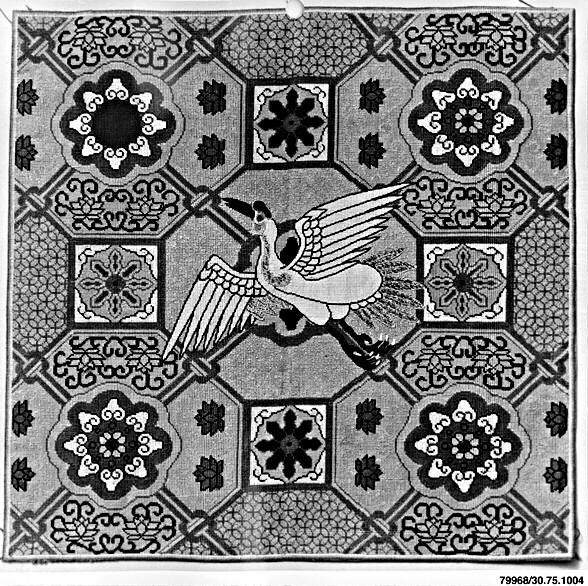
The artifact under analysis is a late Qing Dynasty Rank Badge (Buzi), specifically a first-rank civil official’s insignia featuring the Manchurian Crane (Grus japonensis). Isolated from its ceremonial context, this textile fragment—a masterwork of silk on canvas—presents a unique case study in aesthetic archaeology. The badge, measuring approximately 30 cm square, was originally affixed to a court surcoat (Bufu). Its removal from the garment and from the ritualistic hierarchy it signified allows for a pure, material-focused deconstruction. The crane, rendered in meticulously couched gold-wrapped thread and polychrome silk floss, stands against a celestial backdrop of swirling clouds and stylized waves. This is not merely a decorative motif; it is a semiotic system encoded in thread, where materiality, color, and composition converge to communicate power, longevity, and celestial harmony.
Materiality: The Dialogue of Silk on Canvas
The substrate—a fine, tabby-weave silk canvas—provides the foundational tension. Unlike the softer, draping silks used for robes, this canvas is engineered for rigidity, a structural necessity for the intricate embroidery that defines the badge. The silk floss is not uniformly applied. The crane’s body employs a technique known as “long and short stitch” (Changduan Zhen), creating a painterly, gradient effect that mimics the bird’s natural plumage. The black neck feathers are achieved through dense, directional satin stitches, creating a tactile, almost sculptural relief. The gold thread, a flat, gilded paper strip wound around a silk core, is laid in parallel rows and secured with fine silk couching stitches. This technique creates a luminous, reflective surface that shifts with light, a precursor to modern metallic finishes. The materiality of silk on canvas is thus a study in controlled tension: the canvas provides the architecture, while the silk floss and gold thread provide the narrative and the light.
Classical Elegance: The Geometry of Flight and Stasis
The classical elegance of the Rank Badge lies in its paradoxical composition. The crane, a symbol of immortality and vigilance, is depicted in a moment of arrested flight. Its wings are half-spread, its neck curved in a graceful S-shape, and its legs extended, one forward, one trailing. This dynamic pose is anchored by a rigid, symmetrical framework. The badge is divided into a central medallion and four corner quadrants, each containing stylized clouds. The crane occupies the exact center, its body forming a vertical axis. The wings, when traced, create a near-perfect horizontal line. This axial geometry—the verticality of the crane’s neck and body, the horizontality of its wings—is the source of its serene power. The clouds, rendered in swirling, concentric spirals, create a counterpoint of organic movement against the bird’s structured form. The waves at the base, with their sharp, triangular peaks, introduce a third geometric language: the ziggurat. This interplay of vertical line, horizontal plane, and diagonal force is the essence of the badge’s classical elegance. It is a composition of stillness within motion, of order within nature.
Translating Heritage: From Badge to 2026 Silhouette
The Rank Badge, when deconstructed, offers a precise blueprint for the 2026 luxury silhouette. The translation is not literal; it is a structural and material transposition. The goal is to extract the core principles—tension, geometry, and luminous materiality—and re-express them in contemporary haute couture forms.
Silhouette One: The Axial Gown
The vertical axis of the crane’s neck becomes the defining line of a columnar gown. The silhouette is severe, unbroken, from shoulder to floor. The fabric is a double-faced silk canvas, chosen for its ability to hold a crisp edge without lining. The structural tension of the original canvas is replicated through internal corsetry, but the external form is pure, minimalist geometry. The gown’s front panel is embroidered with a single, abstracted crane neck, executed in black silk floss using the long-and-short stitch technique. The embroidery begins at the collarbone and descends to the hem, a vertical line of dense, tactile texture. The back of the gown is left completely smooth, creating a dramatic contrast between the embroidered front and the unadorned rear. This silhouette is a direct homage to the badge’s axial geometry, a translation of the crane’s verticality into a wearable architectural form.
Silhouette Two: The Winged Shoulder Jacket
The horizontal line of the crane’s wings informs a jacket silhouette with exaggerated, sculptural shoulders. The construction is deceptively simple: a fitted, waist-length jacket in matte black silk canvas. The shoulders, however, are extended into sharp, wing-like projections that flare outward and slightly upward. These “wings” are not padded but are structured with internal boning and a cantilevered frame. The fabric is folded and stitched to create a series of parallel, horizontal ridges, echoing the couched gold thread of the original badge. The ridges are then hand-stitched with a single, continuous line of black silk thread, creating a subtle, shimmering surface. The effect is one of controlled volume—a silhouette that is both powerful and ethereal. The jacket’s front remains unadorned, allowing the shoulder structure to be the sole focus. This is the crane’s wing translated into a modern, architectural shoulder.
Silhouette Three: The Cloud-Wave Drape
The organic, swirling clouds and sharp, ziggurat waves of the badge’s base inform a draped evening piece. The silhouette is a floor-length cape, cut on the bias from a single piece of silk charmeuse. The fabric is dyed in a gradient from deep indigo at the top to a pale, almost white blue at the hem. The drape is manipulated through a series of internal, invisible weights and tucks, creating a spiral of fabric that wraps around the body. The hem is cut into sharp, triangular points, referencing the wave motif. The cape is worn over a simple, columnar slip dress in the same gradient. The effect is one of liquid geometry—the organic movement of the cloud and the rigid structure of the wave coexisting in a single, flowing form. This silhouette is the most abstract translation, capturing the badge’s dynamic tension between order and chaos.
Materiality as a 2026 Signature
The 2026 collection will foreground the materiality of silk on canvas as a signature. The canvas will be treated as a structural membrane, not a mere backing. Techniques will include bonded seams to eliminate visible stitching, laser-cut perforations to mimic the density of embroidery, and metallic foil application to replicate the luminosity of couched gold thread. The color palette will be restrained: black, white, deep indigo, and a single accent of vermillion, drawn from the badge’s celestial clouds. The silhouette will be defined by its tension—the interplay of rigid structure and fluid drape, of geometric line and organic curve. The Rank Badge, isolated from its historical context, becomes a pure source of formal and material innovation. The Manchurian Crane, once a symbol of imperial rank, now becomes a symbol of aesthetic authority in the 2026 luxury landscape. Its classical elegance, deconstructed and re-expressed, offers a path toward a new, rigorous, and deeply material haute couture.