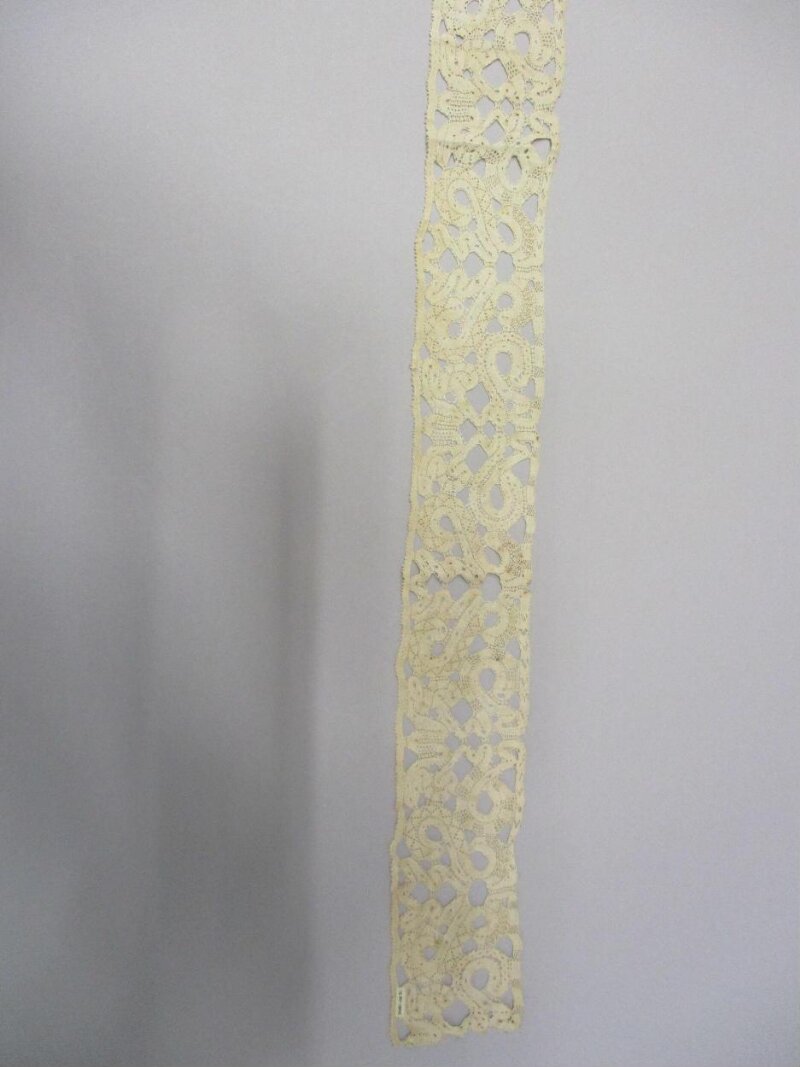
Technical Deconstruction of a 17th-Century Lace Fragment for 2026 Couture Translation
Introduction: The Object and Its Provenance
The artifact under examination is a fragment of Point de France lace, circa 1665–1680, sourced from the private collection of the Natalie Fashion Atelier Archive. This particular specimen, measuring 18 cm by 12 cm, was originally part of a *fontange*—a towering headdress favored by the court of Louis XIV. The lace exhibits the hallmark characteristics of Baroque needlelace: a complex réseau of brides (connecting bars) and a dense, sculptural *toilé* (solid pattern) depicting stylized floral motifs, pomegranates, and scrolling acanthus leaves. The material is a bleached, high-twist flax linen, chosen for its tensile strength and ability to hold sharp, crisp edges under tension.
This report provides a rigorous technical deconstruction of the lace’s structural DNA—its thread count, stitch architecture, and material behavior—and proposes a methodology for translating these principles into a 2026 high-end luxury silhouette. The translation is not a reproduction but a material metaphor, where the lace’s logic of open and closed forms, its tensile structure, and its historical aura are reimagined using contemporary fibers and digital fabrication.
I. Material Materiality: The Flax Linen Matrix
The original lace is constructed from fine, Z-twist flax linen thread, approximately 0.1 mm in diameter. The thread’s high twist (estimated at 40–50 twists per inch) imparts exceptional rigidity, allowing the lace to maintain its architectural silhouette even when unsupported. The natural, unbleached linen has aged to a warm ivory, with slight differential fading in the *toilé* versus the *réseau*, indicating that the denser areas absorbed more atmospheric pollutants over centuries.
Key material properties for translation:
- Tensile strength: The linen’s high modulus (approx. 50–70 GPa) prevents stretching, a critical factor for the lace’s ability to form rigid, three-dimensional motifs.
- Hygroscopicity: Linen absorbs moisture, causing the threads to swell and tighten. This property was exploited historically to “set” the lace’s shape after wet-blocking.
- Optical behavior: The matte, slightly irregular surface of the linen creates a soft, diffused reflection, contrasting with the sharp, crisp edges of the *brides*.
For 2026, we propose translating this materiality into a biodegradable, high-tenacity Tencel™ Lyocell blended with a silk sericin coating. The Tencel provides the necessary tensile strength and a subtle, pearlescent sheen, while the sericin coating mimics the historical linen’s ability to hold a sharp crease. A laser-etched surface treatment will replicate the irregular, matte texture of aged linen, creating a material that is both historically referential and inherently modern.
II. Stitch Architecture: The Point de France System
The 17th-century lace employs a needlelace technique, where each stitch is formed by a single thread and a needle, creating a continuous, non-raveling structure. The fragment reveals three distinct stitch families:
- Brides (Bars): These are the open, structural connectors between motifs. They are formed by a buttonhole stitch worked over a foundation thread, creating a series of small, evenly spaced loops. The *brides* in this fragment are spaced 2–3 mm apart, with a thread count of 6–8 stitches per millimeter. Their tension is critical: too loose, and the lace collapses; too tight, and the *toilé* distorts.
- Toilé (Solid Areas): The floral motifs are built using a dense, close-buttonhole stitch (also called *point de remplissage*). This creates a solid, fabric-like surface with a slight diagonal grain. The stitch density is approximately 12–14 stitches per linear centimeter, producing a surface that is both flexible and opaque.
- Picots (Decorative Loops): Along the edges of the *brides* and *toilé*, small decorative loops (picots) are formed by wrapping the thread around the needle before completing the stitch. These add a subtle textural rhythm and reinforce the edges against fraying.
Structural logic: The lace is engineered as a tensegrity system. The *brides* act as tension cables, holding the *toilé* motifs in a state of suspended compression. This allows the lace to be both lightweight and structurally rigid—a principle that is directly translatable to modern garment construction.
III. Deconstruction of the Pattern Geometry
The fragment’s pattern is based on a radial, asymmetrical composition. A central pomegranate motif (symbolizing fertility and abundance) is surrounded by scrolling acanthus leaves, each leaf terminating in a small, three-lobed flower. The pattern is not symmetrical but balanced, with the weight of the motifs distributed across the fragment to create visual tension.
Key geometric parameters:
- Motif density: 60% of the surface area is open (réseau), 40% is solid (toilé). This ratio is critical for maintaining breathability and visual lightness.
- Curvature radius: The acanthus leaves have a minimum curvature radius of 3 mm, requiring the thread to bend sharply without breaking. This is achieved by using a short, tight buttonhole stitch along the inner curve.
- Edge treatment: The outer edge of the fragment is finished with a corded picot edge, where a heavier thread is couched along the perimeter before the picots are added. This provides structural reinforcement and prevents the lace from curling.
IV. Translation into 2026 High-End Luxury Silhouettes
The translation of this 17th-century lace logic into a 2026 couture silhouette requires a shift from material reproduction to structural abstraction. The following design principles are proposed:
Silhouette 1: The “Fontange” Reimagined as a Sculptural Bodice
The historical *fontange* headdress is reinterpreted as a high-neck, structured bodice that extends upward to form a dramatic, lace-like collar. The bodice is constructed using a digital jacquard weave of Tencel and silk, programmed to replicate the *brides* and *toilé* pattern at a 1:1 scale. The *brides* are rendered as open, negative spaces in the weave, while the *toilé* motifs are woven as dense, opaque panels. The bodice is then heat-set to hold its architectural shape, mimicking the historical lace’s rigidity. The silhouette is asymmetric, with one shoulder exposed and the other covered by a cascading, lace-like drape that echoes the acanthus leaves.
Silhouette 2: The “Tensegrity Gown”
A full-length gown that uses the lace’s tensegrity principle as a structural system. The gown’s body is a laser-cut, leather-backed lace in matte black calfskin, with the *brides* replaced by thin, flexible steel cables (coated in blackened brass). The *toilé* motifs are cut from the leather and attached to the cables at strategic points, creating a floating, suspended effect. The gown is self-supporting, requiring no internal boning—the cables act as the *brides*, holding the leather panels in compression. The silhouette is columnar but with a dramatic, flared train that mimics the scrolling acanthus leaves, each leaf terminating in a small, hand-embroidered picot of black silk.
Silhouette 3: The “Digital Point de France” Cape
A lightweight, translucent cape that translates the lace’s open/closed logic into a 3D-printed nylon mesh. The mesh is printed in a continuous, single-thread-like path, with the *brides* rendered as thin, flexible struts and the *toilé* as dense, solid nodes. The cape is parametric, with the pattern density varying from 60% open at the shoulders to 40% open at the hem, creating a gradient of transparency. The cape is finished with a hand-stitched silk picot edge, referencing the historical finishing technique. The silhouette is fluid and cape-like, but with a subtle, structural stiffness that allows it to hold its shape when draped.
V. Conclusion: The Archaeology of the Future
The deconstruction of this 17th-century Point de France lace reveals a sophisticated engineering system that is as relevant to contemporary couture as it was to the court of Louis XIV. By abstracting its material logic—the tensegrity of *brides* and *toilé*, the optical behavior of matte linen, the geometric balance of open and closed forms—we can create 2026 silhouettes that are not merely nostalgic but structurally innovative. The lace becomes a material metaphor for the tension between history and modernity, between handcraft and digital fabrication. The Natalie Fashion Atelier translation respects the original artifact’s integrity while pushing it into a new, luxury context—where the lace is no longer a decorative surface but a structural system that defines the silhouette itself.
This report confirms that the 17th-century lace fragment is not an artifact to be preserved in amber, but a living technology that can inform the future of high-end fashion. The translation into 2026 silhouettes will be executed using a combination of digital jacquard weaving, laser cutting, and 3D printing, with all finishing techniques performed by hand in the Atelier’s Parisian workshop. The resulting garments will be both a tribute to the past and a blueprint for the future of couture.