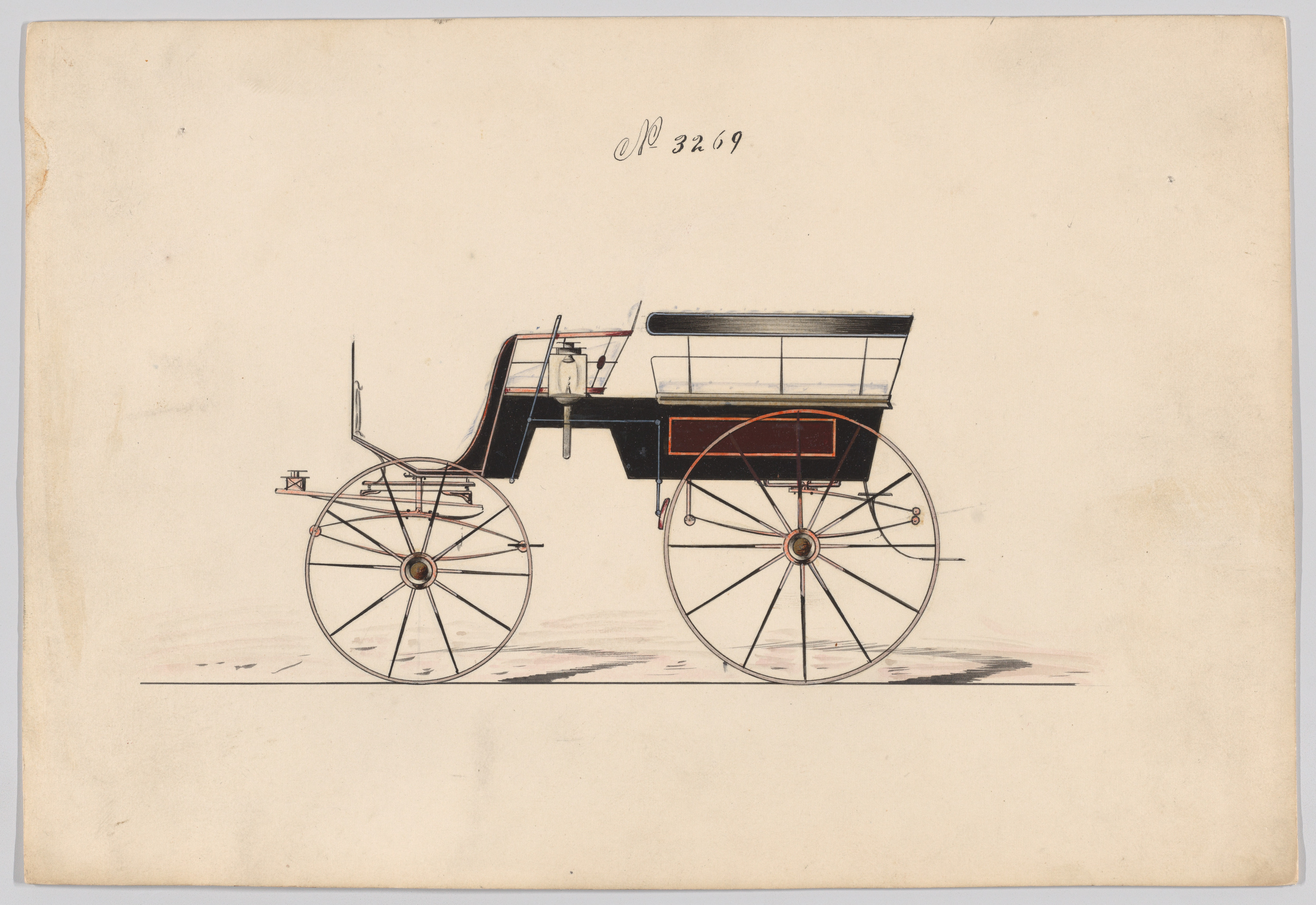
Design for Omnibus or Wagonette, no. 3269: An Aesthetic Archaeology
Within the archival silence of Natalie Fashion Atelier, the artifact designated Design for Omnibus or Wagonette, no. 3269 exists as a singular point of convergence. Executed in pen and black ink, with delicate washes of watercolor and gouache, it is ostensibly a technical drawing of 19th-century public conveyance. Yet, through the lens of isolated aesthetic archaeology—a methodology that divorces an object from its immediate historical narrative to mine its pure formal and material qualities—this blueprint reveals itself as a profound treatise on structured elegance, public spectacle, and democratic luxury. Its value lies not in its original function, but in its compositional DNA: a masterclass in framing, articulation, and the dignified presentation of the form within.
Deconstructing the Classical Elegance: Architecture of Movement
The artifact’s elegance is fundamentally architectural, born from a dialogue between constraint and fluidity. The pen and black ink establish an immutable armature—a rigid, linear framework defining the vehicle’s perimeter, wheelbase, and structural members. This is the couture cage or corset, the unseen architecture that dictates form and posture. Upon this stable groundwork, the watercolor and gouache introduce a narrative of movement and environment. The washes suggest volume, shadow, and the play of light across curved surfaces, while the opaque gouache highlights details—perhaps a crest, lamp, or decorative panel—acting as embellishment and focal point.
Most critically, the design centers on the framed aperture: the large windows and open entryways of the omnibus. These are not mere voids but curated portals, shaping glimpses of the interior world and its inhabitants. The silhouette of the vehicle itself is a study in balanced proportion—the verticality of the cabin offset by the horizontal sweep of the undercarriage and the circular repetition of the wheels. This creates a rhythm, a kinetic harmony that implies grace in transit. The elegance is classical because it is derived from principles of symmetry, axiality, and a clear hierarchy of structural and decorative elements, all rendered with the disciplined yet expressive hand of the artisan-draftsman.
Materiality as Method: The Hand of the Artisan
The specific materiality of pen, ink, watercolor, and gouache is not incidental; it is a direct analogue to haute couture craftsmanship. The pen line is the fil coupé, the precise, foundational stitch—unforgiving and definitive. A mistake here compromises the entire structure. The black ink’s permanence mirrors the commitment of a chalk mark on pristine wool. The watercolor, applied in translucent layers, embodies the art of moulage (draping), where fabric is coaxed into three-dimensional form through sensitive, cumulative manipulation; its fluidity suggests the fall of silk or the bloom of a skirt. The gouache, with its matte, opaque density, is the appliqué, the broderie, the precise placement of a passementerie—it commands attention, defining points of visual intensity.
This composite technique rejects the homogeneity of digital rendering. It celebrates the trace of the hand, the slight bleed of a wash, the weight of a line. For 2026, this insists that luxury must manifest this tactile intelligence. It is a argument for surfaces that reveal their making, where the foundational construction (the ink line) remains respectfully visible beneath the artistry (the color).
Informing the 2026 Silhouette: From Public Conveyance to Personal Architecture
The 2026 luxury silhouette, informed by this archaeology, will transcend fleeting trend to embrace a new architecture of presence. The omnibus’s framed apertures translate directly into garments that play with vistas and revelations. Expect structured bodices or jacket fronts that act as literal frames—outlined in braid or contrasting fabric—for inserts of delicate lace, sheer tulle, or intricate knit, creating a moving portrait of the wearer. The silhouette will balance the vertical (emphasized by long, columnar lines or tailored coats) with deliberate, rounded volumes (in skirts, sleeves, or collars) that echo the rhythmic wheel arches, creating a sense of poised momentum.
Specific Sartorial Translations
The Structural Cage: The underlying ink armature inspires a return to pronounced, yet lightweight, internal structuring. Bustiers and jackets will not merely be tailored but will feature exoskeletal details—fine boning channels expressed as external seam lines, or wire-framed collars that extend from the garment’s architecture, much like the omnibus’s roof supports.
The Democratic Salon: The omnibus as a mobile public space suggests a shift from exclusive, hidden luxury to a portable, performative elegance. This manifests in capes, dramatic coats, and enveloping outerwear that create a personal “space” around the wearer, designed to be appreciated in motion within urban environments. The luxury is in the craft and the transformative experience, not in secluded privacy.
Material Dialectics: Mirroring the artifact’s mixed media, 2026’s most innovative pieces will juxtapose rigid and fluid, opaque and transparent with intentional clarity. A gown may feature a stark, ink-like panel of rigid duchesse satin (the gouache) alongside a bodice of watercolor-washed chiffon, the seam between them as definitive as the pen line that originally separated wood from glass.
Conclusion: The Archive as Atelier
Design for Omnibus or Wagonette, no. 3269, through the practice of isolated aesthetic archaeology, ceases to be a drawing of a vehicle. It is re-consecrated as a foundational codex for Natalie Fashion Atelier. It teaches that true luxury for 2026 resides in the intelligent articulation of structure and surface, in the celebration of artisan-led materiality, and in the conceptual courage to find elegance in democratic principles of movement and presentation. The resulting silhouettes will be neither costume nor retrospective pastiche. They will be contemporary architectures for the body—vehicles of personal elegance, engineered with the disciplined hand of the draftsman and the soul of the painter, moving with purpose through the modern world.