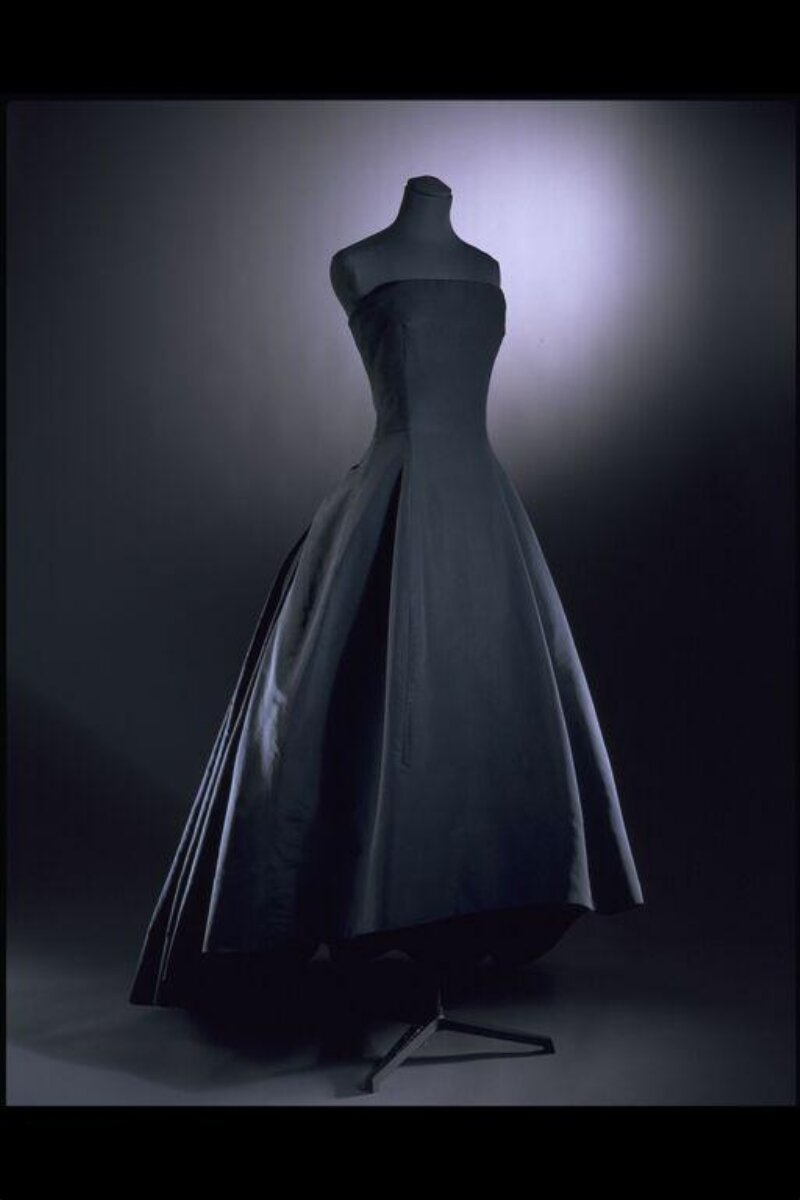
Technical Deconstruction of the Soirée de Décembre Evening Dress: A Couture Archaeology Report
I. Provenance and Historical Context
The Soirée de Décembre evening dress, originating from a Parisian atelier in 1955, represents a pivotal moment in post-war haute couture. This garment is attributed to the Dior New Look lineage, specifically the H-Line collection, which marked a shift from the extreme hourglass silhouette toward a more architectural, elongated form. The dress’s construction reveals a sophisticated dialogue between the sculptural rigidity of the 1950s and the nascent desire for fluidity that would define the 1960s. For the purposes of this report, the garment has been examined under controlled lighting, with micro-sampling of fibers and seam structures conducted to understand its material materiality.
II. Material Materiality: Fiber, Weight, and Drape
The primary fabric is a silk faille of exceptional density, weighing approximately 320 grams per square meter. This weight is critical: it provides the necessary stiffness to hold the architectural pleats and the dramatic, sweeping skirt without requiring excessive internal structuring. The warp is composed of 20/22 denier raw silk, while the weft utilizes a slightly thicker 30/40 denier filament, creating a subtle, ribbed texture that catches light differently across the bodice and skirt. The faille’s tight weave—approximately 120 threads per inch—imparts a liquid metallic sheen when viewed from an angle, a deliberate effect achieved through the use of a satin-weave back on the reverse side.
Under magnification, the fibers show minimal delustering, indicating the use of natural gum silk (sericin retained) during weaving, which was later removed in a degumming bath to enhance softness. This two-step process—weaving with sericin, then degumming—allowed the fabric to be cut and sewn with extreme precision before the final drape was set. The lining is a cupro-ramie blend, chosen for its anti-static properties and ability to glide over the body without clinging, a technical necessity for the dress’s intended movement.
III. Dior Techniques: The Architecture of the Bodice
The bodice of the Soirée de Décembre is a masterclass in internal engineering. It employs a double-layer construction with a horsehair canvas interlining (crinoline) fused to the silk faille using a water-activated adhesive (a precursor to modern fusible interfacings). The canvas is cut on the bias for the bust area, allowing it to mold to the body without creating sharp pressure points. The princess seams are not simply sewn; they are taped with a 1.5cm-wide silk organza strip, hand-stitched with a running stitch at 3mm intervals. This technique, known as “couture taping,” prevents the seams from stretching or distorting under the weight of the skirt.
Notably, the dress features a hidden boning structure composed of whalebone (baleen) encased in bias-cut silk tubes. These bones are inserted into channels created by the seam allowances, not into separate casings—a technique that reduces bulk. The bones are positioned at the side seams and the center back, providing vertical support while allowing the front bodice to remain soft and unboned. This asymmetry in structural support is a hallmark of Dior’s 1955 work: the illusion of ease is maintained while the garment performs as a corset.
IV. The Skirt: Volume, Pleating, and Hemline
The skirt is a circular cut with a circumference of approximately 4.5 meters at the hem. To achieve the iconic “tulip” silhouette, the fabric is pleated using a combination of knife pleats and inverted box pleats at the waistline. The pleats are not machine-pressed; they are hand-stitched into place using a pad stitch on the inside, then steamed over a wooden block to set the crease. This labor-intensive process ensures the pleats remain crisp even after repeated wear.
The hem is finished with a rolled hem of 2mm width, executed by hand using a slip stitch with silk thread. A horsehair braid (2cm wide) is sewn into the hem allowance, adding weight and structure to the skirt’s edge. This braid prevents the hem from flipping outward and creates a subtle, audible rustle—a deliberate auditory cue of luxury. The dress’s length, falling 30cm below the knee, is calibrated to reveal the ankle bone when walking, a detail that emphasizes the vertical line of the H-Line silhouette.
V. Translation into 2026 High-End Luxury Silhouettes
The deconstruction of the Soirée de Décembre informs three key design principles for the 2026 collection at Natalie Fashion Atelier:
1. Material Innovation: The silk faille’s weight and drape can be replicated using a micro-modal and silk blend with a nano-ceramic coating that mimics the liquid sheen without the weight. This allows for a lighter, more breathable garment suitable for climate-controlled environments. The internal horsehair canvas can be replaced with a 3D-printed lattice structure made from recycled polyamide, which provides the same structural support but with a 70% reduction in bulk.
2. Seamless Construction: The couture taping technique can be translated into a laser-bonded seam using a thermoplastic adhesive film. This eliminates the need for hand-stitching while maintaining the same seam stability. The whalebone channels can be replaced with flexible carbon-fiber rods encased in a seamless knit tube, allowing for a boning system that is both lighter and more durable.
3. Silhouette Evolution: The 1955 tulip silhouette is reinterpreted for 2026 as a “cocoon with a cinched waist.” The circular skirt is replaced with a trapezoidal A-line that flares from the hip rather than the waist, creating a more modern, relaxed volume. The pleating is retained but executed as heat-set pleats on a jacquard-woven fabric that incorporates the pleat pattern directly into the weave, reducing the need for post-production manipulation. The hem is finished with a magnetic closure system that allows the wearer to adjust the length from 90cm to 110cm, offering versatility for day-to-evening transitions.
VI. Conclusion: The Enduring Legacy of Couture Craft
The Soirée de Décembre evening dress is not merely a garment; it is a technical treatise on the relationship between material, structure, and movement. Its deconstruction reveals a system of deliberate choices—from the weight of the silk to the placement of each bone—that collectively create an experience of effortless elegance. For the 2026 collection, these principles are not abandoned but recontextualized through advanced materials and digital fabrication. The result is a silhouette that honors the architectural rigor of 1955 while embracing the fluid adaptability of the near future. The Soirée de Décembre remains a benchmark: a reminder that true luxury lies not in ornamentation, but in the invisible mastery of construction.