An Isolated Archaeology: The Tulips Panel and the 2026 Silhouette
Artifact Provenance and Material Lexicon
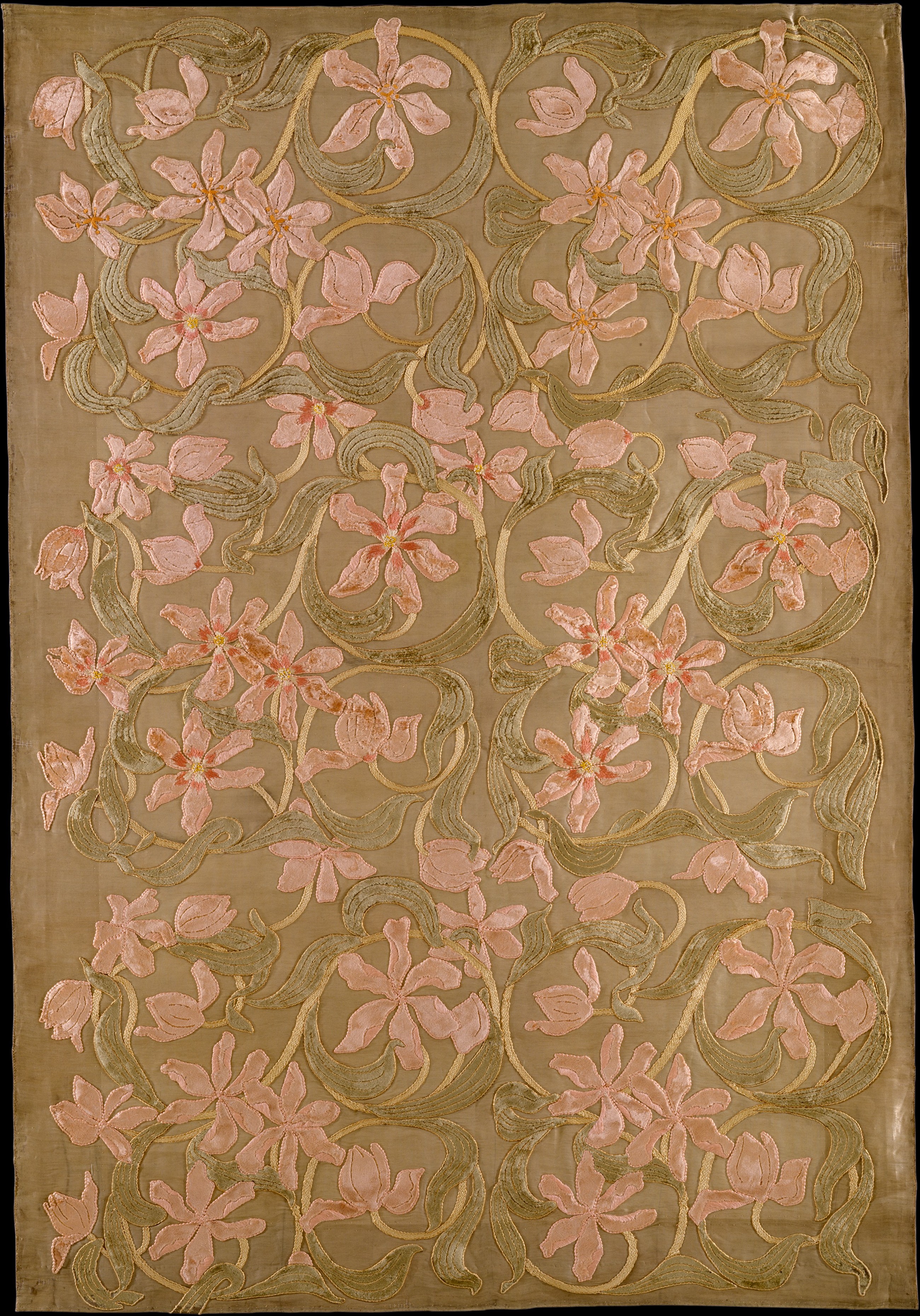
The Tulips Panel exists as a singular, isolated fragment within the Natalie Fashion Atelier archive—a piece of American heritage that defies easy categorization. It is not a garment, but a study in material tension. The base is a silk and metallic cloth, a ground of luminous restraint. Upon this foundation, a narrative is built through appliquéd silk velvet, whose nap creates a play of light absorption against the reflective metallic threads. The embroidery, executed in silk and metallic-wrapped cotton threads, adds a third layer of textural and chromatic complexity. This is not a simple floral motif; it is an exercise in aesthetic archaeology, where the tulip becomes a structural and symbolic device.
Deconstructing Classical Elegance: The Tulip as Structural Metaphor
Classical elegance in American couture often implies a streamlined, functional grace. The Tulips Panel subverts this. The tulip, in its natural state, is a chalice of contained energy—a tight bud that promises explosive bloom. The panel captures this pre-bloom tension. The appliquéd velvet forms the heavy, velvety petals, while the metallic embroidery traces the veins and contours, suggesting the rigid, architectural skeleton of the flower. The classical elegance here is not in simplicity, but in the controlled complexity of the composition. The panel’s asymmetry, the deliberate placement of the tulips as if caught in a perpetual state of unfurling, introduces a dynamic, almost kinetic quality. This is elegance born of calculated imbalance, a precursor to the 2026 silhouette.
Materiality as Silhouette Engine: From Flat Panel to Three-Dimensional Form
The specific materiality of the Tulips Panel is the primary driver for 2026 high-end silhouettes. The silk and metallic cloth provides the necessary structural integrity for sharp, architectural lines. It is a fabric that holds a crease and resists draping, suggesting a silhouette of rigid geometry. The appliquéd silk velvet, by contrast, introduces a volumetric counterpoint. The velvet’s pile, when applied in the tulip forms, creates a raised, almost sculptural relief. This is not mere decoration; it is a blueprint for targeted volume. In 2026, we will see this translated into garments where the body is encased in a sleek, metallic shell, with velvet appliqués creating unexpected, localized bulges—at the shoulder, the hip, or the bust—mimicking the tulip’s petal structure.
The embroidery with metallic-wrapped cotton threads serves a dual purpose. First, it provides a tensile strength that allows the fabric to be manipulated into complex, cantilevered shapes. Second, the metallic thread creates a linear, almost skeletal frame that defines the silhouette’s outer limits. In 2026, this translates into garments where the embroidery is not just surface decoration, but a structural exoskeleton. Imagine a sheath dress where the metallic embroidery traces the tulip’s stem and petal veins, creating a corset-like structure that is both decorative and functional. The silk threads, softer and more pliable, allow for gradated flexibility, enabling the garment to move with the wearer while maintaining its architectural form.
The 2026 Silhouette: The “Tulip Carapace” and the “Unfurled Bloom”
From the Tulips Panel, two distinct 2026 silhouette archetypes emerge. The first is the “Tulip Carapace.” This is a silhouette defined by hard, protective outer layers that echo the metallic cloth base. The jacket or coat is cut with sharp, angular shoulders and a fitted waist, but the volume is concentrated in the upper back and sleeves, mimicking the tulip’s bulbous base. The appliquéd velvet is used as a strategic padding, creating a sense of armored opulence. The metallic embroidery acts as a web of structural seams, holding the shape rigid. This is a silhouette of power and containment, where the wearer is encased in a beautiful, impenetrable form.
The second archetype is the “Unfurled Bloom.” This silhouette inverts the Carapace. Here, the base fabric is a fluid, lightweight silk, while the metallic cloth is used as strategic inserts that create structure at specific points—the hem, the cuffs, the neckline. The appliquéd velvet is used to create asymmetrical, petal-like panels that can be manipulated by the wearer. The embroidery, executed in a looser, more organic pattern, allows the garment to drape and fall like a flower in bloom. This silhouette is about controlled release, where the garment’s volume is not fixed but can be adjusted through integrated ties or hidden closures that mimic the tulip’s opening petals. The 2026 client is not a passive recipient of form; she is an active participant in the silhouette’s creation.
Technical Translation: From Archive to Atelier
The translation of the Tulips Panel into 2026 high-end silhouettes requires a re-engineering of the appliqué and embroidery techniques. The silk velvet appliqué must be treated as a composite material. In the atelier, this means using a laser-cut precision to create the petal shapes, then bonding them to the metallic cloth with a heat-activated adhesive that maintains the velvet’s nap. The metallic-wrapped cotton embroidery must be executed on a computerized multi-head machine that can replicate the exact tension required for the structural exoskeleton. Simultaneously, the silk thread embroidery is done by hand, allowing for the subtle gradations of color and texture that give the tulip its lifelike quality.
The 2026 silhouette will also demand a new approach to pattern cutting. The traditional darts and seams are replaced by embroidery-defined shaping. The metallic thread acts as a structural seam, allowing the garment to curve and contour without visible darts. The velvet appliqués are cut on the bias to ensure they follow the body’s natural movement. This is a zero-waste approach to high-end couture, where every piece of the panel is used to inform the garment’s architecture. The result is a silhouette that is both historically informed and technologically advanced, a true aesthetic archaeology brought to life.