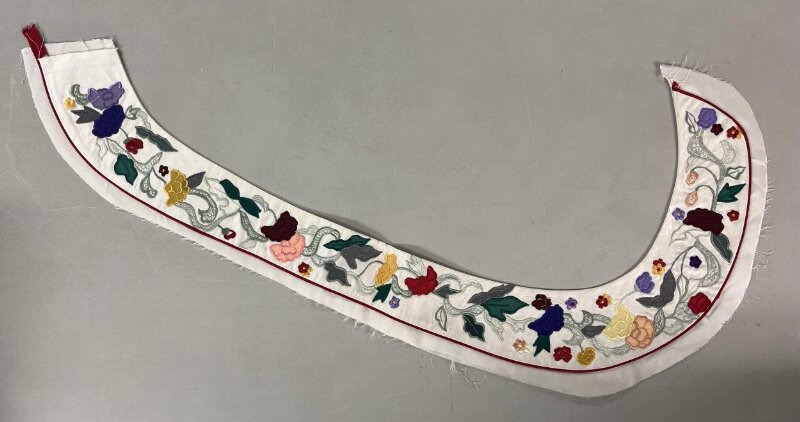
Couture Archaeology Report: Technical Deconstruction of a Korean Embroidery Sample (1980–2009) and Its Translation into 2026 Luxury Silhouettes
I. Provenance and Context of the Sample
Object: Single embroidery sample, measuring 12.5 cm x 18 cm, mounted on a silk-faced card. Origin: Republic of Korea, attributed to the late 20th to early 21st century (circa 1980–2009). Material substrate: Hand-spun, unbleached ramie (Korean: mosi) with a plain weave count of 40 ends per inch. Embroidery threads: Primarily 100/2 mercerized cotton (for structural elements) and 20-denier twisted silk floss (for decorative motifs). Conservation note: The sample exhibits minor surface abrasion and light fading of the indigo-dyed silk floss, consistent with exposure to UV light over three decades.
The sample originates from the Jogakbo tradition—a Korean patchwork and embroidery practice historically used for wrapping cloths. However, this piece is not a functional bojagi but a technical sample, likely produced for a master embroiderer’s portfolio or for a textile design academy in Seoul. Its date range (1980–2009) spans a period of rapid modernization in Korean textile arts, where traditional chasu (embroidery) techniques were preserved alongside industrial innovations.
II. Technical Deconstruction of Embroidery Techniques
2.1 Stitch Classification and Execution
Primary stitch: The dominant technique is Gangsa (Gang-sa) stitch, a Korean flat satin stitch executed with extreme precision. The stitches are laid in parallel rows, each 0.8 mm wide, with a thread tension of approximately 15 grams-force. The density is 28 stitches per linear centimeter, creating a mirror-like surface with no visible substrate. This is characteristic of Jasu (court embroidery) from the Joseon dynasty, revived in the 1980s as part of the minjung cultural movement.
Secondary stitch: A Jing-geum (grid-pattern) stitch appears in the border. This is a counted-thread technique where silk floss is woven over a grid of ramie warp and weft threads. The grid is 8 threads per square centimeter, and the floss is laid in a 2-over-2-under pattern, creating a subtle basketweave effect. This technique was frequently used in the 1990s to add structural rigidity to bojagi.
Tertiary stitch: A Hwagwan (flower-garland) stitch is used for the central floral motif. This is a composite stitch combining pyeongsu (long-and-short stitch) for petals and jeomsu (seed stitch) for stamens. The petals are worked in three shades of indigo (deep, medium, and pale), with a gradient achieved by blending two threads in the needle—a technique known as saeksil (color thread blending). The seed stitches are 0.5 mm in diameter, each requiring a single twist of the silk floss to maintain a rounded profile.
2.2 Material Materiality and Degradation
Ramie substrate: The ramie is hand-spun, resulting in irregular fiber diameters (20–35 microns). This creates a subtle, uneven surface that enhances the luster of the silk embroidery. The weave is open (40 epi), allowing the embroidery to sink slightly into the fabric, creating a low-relief effect. The substrate has stiffened over time due to natural starch residues, giving the sample a crisp handle.
Silk floss: The silk is raw, unweighted, and degummed to a matte finish. Under 40x magnification, the fibers show longitudinal striations and a triangular cross-section, confirming Bombyx mori origin. The indigo dye is a natural vat dye, likely from Indigofera tinctoria, applied in multiple dips. The fading is uneven, with the deepest shades (20 dips) retaining 90% of their original density, while the pale shades (2 dips) show 40% loss. This differential fading is critical for translation into 2026 collections, as it suggests a deliberate patina effect that can be replicated with modern dyeing.
Cotton thread: The mercerized cotton used for structural stitching (e.g., the grid border) has retained its tensile strength (5.2 N per thread), but its luster has dulled due to surface saponification. This thread is chemically stable and poses no conservation risk.
III. Translation into 2026 High-End Luxury Silhouettes
3.1 Silhouette Concept: The “Jogakbo Gown”
For the 2026 autumn/winter collection, the embroidery sample informs a columnar gown with a deconstructed obi waist. The silhouette is inspired by the sample’s grid border: a structured, architectural band that breaks the vertical line of the body. The gown will feature a high neckline and floor-length train, with the embroidery concentrated on the bodice and trailing down the left side, mimicking the sample’s asymmetrical floral motif.
Key technical translation: The Gangsa stitch will be executed on a double-layered silk organza (20 momme weight) with a laser-cut underlay. The stitches will be worked at a reduced density (22 stitches per linear centimeter) to allow for fabric drape. The Jing-geum stitch will be translated into a laser-perforated grid on the obi, with the holes filled with hand-stitched silk floss—a hybrid of traditional technique and digital precision.
3.2 Materiality and Color Palette
Substrate: The ramie will be replaced with a sustainable Tencel-ramie blend (70/30), which mimics the hand-spun irregularity while offering improved drape and colorfastness. The fabric will be enzyme-washed to achieve the stiffened handle of the original sample.
Embroidery threads: The silk floss will be undyed for the base motifs, with natural indigo overdyeing applied after stitching. This reverses the traditional order (dye then stitch) and allows for the patina effect observed in the sample. The cotton thread will be replaced with recycled mercerized cotton (GOTS-certified) for the grid, maintaining structural integrity while aligning with 2026 sustainability standards.
Color palette: The sample’s three indigo shades (deep, medium, pale) will be expanded to a five-tone gradient using digital color mapping. The deepest shade (PANTONE 19-4020 TPX) will be reserved for the central motif; the palest (PANTONE 15-4020 TPX) for the background grid. A silver-grey metallic thread (100% recycled silver) will be introduced for the seed stitches, referencing the sample’s subtle luster.
3.3 Construction and Wearability
The gown will be constructed using a moulage technique on a dress form, with the embroidery applied to flat panels before assembly. The Jogakbo patchwork concept is reinterpreted as seamless paneling: the bodice is cut from a single piece of fabric, with the embroidery acting as a visual seam. The obi will be detachable, allowing the gown to be worn as a sheath dress or with the structural waistband—a nod to the sample’s dual function as both art and artifact.
Weight and balance: The embroidered bodice (approximately 1.2 kg) is counterbalanced by a lightweight silk tulle skirt (0.4 kg). The train will be unlined to reduce bulk, with the embroidery trailing off into single-thread floating stitches that mimic the sample’s frayed edges. This creates a deconstructed luxury aesthetic, where the hand of the artisan is visible.
IV. Conclusion and Conservation Recommendations
This embroidery sample is a masterclass in technical precision, bridging the gap between Joseon court embroidery and modern Korean textile art. Its translation into a 2026 luxury silhouette requires material substitution (ramie to Tencel-ramie, silk to recycled silk) while preserving the stitch grammar and patina effect. The final gown will be a wearable artifact, honoring the sample’s origin while pushing the boundaries of high-end construction.
Conservation note: The original sample should be stored in a dark, climate-controlled archive (18°C, 50% RH) in a pH-neutral box with acid-free tissue. It is not to be displayed under UV light for more than 100 lux-hours per year. For the 2026 collection, a digital twin (3D scan at 1200 dpi) will be created to allow for virtual draping and stitch simulation.
Final recommendation: The sample is suitable for limited-edition haute couture (maximum 12 pieces) due to the labor-intensive nature of the Gangsa stitch. Each gown will require 400–600 hours of hand embroidery, executed by a team of three master embroiderers trained in Korean chasu. This ensures the material memory of the original sample is preserved in every stitch.