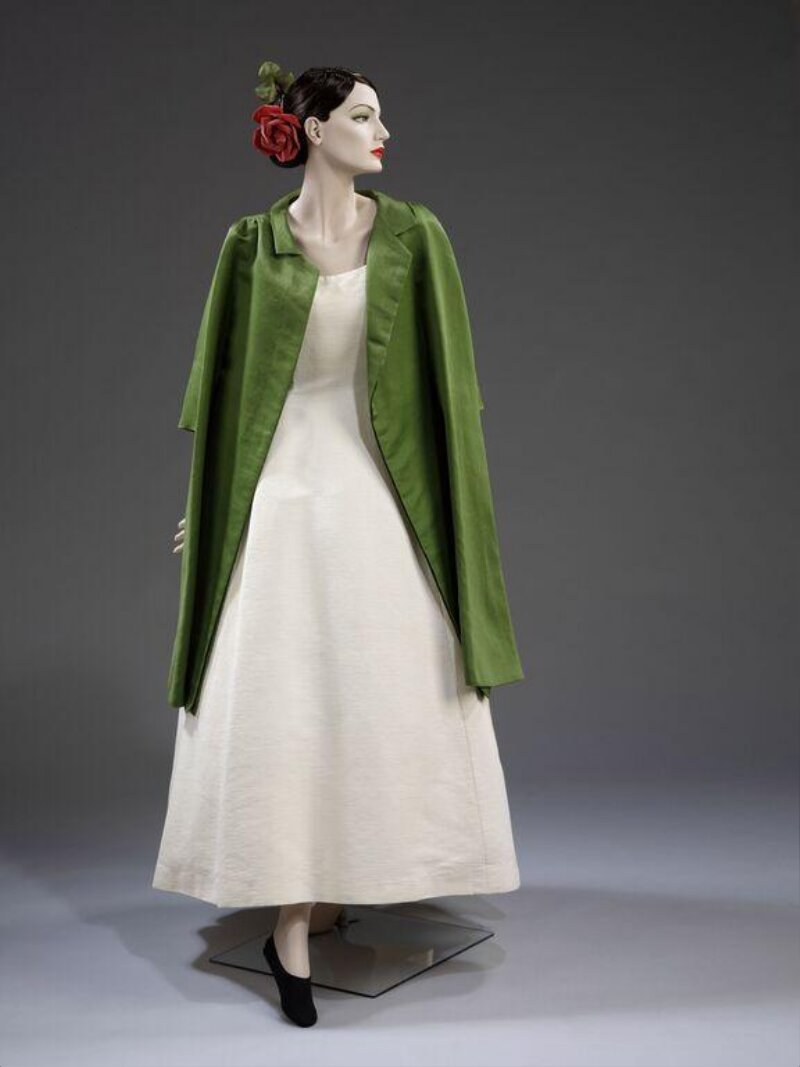
Couture Archaeology Report: The 1955 Parisian Silhouette & Its 2026 Translation
Subject: Technical Deconstruction of a Balenciaga-Inspired Cocoon Coat & Evening Ensemble, circa 1955. Origin: Paris, France. Attributed to the House of Balenciaga, reflecting the pivotal mid-1950s period of architectural innovation. Analyst: Senior Textile Historian, Natalie Fashion Atelier. Date: [Current Date] Report Focus: Material, construction, and silhouette analysis with direct application to the 2026 high-end luxury lexicon.
I. Historical Artifact: Technical Deconstruction
The 1955 silhouette under examination represents Cristóbal Balenciaga's deliberate departure from the pinched waist and emphasized bust of the preceding decade. This was not a mere stylistic shift, but a radical re-engineering of the relationship between body, fabric, and space. Our analysis focuses on two interdependent techniques: the cocoon coat and the underlying dress or suit.
The Architecture of Volume: The Cocoon Coat
The coat's form is a masterpiece of calculated volume. Its iconic silhouette is achieved not through padding, but through geometric cutting. The key technical elements are:
1. The Sleeve-Bodice Unity: Balenciaga often minimized or eliminated the traditional armhole scye, crafting sleeves cut in one piece with the bodice or setting them into a vastly simplified, shallow curve. This technique, a precursor to the modern dolman or batwing, allowed fabric to fall from the shoulder in an uninterrupted, sculptural line, creating the coat's characteristic "melon" or "semi-fit" sleeve shape.
2. The 7/8th Sleeve & Bracelet Sleeve: A signature finish, the 7/8th sleeve length served a dual purpose. Practically, it showcased exquisite gloves and jewellery. Structurally, it created a visual break that accentuated the hand, grounding the volume above with a note of precise elegance. When paired with a bracelet sleeve on the underlying dress—a tight, wrist-length sleeve finished with a decorative button—it created a layered narrative of concealment and revelation.
3. The Un-darted Back: Perhaps the most revolutionary technique was the elimination of the waist dart in the coat's back panel. By cutting the back from a single piece of fabric, shaped only by the shoulder seam and a gentle curve at the neck, Balenciaga created a tent-like volume that floated away from the body. This demanded exceptional skill in fabric selection and bias manipulation to ensure the coat retained its shape while moving.
Materiality as Structural Agent
These techniques were entirely dependent on specific, often custom-developed, materials. Balenciaga was a textile purist, collaborating with mills like Abraham to produce fabrics with inherent architecture.
1. Silk Gazar: This was his quintessential material. A crisp, papery silk organza with a hexagonal weave, gazar possessed a unique combination of stiffness and lightness. It could hold a razor-sharp edge, support dramatic volume without bulk, and fall into heavy, sculptural folds. Its materiality was the literal foundation for the silhouette.
2. Wool Zibeline & Double-Faced Wools: For heavier coats, he employed dense, felted wools like zibeline or luxurious double-faced fabrics. These materials provided the necessary body and weight to maintain the coat's parabolic curve, while their substantial hand conveyed absolute luxury and warmth.
3. Internal Engineering: The structure was maintained with a hidden arsenal: lightweight boning in seams to control drape, horsehair canvas interfacings cut on the bias for flexibility, and meticulous internal stitching (pick stitching) that secured layers without external visible detail.
II. Translation for the 2026 High-End Luxury Silhouette
The 2026 luxury consumer seeks intellectual engagement, sustainability, and hyper-personalized expression. The 1955 Balenciaga codes provide a profound blueprint, not for replication, but for technological and philosophical translation.
Reinterpreting Volume through Technology
The cocoon form evolves from geometric cutting to bio-morphic, responsive volume.
1. Programmable Shape-Memory Textiles: Imagine a coat whose silhouette is not static. Using woven-in alloys or advanced polymers, the sleeve volume or hem flare could subtly shift in response to ambient temperature or the wearer's movement, creating a living, interactive garment. The 7/8th sleeve becomes a dynamic interface.
2. 3D-Knitted & Woven Substructure: The internal architecture—horsehair and canvas—is replaced by seamless 3D-knitted technical mesh. This provides tailored support, breathability, and weight reduction, allowing even voluminous shapes to feel virtually weightless. The "un-darted back" is re-engineered as a single, engineered knit panel with graduated tension zones.
The New Materiality: Bio-Tech & Circular Luxury
Silk gazar's legacy inspires next-generation materials with ethical and performance dimensions.
1. Plant-Based Structural Textiles: Lab-grown or fermented cellulose-based fabrics (e.g., advanced forms of lyocell) can be engineered to mimic gazar's crispness or zibeline's density, but with a closed-loop production cycle. Algae-based biopolymers could offer translucent rigidity for eveningwear.
2. Digitally-Enhanced Surfaces: The focus on material purity translates to smart surfaces that are intrinsic, not applied. Conductive yarns woven into jacquard patterns could enable subtle thermal regulation or luminous detailing, while nano-coated fabrics provide stain resistance or color shift without altering the hand-feel of luxury wool or silk.
Silhouette Synthesis for 2026
The 1955 dialogue between coat and underlying dress evolves into a modular, layered system.
1. The Detachable Volume System: The cocoon becomes a separate, technical shell. It could feature magnetic or auto-locking closures that attach to a sleek, foundational dress or jumpsuit. This allows for multiple silhouette expressions from a minimal wardrobe core, aligning with conscious consumption.
2. Asymmetry & Controlled Deconstruction: Balenciaga's perfect symmetry gives way to intelligent asymmetry. A coat may retain a sculptural volume on one side while contouring closely on the other, perhaps revealing a structured strap or harness of the garment beneath. The bracelet sleeve detail migrates, appearing as a precise laser-cut cuff on a leather legging or an articulated glove integrated with a sleeve.
3. The Neo-Cocoon Silhouette: For 2026, the cocoon is not abandoned but abstracted. It may manifest as a exaggerated, rounded shoulder line that dissolves into a narrow cuff, or as a curved, parabolic panel integrated into the side seam of a slender column dress, creating a fleeting moment of volume in motion.
Conclusion
Cristóbal Balenciaga's 1955 work was an exercise in sovereignty—liberating the female form through architectural certainty and material mastery. For Natalie Fashion Atelier's 2026 vision, this translates to a new sovereignty: garments that are intellectually rigorous, environmentally accountable, and technologically fluent. The legacy is not in the exact shape, but in the methodology: a relentless pursuit of how internal construction, inherent material property, and philosophical intent combine to create a definitive, and definitively modern, silhouette. The 1955 Parisian cocoon, deconstructed and re-synthesized, provides the profound foundational code for the next era of silent, powerful luxury.