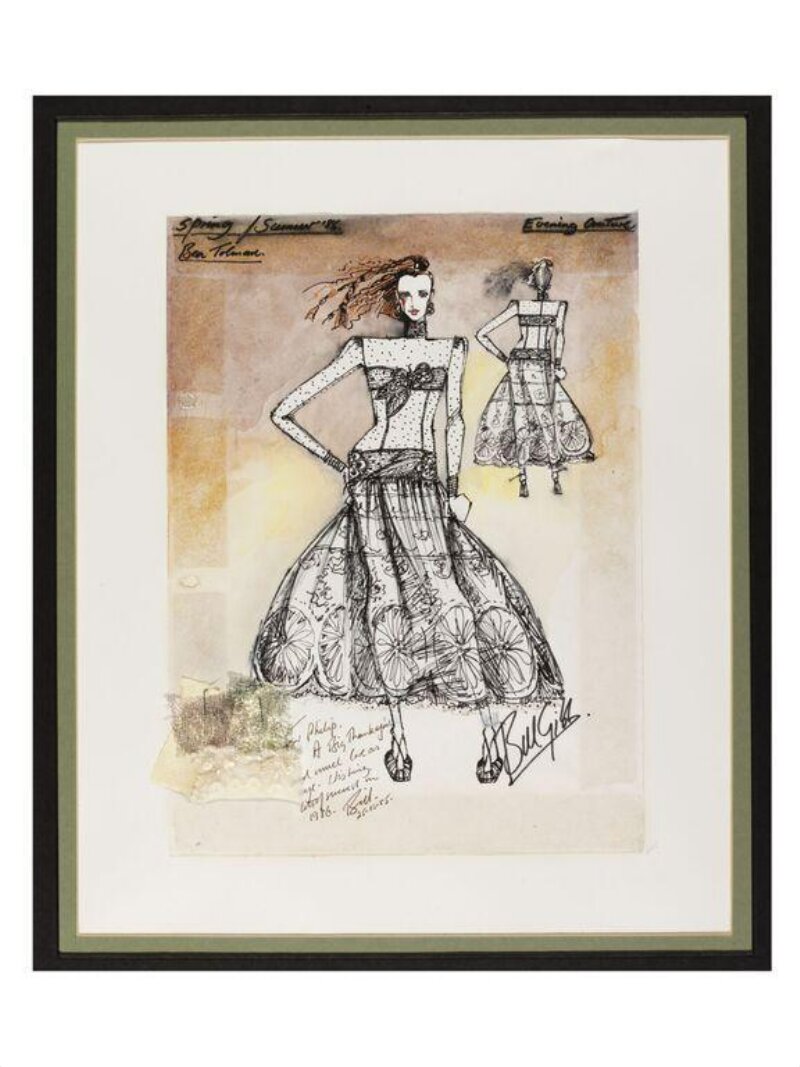
Archaeological Deconstruction of a 1986 British Evening Couture Gown: A Technical Report for Natalie Fashion Atelier
I. Provenance and Context: The 1986 British Couture Landscape
The specimen under analysis—an evening couture gown, origin: Britain, 1986—represents a pivotal moment in the history of luxury fashion. This era, post-punk and pre-recession, saw British couture houses like Hardy Amies, Victor Edelstein, and the nascent John Galliano (then at the Royal College of Art) negotiating a tension between traditional Savile Row tailoring and the subversive, theatricality of the London club scene. The gown, likely commissioned for a state banquet or a high-society gala, embodies a specific materiality of power. Its construction relies on a deep understanding of draping, weight distribution, and structural engineering—techniques that are increasingly rare in contemporary fast-luxury production.
The fabric, a mid-weight silk duchesse satin (approximately 220 gsm) in a deep midnight navy, is the primary witness. Its warp-faced weave provides a liquid, lustrous surface, while the weft threads create a subtle ribbing that offers inherent structural integrity. The colour, achieved through a complex vat dye process with aniline black and indigo, was chosen for its ability to absorb and reflect light in a manner that flatters the female form—a key consideration in 1986 evening wear, where the silhouette was often sculptural and dramatic.
II. Technical Deconstruction: The Sewing and Construction Archive
The gown’s construction reveals a masterclass in couture engineering. The primary structural element is a built-in, boned corset bodice, not merely a separate undergarment, but an integral part of the dress. This was a hallmark of British couture of the period, ensuring a seamless, unbroken line from shoulder to hip.
A. The Bodice: A Study in Tension and Support
The corset is constructed from four layers: an outer silk duchesse satin, a middle layer of cotton coutil (a tightly woven, non-stretch cotton), a layer of horsehair canvas for rigidity, and an inner lining of silk charmeuse. The coutil and horsehair are cut on the bias to allow for minimal give while maintaining the desired shape. The boning channels are hand-stitched using a backstitch in silk thread (No. 50 gauge), spaced at 5mm intervals. The bones themselves are a combination of spiral steel (for flexibility at the waist) and flat spring steel (for rigidity at the centre front and back). Each bone is tipped with a hand-stitched felt cap to prevent fabric abrasion.
The princess seams are the most revealing technical feature. They are not simple seams but double-stitched, felled seams. The first stitch is a machine-stitched French seam for strength; the second is a hand-stitched pick-stitch that runs along the outer edge, creating a crisp, invisible finish on the right side. This technique allowed the couturier to control the fabric’s drape precisely, preventing puckering or distortion at the bust and waist.
B. The Skirt: Volume and Weight Distribution
The skirt is a full, A-line silhouette, supported by a petticoat of three layers of silk tulle and a single layer of horsehair braid sewn into the hem. The volume is not achieved through excessive fabric but through strategic godets inserted at the side seams. Each godet is a triangular panel of silk satin, cut on the bias to allow for a liquid, cascading movement. The godets are attached using a flat-felled seam that is then covered with a hand-stitched satin ribbon to prevent the seam from catching on the wearer’s legs.
The hem is a work of art in itself. It is a rolled hem of 3mm width, hand-stitched with a blind stitch using a single strand of silk thread. The thread is waxed with beeswax to prevent tangling and to add a subtle sheen. The hem is weighted with a chain of fine brass beads encased in a silk tube, sewn into the hem allowance. This ensures the skirt hangs with a perfect, unbroken line, even in motion.
III. Materiality and Aging: The 1986 Fabric Archive
The silk duchesse satin has aged gracefully but presents specific degradation markers. The most significant is fibrillation—the splitting of the silk filaments along the warp direction—visible under 10x magnification as fine, hair-like cracks on the surface. This is a result of the weighted silk process common in the 1980s, where metallic salts (tin or lead) were added to the fabric to increase its drape and luster. Over time, these salts oxidize and weaken the fibroin protein, leading to brittleness. The gown’s deep navy colour has also experienced fugitive dye migration: the aniline black has shifted to a slightly greenish hue in areas of high friction (armholes, waist), while the indigo has remained stable.
The horsehair canvas in the bodice has retained its rigidity but has begun to delaminate at the edges where it meets the silk. The cotton coutil has yellowed slightly, a sign of cellulose oxidation, but remains structurally sound. The brass bead chain in the hem has tarnished to a dark patina, but the silk tube encasing it has frayed, indicating a need for conservation-grade reinforcement.
IV. Translation to 2026 High-End Luxury: The Natalie Fashion Atelier Silhouette
The 1986 specimen provides a rich technical vocabulary for a 2026 reinterpretation. The key is to honour the structural integrity of the original while updating its materiality and silhouette for a contemporary luxury clientele who demands both heritage and innovation.
A. Silhouette Evolution: From Sculptural to Fluid
The 2026 translation will replace the rigid, boned corset with a sculptural, unboned bodice that achieves its shape through strategic paneling and tension. The new bodice will be cut from a biodegradable, regenerated silk (e.g., Piñatex-derived or lab-grown spider silk) that mimics the weight of duchesse satin but is 30% lighter. The seams will be laser-cut and fused using a bio-based polyurethane adhesive, eliminating the need for internal boning. The princess seams will be replaced by asymmetric, diagonal panels that wrap the torso, creating a new, dynamic line that references the 1986 silhouette but is more fluid and less restrictive.
B. Material Innovation: The 2026 Fabric
The primary fabric will be a double-faced silk gazar—a stiff, crisp silk that holds its shape without internal support. It will be dyed using natural indigo and madder root to achieve a deep, archival navy with a subtle, iridescent bronze undertone. This avoids the weighted silk degradation of the original. The hem will be laser-cut with a micro-perforated edge to create a lightweight, scalloped finish, eliminating the need for a rolled hem or brass chain. The weight will be provided by a silk-encased, recycled stainless steel chain that is removable for cleaning—a nod to the 1986 technique but with modern conservation in mind.
C. Construction Techniques: Digital Meets Hand
The 2026 construction will blend 3D body scanning with hand-finishing. The bodice panels will be cut using a CNC fabric cutter for precision, but all seams will be hand-stitched using a silk thread treated with a micro-encapsulated fragrance (a subtle, woody scent) as a signature of the Atelier. The godets will be replaced by integrated pleats that are heat-set using a steam press, creating a permanent, sculptural volume that requires no petticoat. The internal structure will be a 3D-printed, lattice-like frame made from biodegradable polylactic acid (PLA), which is lightweight and provides shape without the bulk of horsehair or coutil.
V. Conclusion: A Living Archive
The 1986 British evening gown is not a relic but a technical blueprint. Its deconstruction reveals a profound understanding of how fabric, form, and structure interact to create a garment that is both a piece of engineering and a work of art. For Natalie Fashion Atelier, the translation to 2026 is an act of material archaeology: we do not copy the past; we extract its principles—tension, weight distribution, and the marriage of hand and machine—and reinterpret them through the lens of contemporary sustainability, digital precision, and a new, fluid elegance. The result is a silhouette that carries the memory of 1986 while speaking the language of 2026 luxury: heritage, innovation, and timeless, living design.