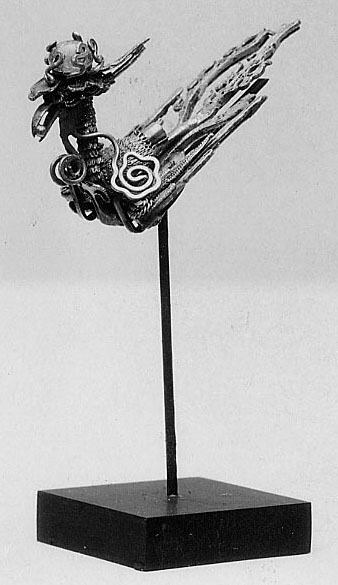
Ornament as Structure: The Gold Standard of 2026
Within the hallowed archives of Natalie Fashion Atelier, the artifact known as “Mirror with Split-Leaf” serves as a pivotal node of aesthetic archaeology. This object, a duality of polished silver and encrusted gold, presents a profound paradox: one face offers the cold, reflective clarity of a silver mirror adorned with intricate golden palmettes; the reverse bears the narrative weight of life etched into the cold stone of a sarcophagus lid. For the 2026 Haute Couture season, this Chinese heritage artifact is not merely a source of decorative motifs. It is a structural blueprint. The gold, in its materiality and application, is deconstructed from ornament into the very skeleton of the silhouette, informing a new lexicon of luxury where embellishment is load-bearing and historical resonance is cut into the cloth.
The Dialectic of Surface: Mirror and Relief
The genius of the Mirror with Split-Leaf lies in its binary surface logic. The first surface—the silver mirror—represents a state of pure potentiality. It is a void waiting to be filled, a field of light. The gold palmette applied to this surface is not a mere appliqué; it is a structural intervention. It breaks the perfect plane, creating a topography of reflection and shadow. For the 2026 silhouette, this translates into a radical rethinking of the garment’s surface. We are moving beyond flat embroidery. The new couture silhouette features “structural gilding”—where panels of gold-lame or metallic organza are not sewn onto a base but are integrated as architectural seams. A gown’s bodice might be constructed from alternating strips of matte black crepe and polished gold micro-chain mail. The gold acts as the load-bearing element, shaping the torso much like the palmette shapes the mirror’s void. The negative space (the silver) becomes the skin, the breath, while the positive space (the gold) becomes the bone.
Materiality of Gold: From Weight to Weightlessness
Historically, Chinese gold ornamentation in the Tang and Song dynasties was characterized by its granulation and filigree—a technique of applying immense pressure and heat to create a seemingly weightless, lace-like structure from a dense metal. This paradox of heavy material rendered as ethereal form is the central technical challenge for 2026. The archive node teaches us that gold’s value is not in its mass, but in its discipline. For the atelier, this has led to the development of a proprietary textile: “Aurum Plissé.” This is not a fabric printed with gold; it is a fabric woven from a core of ultra-fine gold thread (23k, for its malleability) and encased in a micro-filament of liquid silk. The result is a material that possesses the liquid drape of charmeuse but the structural memory of metal. When pleated using a heat-set process derived from ancient Chinese armor-making, the gold thread holds a permanent, sculptural wave. A 2026 evening coat in Aurum Plissé will not drape; it will hold its own architecture, standing away from the body like a golden leaf unfurled from the mirror’s surface. The weight has been transmuted into a tensile strength that defines the silhouette’s volume.
The Narrative of the Reverse: Gold as Epitaph
The second face of the artifact—the sarcophagus lid with its relief-carved narrative—is equally critical. Here, gold is absent, yet its memory lingers. The stone is a negative record of the gold’s positive form. This inversion informs the 2026 concept of “negative gilding.” Instead of applying gold, we are carving it away. This technique manifests in the silhouette through the use of laser-cut leather and suede that is then backed with a gold leaf membrane. The garment’s surface becomes a bas-relief. A jacket, for instance, might be crafted from black matte calfskin. The surface is then laser-ablated to remove the top layer of leather, revealing a gold underlay in the precise pattern of the split-leaf palmette. The gold is not on the surface; it is embedded within the material’s depth. The silhouette is thus a narrative of excavation. The wearer becomes the archaeologist, revealing the historical ornament through movement and light. The gold is a secret, a buried treasure that only emerges when the garment is in motion, catching the light at a specific angle—a direct translation of the stone relief’s story-telling through shadow.
Silhouette Architecture: The Gold Skeleton
How does this inform the 2026 high-end silhouette? The classical Chinese aesthetic, with its emphasis on horizontal lines and structured shoulders (the ru jacket and the pao robe), is reimagined through the lens of gold’s tensile strength. The 2026 silhouette is defined by the “Gilded Carapace.” This is not armor in the Western medieval sense, but a biological exoskeleton of light. Key pieces include:
- The Palmette Bodysuit: A second-skin base of nude silk tulle, upon which individual gold palmette motifs (cast from the archive’s pattern) are articulated on micro-hinges. The gold does not cover the body; it frames it, creating a structural corset that is both rigid and flexible, allowing the skin to breathe through the negative space.
- The Split-Leaf Coat: A floor-length duster in Aurum Plissé, where the pleats are heat-set to flare out at the hem, mimicking the split-leaf’s organic growth. The coat’s silhouette is not a cylinder; it is a spiral, wrapping the body in a continuous golden ribbon that is both covering and revealing.
- The Mirror-Grid Gown: A column dress constructed from rectangular panels of silver organza and gold micro-chain mail. The gold panels act as the structural ribs, holding the silver panels taut. The silhouette is a direct architectural quote of the mirror’s surface—a grid of reflection and gold, with the body as the void in the center.
Conclusion: The Ornament is the Structure
The 2026 collection for Natalie Fashion Atelier does not use gold as an afterthought or a signifier of wealth. It uses gold as a primary structural material, a load-bearing element that defines the silhouette’s volume, its tension, and its narrative. The Mirror with Split-Leaf teaches us that the most profound ornament is the one that holds the entire composition together. The gold is not decoration; it is the architecture. The 2026 silhouette is a testament to this principle: a body clad in a gilded skeleton, where every shimmering line is a line of force, and every gilded leaf is a structural rib. The classical elegance of Chinese gold is not preserved; it is deconstructed and rebuilt into a new, tensile, and profoundly modern form of haute couture. The ornament has become the body’s new skeleton, a golden ghost from the archive, made flesh for the future.