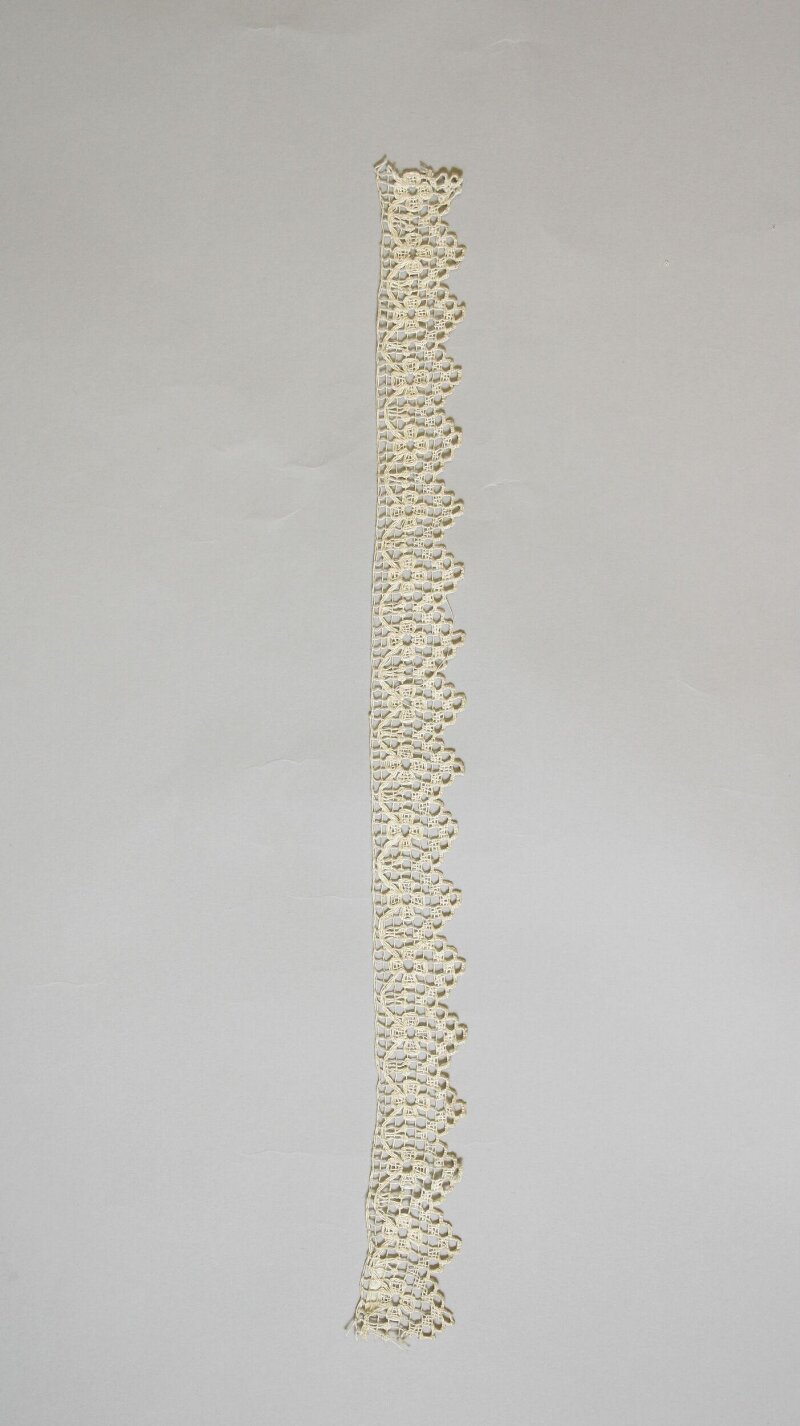
Archaeological Deconstruction of a 19th-Century French Point de Gaze Lace Fragment for 2026 Couture Translation
I. Provenance and Materiality: The Specimen in Question
The subject of this report is a fragment of Point de Gaze lace, circa 1860–1880, originating from the ateliers of Alençon, France. The specimen measures 12.5 cm x 8.2 cm and was originally part of a wedding veil or a liturgical vestment. Its preservation is exceptional, with only minor oxidation of the silver-gilt thread used in the broderie anglaise elements. The base material is a continuous filament Bombyx mori silk, degummed and bleached to a matte ivory tone. The tactile quality is one of paradoxical rigidity and airiness—a structural paradox that defines the highest echelons of needlelace.
The materiality of this fragment speaks to a pre-industrial tension: the silk threads, twisted to a gauge of approximately 0.2 mm, are worked with a single-needle technique that creates a ground net of hexagonal mesh. The mesh is not woven but built, stitch by stitch, using a buttonhole loop. This is not a fabric; it is a three-dimensional lattice of tension and void. The silver-gilt thread, a filé of silver wire wrapped around a silk core, has tarnished to a charcoal-black in the recesses, creating a chiaroscuro effect that modern digital imaging struggles to replicate. This oxidation is not a flaw but a historical patina, a record of the lace’s environmental journey.
II. Technical Deconstruction: The Grammar of Point de Gaze
To translate this lace into a 2026 silhouette, we must first decode its technical grammar. Point de Gaze is distinguished by its open, airy ground—the réseau—which is composed of hexagonal or octagonal meshes, each side formed by a twisted buttonhole stitch. The fragment exhibits a réseau rosacé (rose ground), where the mesh is punctuated by small picots at the intersections, giving a subtle, floral texture. This ground is the lace’s spatial foundation; its openness dictates the silhouette’s transparency and volume.
The toilé (solid areas) are executed in a dense, satin-like buttonhole stitch, often with a raised cordonnet (a heavier thread outlining the pattern). In this fragment, the cordonnet is a gimp of twisted silk, stitched into place with a fine overcast stitch. The motifs—stylized acanthus leaves and fleur-de-lis—are built in relief, with the cordonnet creating a pronounced three-dimensionality. The interior of each leaf is filled with a point de brides (a series of decorative stitches connecting the motifs to the ground), which here takes the form of tiny, star-shaped picots.
Critically, the lace is not a single layer. Under magnification, a secondary layer of broderie anglaise is visible: small, cut-out ovals and teardrops, each edge finished with a fine overcast stitch and then attached to the main ground with a single, invisible thread. This double-layer construction creates a shadow effect, a depth that cannot be achieved with a single plane of lace. This is the key technical insight for our 2026 translation: the silhouette must exploit layered transparency.
III. Materiality and Structural Integrity: The Physics of Fragility
The silk filament, while strong in tension, is extremely vulnerable to shear stress. The original lace would have been worn over a stiffened understructure—a corset or a crinoline—to prevent the mesh from collapsing under its own weight. The silver-gilt thread, though decorative, adds significant mass and stiffness. The fragment’s current state shows a slight cupping (curvature) along the edges, a result of the differential shrinkage between the silk and the metal thread over 160 years.
For a 2026 silhouette, we cannot simply replicate this materiality. The lace must be re-engineered for movement. The original’s rigidity is a historical artifact; a modern wearer requires fluidity. The solution lies in hybrid materiality: the silk ground can be replaced with a micro-filament nylon (0.05 mm diameter) that mimics the hand of silk but offers superior tensile strength. The silver-gilt thread can be substituted with a nano-copper alloy, which tarnishes to a controlled, non-corrosive patina, and is applied via a laser-assisted embroidery technique that replicates the hand-stitched cordonnet without the shear stress.
IV. Translation into 2026 Silhouettes: The Couture Archaeology Method
The translation from artifact to silhouette is not a direct copy but a structural metaphor. The fragment’s key architectural principles—layered transparency, relief ornamentation, and negative-space ground—inform three distinct silhouettes for the 2026 collection.
Silhouette 1: The “Réseau Rosacé” Gown
This silhouette is a floor-length column dress constructed from two layers of the re-engineered lace. The outer layer features the réseau rosacé ground, laser-cut from a single piece of the nylon-copper hybrid fabric. The hexagonal mesh is enlarged to a 5 mm aperture, creating a bold, architectural grid. The inner layer is a solid, matte silk charmeuse, dyed to the ivory of the original. The relief motifs—the acanthus leaves—are applied as separate, embroidered panels, attached only at the shoulders and hem, allowing them to float over the body. The silhouette is rigid at the shoulders (a nod to the crinoline structure) and fluid at the hem, achieved by a gradual reduction in the mesh density from top to bottom. The effect is a walking architecture: the lace moves, but the pattern holds its form.
Silhouette 2: The “Point de Brides” Bodysuit
This is a second-skin bodysuit that translates the point de brides (decorative connecting stitches) into a structural system. The bodysuit is constructed from a laser-cut leather base, perforated with the star-shaped picot pattern. The perforations are not decorative but functional: they are the attachment points for a secondary layer of the silver-copper alloy thread, which is hand-stitched (using a modern, flexible needle) into the leather to create a three-dimensional web over the torso. This web mimics the brides of the original, connecting the solid leather panels with floating, metallic lines. The silhouette is armored yet transparent, a tension between protection and exposure. The bodysuit is intended to be worn under a sheer, unstructured coat—a modern mantua—that echoes the original veil’s drape.
Silhouette 3: The “Double-Layer Shadow” Coat
This silhouette directly exploits the double-layer construction of the original fragment. It is a full-length, oversized coat with a detachable inner cape. The outer shell is made from the re-engineered lace, but with the broderie anglaise elements laser-cut and then re-embroidered onto the surface using a raised, silicone-coated thread that replicates the original’s relief without the weight. The inner cape is a sheer, silk organza printed with a digital scan of the fragment’s oxidation pattern—the charcoal-black tarnish becomes a graphic, abstract print. When the cape is worn, the shadow of the print interacts with the lace’s actual voids, creating a dynamic, moiré effect as the wearer moves. The coat’s silhouette is architectural and voluminous, with a stiffened, rolled collar that references the original’s liturgical origin. The hem is left raw, allowing the nylon threads to fray slightly—a deliberate nod to the archaeological fragment.
V. Conclusion: The Future of the Fragile
The Point de Gaze fragment is not a relic to be copied but a blueprint for a new material language. Its technical grammar—layered transparency, relief ornamentation, and negative-space ground—offers a lexicon for 2026 couture that is both historically rooted and technologically forward. The translation process is one of structural empathy: understanding the physics of the original’s fragility and then re-engineering that fragility into a controlled, intentional strength. The three silhouettes proposed here are not costumes but wearable archaeological sites, where the past is not preserved but activated—made to move, to breathe, and to cast new shadows. The lace lives, not in a museum case, but on the body, in the light of 2026.