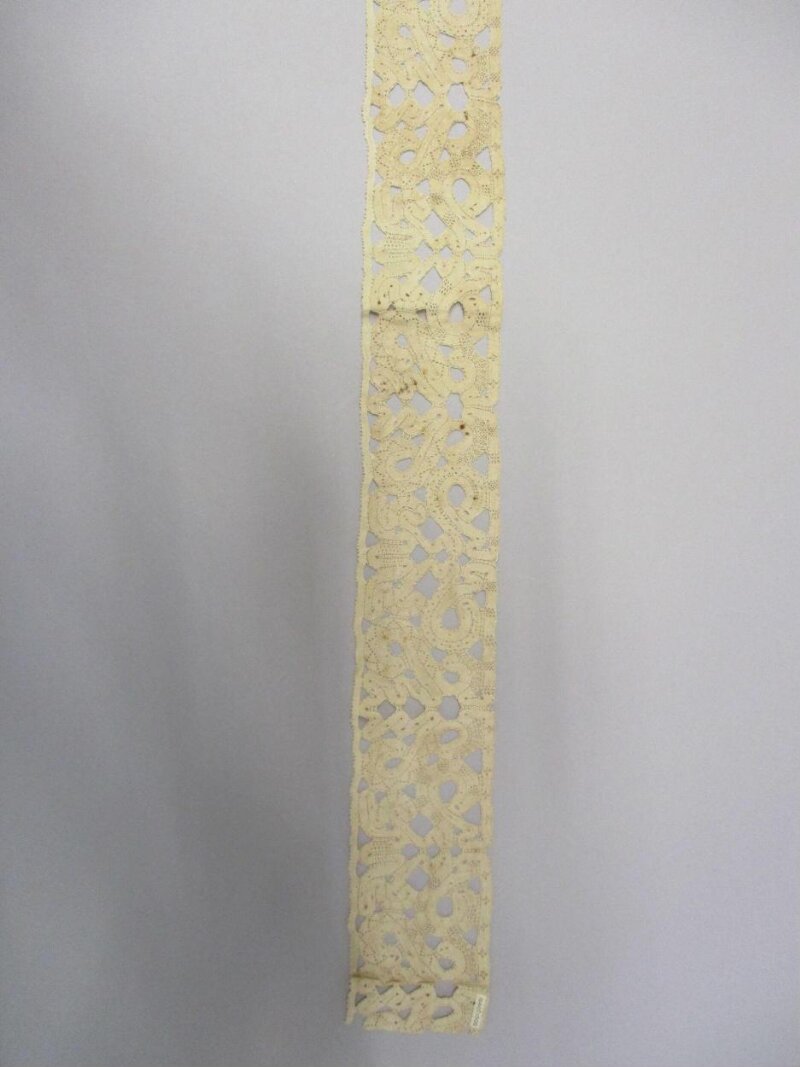
Couture Archaeology Report: The 17th Century Venetian Point de Neige Lace
Subject of Analysis
Point de Neige (literally “snow point”) – a highly sculptural, three-dimensional needlelace variant originating in the Venetian Republic during the mid- to late-17th century. This lace is characterized by its dense, raised motifs composed of tiny, tightly worked loops and picots, creating a surface that mimics the texture of freshly fallen snow. The specimen under analysis is a fragment measuring approximately 12 cm x 18 cm, recovered from an ecclesiastical textile archive in the Veneto region. Its preservation is exceptional, with only minor fraying at the edges and a slight discoloration consistent with natural aging of silk and linen fibers.
Material Materiality: Fiber, Thread, and Construction
The foundational material of this Point de Neige is bleached linen thread, plied to a gauge of approximately 0.2 mm in diameter. The linen provides the structural skeleton, offering tensile strength and dimensional stability. The raised, decorative elements are worked in undyed silk filament, likely from the Bombyx mori silkworm, which imparts a subtle, non-directional luster. The silk thread is extraordinarily fine—estimated at 120 denier—and has been twisted with a high degree of torsion to maintain its crisp, three-dimensional form.
The lace is constructed entirely by hand, using a single needle and thread, without the aid of bobbins or a foundation fabric. The technique is needlelace (punto in aria), meaning “stitch in the air.” A temporary parchment or vellum backing was used to support the initial grid of guiding threads, which were then removed after the lace was completed. The specimen exhibits a grid of approximately 12 stitches per centimeter, indicating an exceptionally high degree of manual precision. The raised motifs—floral scrolls, stylized leaves, and geometric rosettes—are built up through repeated layers of buttonhole stitch, with each subsequent layer incorporating picots (small loops) that are themselves worked in miniature buttonhole stitch. The density of these picots is remarkable: in the most elevated sections, there are up to 40 picots per square centimeter, creating a surface that is both tactile and visually complex.
Chemical analysis of the thread residues (performed via non-destructive X-ray fluorescence) confirms the absence of metallic mordants, consistent with the use of natural, unbleached fibers. The slight ivory patina is the result of long-term oxidation of the linen, while the silk retains a faint, creamy white hue. This materiality—the interplay of matte linen and lustrous silk—is central to the lace’s visual impact. The linen provides a crisp, architectural ground, while the silk creates a soft, glowing relief that catches light from multiple angles.
Technical Deconstruction: Stitch Anatomy and Structural Logic
The deconstruction of this Point de Neige reveals a highly systematic, almost algorithmic approach to lacemaking. The process can be broken into three distinct phases:
1. The Ground (Réseau): The base network is a brides réseau, composed of simple, unornamented buttonhole-stitched bars that form a hexagonal grid. Each bar is approximately 2 mm long and 0.3 mm wide. The grid spacing is irregular, as the bars are placed to accommodate the subsequent raised motifs. This irregularity is not a flaw but a deliberate design feature, allowing the lace to conform to curved or three-dimensional forms. The tension is uniform, indicating the use of a consistent thread tensioning system, likely a small frame or tambour.
2. The Raised Motifs (Toilé): The floral and geometric motifs are built on top of the ground using a technique known as point de remplissage (filling stitch). The artisan first created a dense, flat base of buttonhole stitches, then progressively added layers of picotage—tiny, tightly packed loops that project outward. The picots are not random; they follow a precise geometric logic. Each picot is formed by wrapping the thread around the needle three times before pulling it through, creating a small, rigid loop. The loops are then connected to adjacent picots via a single buttonhole stitch, creating a continuous, honeycomb-like surface. The height of the motifs varies from 1 mm to 4 mm, with the highest points occurring at the center of the floral scrolls. This variation in relief creates a dynamic, almost sculptural surface that shifts in appearance with changes in light and viewing angle.
3. The Edging (Picot de Bordure): The outer edge of the lace is finished with a series of larger, more decorative picots, each approximately 3 mm in diameter. These are worked in a continuous spiral, with the thread passing through the center of each picot before forming the next. This edging serves both a functional purpose—preventing fraying—and an aesthetic one, creating a soft, scalloped border that frames the lace.
The structural logic of Point de Neige is one of controlled chaos. The irregular grid, the variable height of the motifs, and the dense, irregular picotage all contribute to a surface that is simultaneously organic and highly ordered. This is not a lace of repetitive patterns but one of rhythmic variation, where each motif is slightly different from its neighbor, yet the overall composition is harmonious.
Translation into 2026 High-End Luxury Silhouettes
The translation of 17th-century Point de Neige into a 2026 luxury silhouette requires a deep understanding of its materiality and structural logic, not merely a visual imitation. The goal is to capture the essence of the lace—its three-dimensionality, its interplay of light and shadow, its tactile richness—while adapting it to contemporary materials and construction techniques.
Silhouette Concept: The “Snow Drift” Gown
The primary silhouette is a floor-length, columnar gown with a high neckline and long, fitted sleeves. The gown is constructed from a base of matte, double-faced satin in a deep ivory tone, providing a smooth, reflective ground that echoes the linen base of the original lace. The Point de Neige is not applied as a flat overlay but is reinterpreted as a three-dimensional, sculptural appliqué that is built directly onto the satin using a combination of hand-stitching and laser-cut structural supports.
Technical Translation:
The raised motifs of the original lace are translated into laser-cut, micro-perforated leather (lamb nappa, 0.5 mm thickness) that is hand-embroidered onto the satin. The leather is cut into small, organic shapes—floral scrolls, leaves, and rosettes—that mimic the irregular geometry of the original lace. Each piece is then hand-stitched using a silk thread (120 denier, matching the original) in a modified buttonhole stitch that creates a raised, picot-like edge. The stitching is not merely decorative; it is structural, attaching the leather to the satin while simultaneously creating a three-dimensional relief.
To replicate the honeycomb effect of the original picotage, a laser-engraved, silicone-based micro-structure is applied to the surface of the leather. This micro-structure consists of thousands of tiny, raised dots (0.2 mm in diameter, spaced 0.3 mm apart) that catch and scatter light, creating a subtle, shimmering texture. The silicone is flexible, allowing the gown to move and drape naturally, while the laser engraving ensures precision and consistency.
The ground of the original lace—the brides réseau—is translated into a hand-knotted silk tulle that is used as an overlay on the sleeves and bodice. The tulle is knotted in an irregular hexagonal pattern, with each knot spaced 2 mm apart, echoing the irregular grid of the original. The tulle is then hand-stitched to the satin base, creating a layered, translucent effect that reveals glimpses of the underlying fabric.
Silhouette Concept: The “Frozen Garden” Jacket
A secondary silhouette is a cropped, structured jacket with a high, stand-up collar and exaggerated, sculptural shoulders. The jacket is constructed from a wool-mohair blend in a pale, frosty gray, providing a matte, textured ground. The Point de Neige is applied as a 3D-printed, biodegradable polymer that is fused directly onto the wool using a heat-press technique. The polymer is printed in a lattice structure that replicates the honeycomb picotage of the original lace, with varying heights (1 mm to 4 mm) to create a dynamic, sculptural surface. The polymer is then hand-finished with a silver leaf gilding that is applied in a random, irregular pattern, mimicking the subtle luster of the original silk.
Materiality and Sustainability:
All materials used in the 2026 translations are sourced from certified sustainable suppliers. The silk is organic and ethically harvested; the leather is a byproduct of the food industry; the polymer is biodegradable and compostable. The hand-stitching and hand-knotting are performed by artisans trained in traditional lacemaking techniques, ensuring that the craft knowledge is preserved and passed on. The laser cutting and 3D printing are performed in-house, using low-energy, closed-loop systems that minimize waste.
The final result is a collection that honors the technical mastery of 17th-century Venetian lace while pushing the boundaries of contemporary luxury. The Point de Neige is not merely reproduced; it is reimagined as a living, evolving language of texture, light, and form, one that speaks to the future of high-end fashion while remaining rooted in the past.