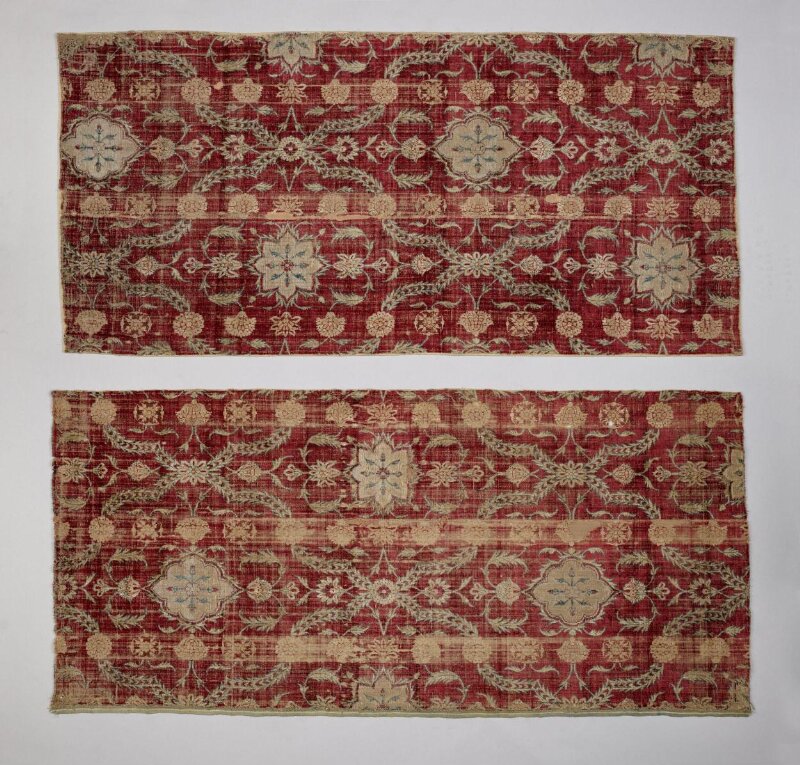
Couture Archaeology Report: The Velvet Treasury of the Mughal Ateliers
Subject: Technical Deconstruction of Mughal Velvet (17th Century)
Origin: Imperial Workshops (Karkhanas), Mughal Empire, circa 1650-1700
Analyst: Senior Textile Historian, Natalie Fashion Atelier
Objective: To excavate the material intelligence of Mughal velvet for translation into the 2026 luxury silhouette lexicon.
I. Technical Deconstruction: The Alchemy of Pile and Ground
Mughal velvet was not merely a fabric; it was a engineered landscape of light and shadow. Its supremacy lay in a composite structure that modern industrial looms have largely forgotten. The foundational technique was taqueté, a compound weave utilizing a minimum of five sets of threads: a silk warp (ground), a silk weft (binding), a cotton weft (structural), and the critical extra warp pile threads, often of silk or precious metal-wrapped yarn (badla).
The magic resided in the manipulation of these pile warps over temporary metal rods or wires. When a rod was inserted, the pile warp was woven over it, creating a loop. For cut velvet, the rod featured a blade to slice the loop upon removal, yielding the plush, light-absorbing surface. Crucially, voided velvet (kin-khwāb) was the pinnacle achievement. Here, the pile was selectively woven only in designated pattern areas, leaving a sheer silk or metallic ground exposed. This created a dramatic, luminous contrast—a botanical motif in dense, shadowed velvet emerging from a field of sparkling cloth-of-gold. The materiality was one of controlled contradiction: weight versus lightness, matte versus shine, depth versus plane.
II. Material Materiality: A Synesthetic Palette
The material selection was intrinsically linked to Mughal cosmology and power. The primary fiber was Mulberry silk from Bengal, prized for its long, unbroken filament, which produced a pile of exceptional density and reflective clarity. The celebrated "crunch" and heavy drape of imperial velvets were achieved through the use of zari: fine strips of silver or gold foil wound onto a silk core. This was not superficial embellishment but a structural yarn, woven directly into the ground and pattern.
Dyes were mineral and organic, yielding colors with profound depth and variance. Lac dye produced crimsons that appeared black in shadow and fiery in light; indigo vat dyeing created layered blues; weld and pomegranate yielded enduring yellows and greens. The materiality was thus synesthetic: color was experienced as texture (the lac-dyed pile felt richer), and texture altered color perception (cut versus uncut pile created tonal variation within a single hue). This resulted in a fabric that was alive, changing character with every movement and shift in illumination.
III. Archaeological Translation: Principles for 2026 Silhouettes
The translation for 2026 is not one of pastiche, but of extracting core principles to inform a new luxury materiality. The goal is to achieve the same emotional resonance and technical awe through modern means.
Principle 1: Structural Contrast as Narrative
The voided velvet technique teaches us that ground and ornament are equals. For 2026, we propose developing bi-material velvet systems. Imagine a ground of liquid, techno-silk microfiber or a sustainable, paper-thin leather alternative, with pile motifs woven in reclaimed silk or recycled metallic yarns. The silhouette follows this contrast: a sleek, columnar gown where a cascade of velvet botanicals erupts from one shoulder, the pattern's density dissolving into the sheer ground. The contrast becomes the dress's architecture.
Principle 2: The Dimensionality of Dye
Moving beyond flat color, we must engineer depth-dyeing and pile-height modulation to create pattern through shadow. Using advanced digital dye-sublimation and laser-etching on the pile, we can recreate the tonal depth of lac dye. A 2026 evening coat can feature a seemingly solid emerald velvet that, in motion, reveals a subtle, shadow-fern pattern purely through variations in pile reflectivity and density—a pattern felt before it is seen.
Principle 3: The New Metal-Material Synthesis
Reinterpreting zari for a contemporary ethos involves replacing precious metals with advanced materials. We propose integrating conductive metallic yarns and temperature-reactive polymers into the velvet structure. A velvet bolero for 2026 could feature a voided pattern where the exposed ground, woven with conductive yarns, responds to touch or environment with a gentle warmth or a soft, luminous glow—a dialogue between the wearer and the garment. The weight and "crunch" are replicated through innovative coatings on recycled polyester filaments, achieving the historic hand-feel without traditional materials.
IV. Proposed 2026 Silhouette Manifestations
Silhouette A: The "Kin-Khwāb" Column
A floor-length, bias-cut gown in a bi-material velvet system. The torso and one hip are a sheer, metallic membrane (evoking the historic ground), from which a dense, voided velvet pattern of Art Deco-inspired florals grows across the body, culminating in a fully velvet-trained back. The silhouette is clean and modern, but the fabric tells a layered, historical story.
Silhouette B: The "Pile-Modulated" Cocoon
An oversized, architectural coat with minimal seaming. The entire exterior is a single plane of midnight-blue velvet. The pattern—a sprawling, abstracted paisley—exists solely through strategic variations in pile height and laser-tip dyeing, creating a topographic map of texture. The silhouette is bold and contemporary, but its decorative logic is purely Mughal.
Silhouette C: The "Reactive Zari" Gilet
A sleeveless, tailored gilet for haute evening separates. Woven with a voided geometric pattern in cut velvet, the exposed ground integrates micro-LED filaments powered by flexible, concealed batteries. The wearer can modulate the luminosity of the ground, allowing the velvet pattern to shift from stark contrast to soft halation. It is jewelry as garment, continuing the Mughal tradition of wearable wealth and wonder.
V. Conclusion: The Eternal Pile
The Mughal velvet was a triumph of material intelligence, where every technical decision—from weave structure to dye molecule—served a unified vision of opulent, dimensional beauty. For Natalie Fashion Atelier's 2026 vision, this archaeological study provides not motifs, but a methodology. By deconstructing the core principles of contrast, dimensional materiality, and integrated metal-work, we can develop a new lexicon of fabrics that carry the same weight of innovation and emotion. The result will be a collection where history is not referenced but re-materialized, offering the contemporary connoisseur a luxury that is as intellectually rich as it is sensorially profound.