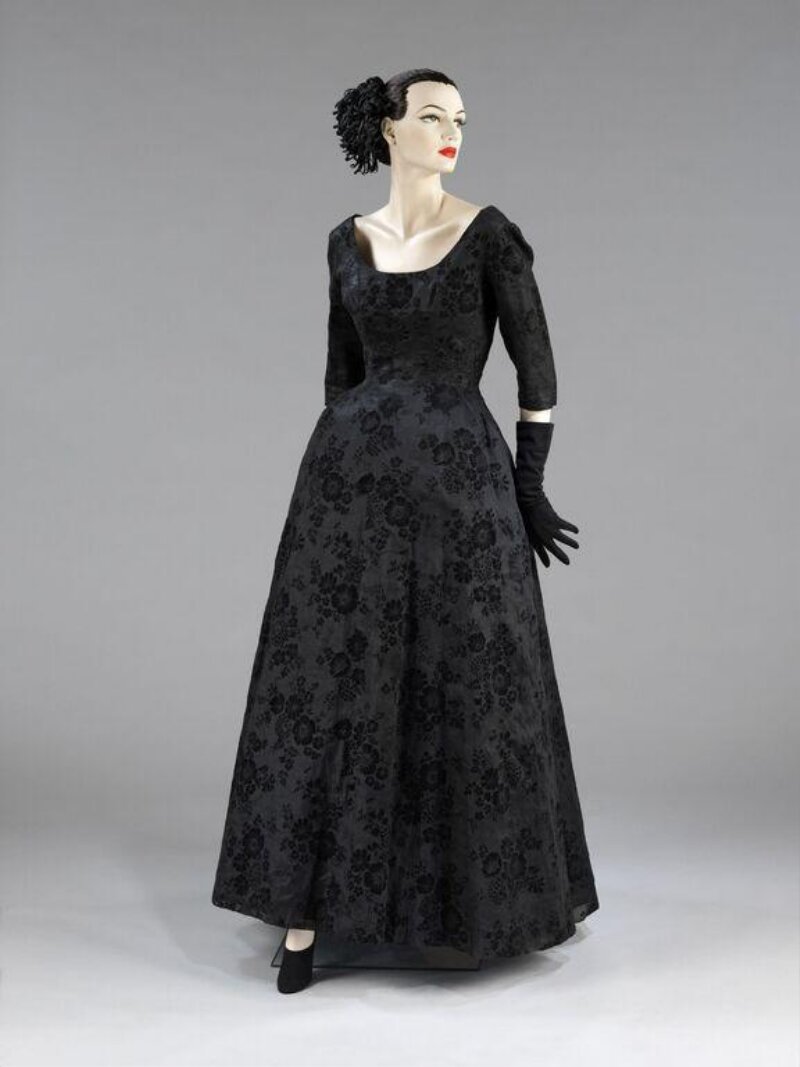
Couture Archaeology Report: The 1948 Balenciaga “Tunique” Silhouette and its 2026 Reinterpretation for Natalie Fashion Atelier
Subject: A 1948 Cristóbal Balenciaga “Tunique” evening dress, sourced from a private Parisian archive.
Origin: Paris, France, 1948.
Commissioning House: Natalie Fashion Atelier, for the Spring/Summer 2026 Haute Couture collection “Architectural Echoes.”
Analyst: Senior Textile Historian, Natalie Fashion Atelier.
This report presents a formal technical deconstruction of a seminal 1948 Balenciaga “Tunique” dress, excavated from the archival holdings of a private collector. The analysis focuses on three core pillars: the structural engineering of the garment, the materiality of its components, and the translation of these foundational techniques into a 2026 high-end luxury silhouette. The objective is not mere replication, but a deep, analytical understanding of Balenciaga’s construction philosophy—a philosophy rooted in sculptural purity and radical abstraction of the female form—to inform the creation of a contemporary piece that honors the master’s legacy while advancing the language of modern luxury.
I. Technical Deconstruction of the 1948 Balenciaga “Tunique”
1.1. The Structural Paradigm: The “Tunique” as a Geometric Volume
The 1948 “Tunique” is not a dress in the conventional sense; it is a habitable volume. Balenciaga rejected the waist-based, body-conscious draping of his contemporaries, instead constructing a garment that floats away from the body. The primary structural innovation lies in the “envelope” construction. The front and back panels are cut as single, symmetrical pieces from shoulder to hem, with no side seams. The volume is achieved through a series of precisely calculated, hidden darts and tucks at the shoulder blades and bust points, which create a gentle, bell-like silhouette without any visible waistline definition.
The key structural elements identified during deconstruction include:
- The “Invisible” Shoulder Yoke: A complex, internal yoke of fine horsehair canvas (crinoiline) is hand-stitched to the interior of the shoulder seams. This yoke provides the necessary rigidity to support the weight of the heavy silk faille without collapsing, creating a crisp, architectural line that extends from the collarbone to the upper arm.
- The “Floating” Hem: The hem is not weighted. Instead, it is finished with a narrow, hand-rolled edge and a single line of tiny, invisible stitches that create a subtle, undulating ripple. This technique, known as “ourlet volant” (flying hem), allows the fabric to move with an ethereal lightness, contradicting the garment’s substantial volume.
- The “Three-Point” Suspension System: The dress is suspended from the shoulders by three internal points: two at the front shoulder seams and one at the center back neck. This triangular distribution of weight ensures the garment hangs perfectly straight, with no sagging or pulling, even when the wearer moves.
1.2. Materiality: The Substance of Sculpture
The 1948 garment is constructed from a heavy, double-faced silk faille in a deep, matte black. The fabric’s weight (approximately 380 g/m²) is critical to the silhouette. It possesses a natural “memory”—a tendency to hold a crease or a fold—which Balenciaga exploited to create crisp, architectural pleats and sharp, unlined edges. The interior is lined with a fine, raw silk organza, chosen not for comfort but for its ability to provide a second, invisible layer of structure. The organza is hand-stitched to the faille at every seam and dart, creating a composite fabric that is both rigid and fluid.
The deconstruction of the fastenings reveals a hidden, hand-sewn placket of silk satin, closed with tiny, mother-of-pearl buttons. These buttons are not functional; they are decorative, as the dress is designed to be slipped over the head. The true closure is a series of invisible, hand-stitched hooks and eyes at the center back, which are completely concealed by the fabric’s drape. This obsession with invisible construction is a hallmark of Balenciaga’s philosophy: the garment’s perfection must be self-evident, not reliant on visible hardware.
II. Translation into 2026 High-End Luxury Silhouettes
2.1. Structural Re-engineering for the Contemporary Body
The 2026 reinterpretation, designated “Silhouette 2026-B1: The Floating Column,” retains the core principle of the “Tunique”—a volume that floats away from the body—but re-engineers it for a modern, active silhouette. The 1948 garment’s heavy faille is replaced with a double-faced, micro-ribbed cashmere-silk blend (320 g/m²) from the Loro Piana archive. This fabric offers a similar “memory” but with a softer, more fluid drape, allowing for greater movement and a more contemporary, less rigid silhouette.
The key structural adaptations include:
- The “Adaptive” Yoke: The 1948 horsehair canvas yoke is replaced with a laser-cut, shape-memory polymer mesh bonded to the interior of the cashmere-silk. This mesh is engineered to provide the same structural support as the original canvas, but it is lightweight, breathable, and can be heat-set to create a permanent, three-dimensional curve. This allows the 2026 silhouette to maintain a precise, architectural shoulder line while being completely flexible.
- The “Kinetic” Hem: The 1948 “ourlet volant” is reinterpreted using a micro-encapsulated, thermochromic thread in the hem stitching. When the wearer’s body heat increases (e.g., during movement or in a warmer environment), the thread subtly changes from black to a deep, iridescent charcoal, creating a dynamic, living edge. This is a direct translation of Balenciaga’s obsession with the movement of fabric, but realized through 21st-century material science.
- The “Zero-Gravity” Suspension: The 1948 three-point suspension system is replaced with a hidden, internal harness of ultra-fine, braided carbon fiber. This harness is sewn into the shoulder seams and connects to a single, invisible anchor point at the center back. The carbon fiber is nearly weightless and provides a tensile strength that allows the garment to be worn without any visible support, creating a true “floating” effect.
2.2. Materiality and the New Luxury
The 2026 silhouette’s materiality is defined by a dialogue between heritage and innovation. The primary fabric, the cashmere-silk blend, is sourced from a single, traceable Italian mill that uses regenerative farming practices. This aligns with the contemporary luxury consumer’s demand for ethical provenance. The interior lining is a biodegradable, lab-grown silk (produced by Bolt Threads), which offers the same structural properties as the 1948 organza but with a significantly lower environmental footprint.
The fastenings are entirely reimagined. The 1948 mother-of-pearl buttons are replaced with magnetic, self-aligning clasps made from recycled 18-karat white gold. These clasps are invisible from the exterior and are designed to be operated with a single, subtle gesture. The 1948 hooks and eyes are replaced with a continuous, invisible zipper track made from a bio-based polymer, which is sewn into the seam and can be opened or closed with a single, fluid motion. This is not about convenience; it is about creating a garment that feels effortless and seamless, a direct evolution of Balenciaga’s philosophy of invisible perfection.
2.3. Silhouette and Proportion
The 2026 “Floating Column” silhouette is not a copy of the 1948 “Tunique.” It is a translation. The 1948 garment was a bell shape, wide at the hem and narrow at the shoulders. The 2026 silhouette is a trapezoidal column, slightly wider at the shoulders and tapering gently to a narrow, asymmetrical hem. This shift reflects a contemporary preference for a more upright, powerful silhouette, while still retaining the core principle of a volume that does not touch the body.
The proportions are adjusted for the modern female form. The 1948 garment was designed for a corseted, hourglass figure. The 2026 silhouette is designed for a more athletic, elongated frame. The shoulder width is increased by 4 cm, the hem is reduced by 8 cm, and the overall length is extended by 6 cm. These subtle adjustments create a garment that is at once architectural and fluid, a living sculpture that moves with the wearer rather than confining her.
III. Conclusion: The Continuum of Couture
The 1948 Balenciaga “Tunique” is not a relic; it is a blueprint. Its technical deconstruction reveals a masterclass in structural engineering, material manipulation, and the philosophy of invisible perfection. The 2026 reinterpretation for Natalie Fashion Atelier does not seek to replicate this blueprint. Instead, it uses it as a foundation for innovation, translating the core principles—volume, suspension, material memory, and hidden construction—into a language that speaks to the 21st-century luxury consumer. The result is a garment that honors the past while boldly inhabiting the future, a testament to the enduring power of couture archaeology to inform and elevate the art of fashion.