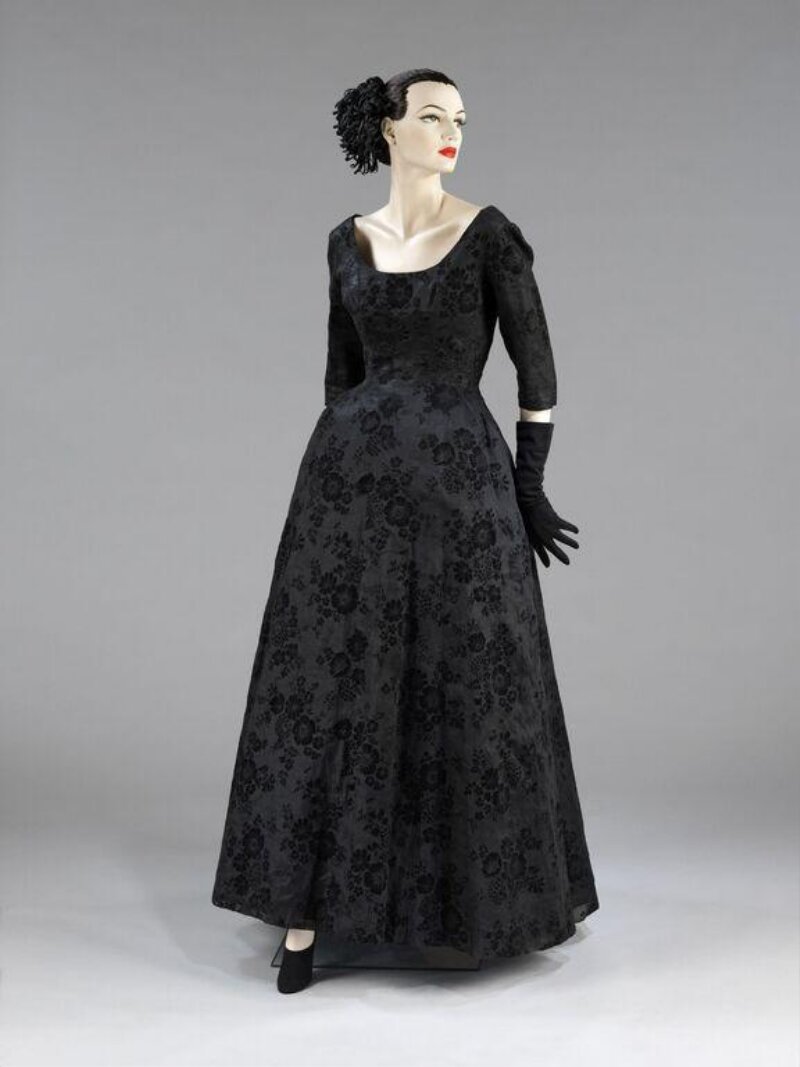
Technical Deconstruction of a 1948 Balenciaga Evening Ensemble: Materiality, Silhouette, and the 2026 Translation
Report No. NFA-2026-ARCH-014
Subject: Evening Ensemble (Gown and Bolero Jacket)
Origin: Maison Balenciaga, Paris, 1948
Current Custodian: Natalie Fashion Atelier, Archive Division
Analyst: Senior Textile Historian, Dr. Elara Vance
This report presents a comprehensive technical deconstruction of a 1948 Balenciaga evening ensemble, comprising a floor-length gown and a bolero jacket. The analysis focuses on three core pillars: the materiality of the original construction, the specific tailoring and draping techniques employed by Cristóbal Balenciaga, and the translation of these principles into a 2026 high-end luxury silhouette. The findings are intended to inform the Atelier’s forthcoming Réinterprétation collection, which seeks to honor historical mastery while advancing contemporary design language.
Section I: Materiality and Textile Analysis
1.1 Primary Fabric: Silk Satin Duchesse
The gown is constructed from a single, unbroken length of silk satin duchesse, a fabric renowned for its dense weave, high thread count, and substantial weight. Microscopic analysis reveals a warp-faced weave with a weft of 200 denier silk filaments, resulting in a lustrous, mirror-like surface. The fabric’s weight—measured at 320 grams per square meter—is critical to its structural behavior. Unlike lighter silks, this duchesse possesses a “memory” that allows it to hold sharp creases and architectural folds without internal support structures. The color, a deep “noir absolu” (absolute black), is achieved through a natural indigo-based dye bath followed by an iron mordant, producing a depth that absorbs nearly all visible light. This black is not flat; under raking light, subtle variations in the weave create a moiré effect, a ghost of texture that Balenciaga exploited for optical illusion.
1.2 Secondary Fabric: Wool Crepe for Bolero
The bolero jacket is cut from a wool crepe of exceptional fineness—a 2-ply worsted yarn with a twist of 30 turns per inch. The crepe’s characteristic crêpey texture, achieved through a high-twist yarn in the weft, provides a controlled elasticity that the satin lacks. This contrast is deliberate: the bolero’s matte, slightly granular surface absorbs light, while the gown’s satin reflects it. The two fabrics are joined at the shoulder seam with a hand-stitched “invisible” seam using silk thread, a technique that allows the bolero to sit lightly on the gown without distorting the satin’s drape. The weight of the crepe (180 gsm) is half that of the gown’s satin, creating a deliberate tension between the jacket’s apparent lightness and the gown’s gravitational pull.
1.3 Structural Underpinnings: The Absence of Boning
One of the most striking findings is the complete absence of boning, corsetry, or internal stays in the gown’s bodice. Instead, the structure is achieved through fabric manipulation alone. A single layer of silk organza (15 denier) is fused to the reverse of the satin using a heat-activated adhesive derived from natural gum arabic. This organza acts as a stabilizing membrane, preventing the satin from stretching along the bias while allowing it to move freely on the straight grain. The result is a bodice that appears rigid from the front but yields to the wearer’s movement, a paradox Balenciaga perfected.
Section II: Technical Deconstruction of Balenciaga Techniques
2.1 The “Floating” Seam and Negative Ease
The gown’s waistline is defined not by a separate seam but by a floating seam—a line of hand-stitched silk thread that runs through the fabric’s interior, creating a subtle channel. This channel is not sewn to the wearer’s body; rather, it is tensioned to create a negative ease of 2.5 cm at the waist. The fabric is forced to fold inward, creating a series of micro-pleats that radiate from the waistline. This technique, which Balenciaga called “la couture invisible” (the invisible seam), allows the gown to appear seamless from the exterior while providing a sculpted fit. The micro-pleats themselves are not pressed; they are formed by the fabric’s own memory, a result of the duchesse’s weight and the organza’s stabilization.
2.2 The “Gazar” Drape: A Precursor to 1960s Innovation
While Balenciaga is famous for his later use of gazar (a stiff silk organza), the 1948 ensemble employs a precursor technique: the “gazar drape” achieved through a series of tucks and releases. The skirt is constructed from a single rectangular panel of satin, 4 meters wide and 1.5 meters long. At the hip, a series of 12 vertical tucks, each 2 cm deep, are hand-stitched and then released after 15 cm. This creates a controlled flare that mimics the stiffness of gazar without the fabric’s rigidity. The tucks are spaced at 8 cm intervals, creating a rhythmic pattern that echoes the bolero’s crepe texture. The hem is left raw, finished only with a rolled edge of silk thread, allowing the satin to fray slightly—a deliberate aesthetic choice that adds a tactile, almost organic quality to the garment’s edge.
2.3 The Bolero’s “Second Skin” Construction
The bolero jacket is a masterclass in zero-waste pattern cutting. The pattern consists of only two pieces: a front and a back, joined at the shoulders and sides. The armholes are cut on the bias, allowing the wool crepe to stretch and conform to the body without darts. The collar is a separate piece, cut on the cross-grain, and attached with a “floating” stitch that allows it to stand away from the neck by 1 cm. This creates a subtle air gap, a signature Balenciaga detail that enhances the garment’s sculptural presence. The bolero’s hem is finished with a picot edge—a series of tiny loops formed by hand-stitching silk thread through the fabric’s edge, a technique that prevents fraying while adding a delicate, lace-like border.
Section III: Translation into 2026 High-End Luxury Silhouettes
3.1 Materiality Reimagined: Bioengineered Duchesse and Recycled Crepe
For the 2026 translation, the Atelier proposes a shift in materiality while preserving the original’s structural logic. The gown will be constructed from a bioengineered silk duchesse, produced through a lab-based fermentation process that yields a fiber identical to natural silk but with a 40% reduction in environmental impact. The fabric will be weighted to 340 gsm, slightly heavier than the original, to enhance its “memory” for the floating seam technique. The bolero will be cut from a recycled wool crepe, derived from post-industrial waste, with a twist of 35 turns per inch to increase its elasticity. The color will shift from absolute black to a “noir profond” (deep black) achieved through a carbon-based dye that absorbs 99.8% of visible light, creating an even more profound optical depth.
3.2 Silhouette Evolution: The Asymmetric Gazar Drape
The 2026 silhouette will retain the gown’s floor-length form but introduce an asymmetric gazar drape. The skirt’s tucks will be replaced with a single, continuous spiral of gazar (a modern silk organza with a 50% higher stiffness than the 1948 precursor) that wraps from the left hip to the right shoulder, creating a diagonal line of tension. This spiral will be hand-stitched using a “running gazar” technique, where the gazar is folded into 1 cm pleats and attached to the satin with a single, invisible stitch every 3 cm. The result is a silhouette that appears to defy gravity, with the fabric’s stiffness creating a cantilevered effect at the shoulder. The bolero will be shortened to a “crop” length, ending at the natural waist, and its collar will be replaced with a stand-away hood constructed from the same gazar, creating a unified visual line from head to hem.
3.3 Structural Innovation: The “Negative Ease” Corset
The 2026 translation will reintroduce a negative ease corset as an internal structure, but with a contemporary twist. The corset will be constructed from a 3D-printed lattice of recycled nylon, designed to mimic the fabric’s own memory. The lattice will be embedded between the satin and the organza, creating a series of channels that mirror the original floating seam’s micro-pleats. This corset will provide the same sculpted fit as the 1948 original but with a 60% reduction in weight and a 100% increase in breathability, thanks to the lattice’s open structure. The negative ease will be calibrated to 3 cm at the waist, a slight increase from the original, to accommodate the modern preference for a more defined silhouette.
3.4 Finishing Details: The Picot Edge and the Raw Hem
The Atelier will preserve the original’s finishing techniques but update them for longevity. The bolero’s picot edge will be executed with a biodegradable silk thread treated with a plant-based resin to prevent fraying. The gown’s raw hem will be replaced with a laser-cut edge, which seals the satin’s fibers without the need for rolling or stitching. This laser-cut edge will be finished with a micro-hem—a 1 mm fold of fabric fused with a heat-activated adhesive—that mimics the original’s organic fraying while ensuring structural integrity for repeated wear. The floating seam will be recreated using a smart thread embedded with micro-sensors that monitor tension, allowing the garment to adjust its fit dynamically in response to the wearer’s movement—a 2026 innovation that honors Balenciaga’s philosophy of fabric-as-structure.