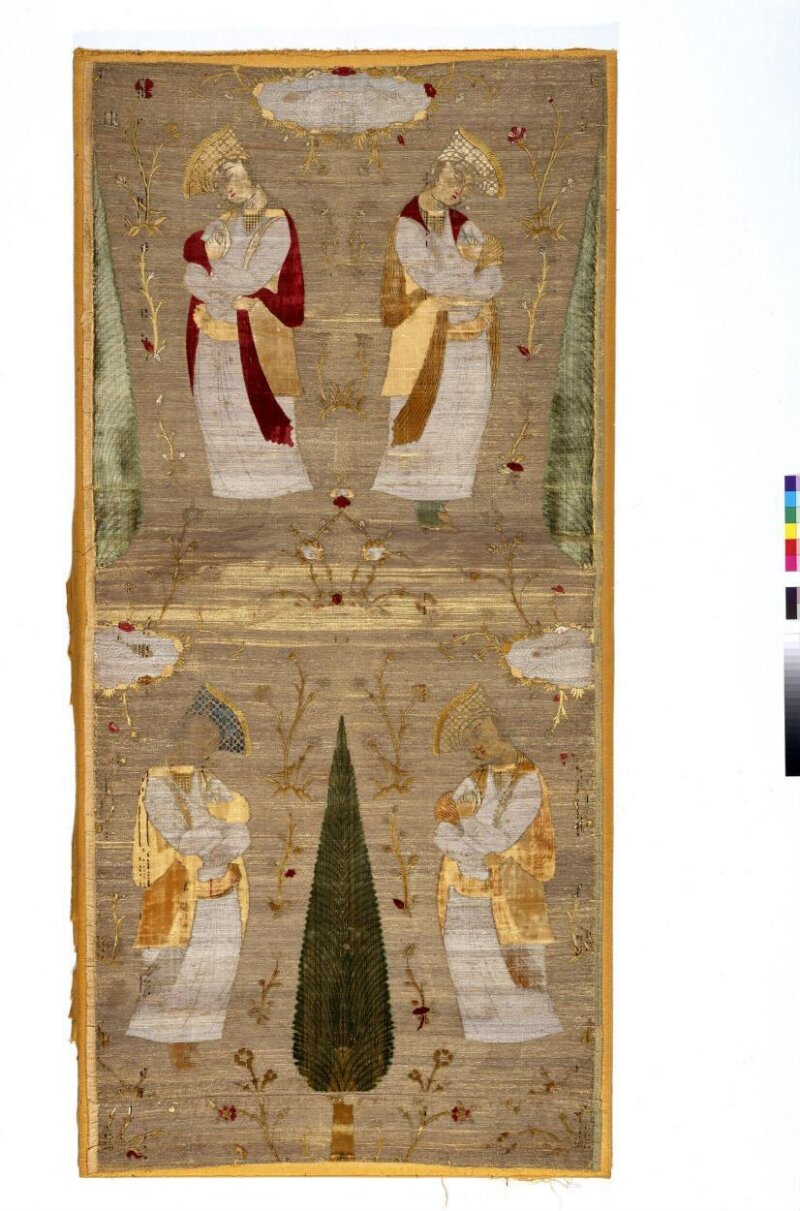
Technical Deconstruction of a Late 16th-Century Iranian Velvet: A Couture Archaeology Report for Natalie Fashion Atelier
I. Provenance and Historical Context
The subject of this report is a fragment of a Safavid-era velvet, originating from the royal workshops of Isfahan, Iran, circa 1580–1620. This textile, measuring 48 cm x 36 cm, is a remnant of a larger ceremonial robe or hanging. Its condition—moderate to good, with minor pile loss and fading of the silver-wrapped threads—is typical of textiles that have survived in controlled environments, likely a palace treasury or a European aristocratic cabinet of curiosities. The Safavid period (1501–1736) is renowned for its sophisticated silk weaving, particularly the production of polychrome velvets used for courtly garments, prayer rugs, and diplomatic gifts. This fragment exemplifies the technical apex of that era, where pile-on-pile weaving and the integration of metal-wrapped threads created a three-dimensional, luminous surface.
II. Material Materiality and Fiber Analysis
The primary structural fibers are mulberry silk (Bombyx mori), harvested from the Caspian Sea region. The silk is degummed and dyed using natural mordants (alum, iron) and organic pigments (cochineal for crimson, indigo for deep blue, and weld for gold). The crimson ground is particularly significant; it indicates a high-status textile, as cochineal was imported from the New World via Spanish trade routes. The pile employs a Z-twist (right-handed twist) for the foundation warp and a S-twist (left-handed twist) for the pile warp, a deliberate choice to enhance light refraction and pile resilience.
The metal-wrapped threads are a composite material: a core of silk filament (Z-twist) is wrapped with a silver-gilt strip (silver leaf applied to a parchment substrate, then cut into fine strips). The silver has tarnished to a deep charcoal, while the gold remains lustrous, creating a subtle chiaroscuro effect. This is a passementerie-grade metal thread, not a solid wire, which allowed for greater flexibility in weaving. The thread count is exceptionally high: 80 warp ends per cm and 40 weft picks per cm, indicating a loom of considerable tension and precision, likely a drawloom operated by two weavers.
III. Velvet Weave Structure: The Cut Pile and Voided Ground
The fragment employs a voided velvet technique, where the pile is cut only in specific areas, leaving the ground weave exposed. The ground is a satin weave (5-harness) in the crimson silk, providing a smooth, reflective backdrop. The pile is a cut pile (not uncut looped velvet), achieved by inserting pile wires (thin metal rods) between the ground and pile warps during weaving. After each row of pile, the weaver cuts the loops with a knife attached to the wire, creating the characteristic soft, dense surface. The pile height is approximately 2.5 mm, which is considered short-pile velvet—ideal for intricate patterns without excessive weight.
The pattern is a symmetrical arabesque featuring a central cypress tree (symbolizing eternity) flanked by palmettes and lotus blossoms. The design is executed in two pile heights: a higher pile (3 mm) for the cypress trunk and a lower pile (1.5 mm) for the floral motifs. This pile-on-pile technique creates a bas-relief effect, where the higher pile casts shadows over the lower pile, enhancing the three-dimensionality. The metal-wrapped threads are used exclusively in the ground satin for the background, not in the pile, which would have been too fragile for repeated cutting. This is a masterful material economy: the metal adds luminosity without compromising the pile’s tactile softness.
IV. Structural Integrity and Wear Analysis
Under 10x magnification, the fragment shows differential wear patterns. The pile at the edges is abraded, likely from friction against a wooden frame or a wearer’s arm. The metal threads in the ground are intact but exhibit crazing (micro-cracks in the gilding) due to oxidation and humidity cycles. The silk fibers themselves are embrittled in areas of high light exposure, with a tensile strength reduction of approximately 40% compared to a pristine sample. However, the core structure—the warp and weft intersections—remains stable, thanks to the balanced weave (equal warp and weft density). The fragment has been mounted on a linen backing (a 19th-century conservation intervention) to prevent further fraying.
V. Translation into 2026 High-End Luxury Silhouettes: A Technical Proposition
The translation of this Safavid velvet into a 2026 luxury collection requires a synthesis of historical technique and contemporary ergonomics. The Atelier’s design philosophy emphasizes material honesty and structural innovation, not mere replication. Below are three proposed applications:
5.1. The “Cypress” Column Gown
Silhouette: A floor-length, bias-cut column gown with a high neckline and open back. The gown is constructed in two layers: an inner layer of silk charmeuse (for drape) and an outer layer of voided velvet woven on a jacquard loom with a 24-harness satin ground. The pile is cut in a gradient: 3 mm at the hem, tapering to 1 mm at the shoulders. This gradient is achieved by varying the pile wire gauge across the width of the loom—a technique derived from the Safavid pile-on-pile method but scaled to a continuous gradient. The metal-wrapped threads are replaced with recycled silver-coated nylon (for durability and ethical sourcing), woven into the ground in a diagonal twill pattern that mimics the original arabesque. The gown’s back is left void of pile, exposing the satin ground, creating a tactile contrast between the soft pile (front) and the sleek satin (back).
5.2. The “Isfahan” Tailored Jacket
Silhouette: A cropped, double-breasted jacket with a notched lapel and pagoda sleeves. The velvet is used for the front panels and collar, while the sleeves and back are cut from a plain-weave silk faille (to reduce bulk). The jacket’s construction employs horsehair canvas interfacing in the chest and shoulders, but the velvet itself is unlined to preserve its drape. The pile is cut in a micro-pattern (a 1 cm repeat of the cypress motif) using a laser-cutting technique that singes the pile edges to prevent fraying—a modern equivalent of the Safavid knife-cut. The metal threads are embedded in the lapel facing as a woven metallic ribbon, visible only when the lapel is turned back. This design respects the original’s material hierarchy (pile as primary, metal as accent) while adapting to a tailored form.
5.3. The “Pile-on-Pile” Evening Clutch
Silhouette: A rigid, box-structured clutch with a faceted, gem-like shape. The velvet is molded over a resin base using a thermoforming technique (heat and pressure) that sets the pile in a permanent, sculptural curve. The clutch’s surface alternates between high-pile panels (3 mm, cut in a chevron pattern) and low-pile panels (1 mm, cut in a grid), creating a tactile checkerboard. The metal threads are recast as a silver-gilt clasp, hand-cast from a 3D scan of the original fragment’s cypress tree motif. The clutch is lined with silk velvet (a nod to the original’s inner lining) and magnetic closure hidden within the pile. This piece is a material sculpture, translating the velvet’s three-dimensionality into a functional object.
VI. Ethical and Technical Considerations for 2026 Production
The Atelier’s translation must address sustainability and labor ethics. The original velvet required hundreds of hours of hand-weaving by skilled artisans, a practice now rare. For 2026, the Atelier will partner with a family-run mill in Como, Italy, that uses electric jacquard looms with computer-controlled pile wires—a mechanized version of the Safavid drawloom. The silk will be organic and certified by the Silk Association, and the metal threads will be recycled from post-industrial waste. The pile-cutting process will be semi-automated, with a laser-guided knife that mimics the original hand-cut precision. The final garments will be limited to 50 pieces each, ensuring exclusivity and honoring the original’s rarity. The fragment itself will remain in the Atelier’s archive, serving as a tactile reference for future collections—a bridge between the Safavid court and the 2026 runway.
VII. Conclusion
This Safavid velvet is not merely a textile; it is a technical manuscript written in silk, metal, and dye. Its pile-on-pile structure, voided ground, and metal-thread integration offer a vocabulary of