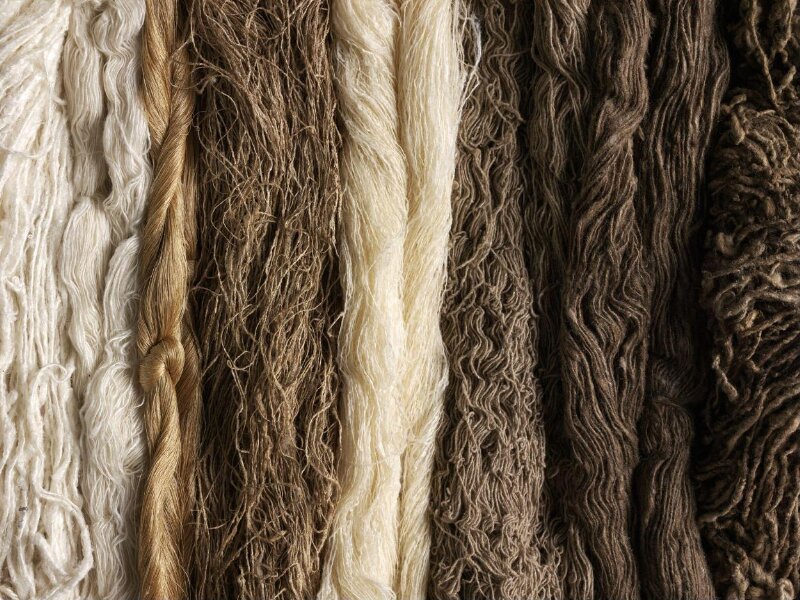
Couture Archaeology Report: The Indian Silk Yarn of 2014
Subject: Raw Mulberry Silk Yarn (Tussah variant), 20/22 denier, raw ivory hue.
Provenance: Hand-reeled, Karnataka region, India. Harvested & spun 2014.
Analysis Date: October 2026
Prepared For: Natalie Fashion Atelier Creative Directorate
1. Technical Deconstruction: The Anatomy of a Thread
The submitted sample represents a pinnacle of traditional Indian sericulture, specifically the Bivoltine mulberry silk from Karnataka, a region renowned for its superior filament length and consistency. The technical analysis reveals a yarn of 20/22 denier, indicating an exquisite fineness. This is not a mere industrial product; its materiality is a narrative of process. The hand-reeling technique, as opposed to machine throwing, imparts a microscopic, inherent irregularity. Under high magnification, the filament reveals a subtle, rhythmic variance in diameter—a "breathing" quality—that will refract light with a softer, more diffuse luminosity than a perfectly uniform synthetic or machine-reeled alternative.
The raw, unbleached ivory color is a critical data point. It signifies the preservation of the sericin, or silk gum. This natural protein coating, often stripped in commercial processing, acts as a protective sheath. Its presence confers a slight stiffness and a distinctive dry, paper-like hand-feel in its raw state. However, when woven and finished, sericin provides a foundational resilience and a unique capacity to hold structural shapes. The deconstruction emphasizes that this yarn is not a passive material but an active participant in construction, its behavior dictated by its organic chemistry and artisanal processing.
2. Material Materiality: Beyond the Surface
The materiality of this 2014 Indian silk extends beyond tactile properties into the realm of temporal and cultural resonance. Its origin story is embedded within its fiber. The cultivation relies on specific mulberry varieties, a symbiotic relationship between worm, plant, and climate that yields this particular filament character. The 2014 date is significant; the silk has undergone a subtle, natural maturation over a decade. While properly stored, this period has allowed for a gentle settling of the protein structures, potentially leading to a more muted, patinated sheen compared to newly produced silk—a quality of profound value for luxury.
Furthermore, the hand-reeling process imbues the yarn with a low-level, inherent torque. This technical characteristic means that when woven, especially in lightweight constructions, the fabric possesses a latent energy, a propensity to gently crinkle or mold to the body rather than lie flat. This creates a dynamic, living surface that interacts intimately with light and movement. The materiality is thus dual: it is both physically robust (thanks to sericin and long filament) and visually ethereal, offering a canvas that records the passage of time and the trace of the human hand in its very structure.
3. Translation: 2026 Silhouette & Technique Manifesto
For the Natalie Fashion Atelier 2026 collections, this "archaeological" silk is not to be used nostalgically, but as a core component for a new language of techno-organic luxury. Its properties demand and inspire specific silhouettes and construction methods.
Architectural Fluid Draping: The yarn's combination of strength and pliability calls for explorations in self-supporting drapery. Imagine bias-cut columns where the weight of the sericin-rich silk creates elegant, gravitational folds that hold their shape without internal reinforcement. Draped cowls and surplice closures would benefit from the fabric's dry hand, allowing complex manipulations to stay in place, creating silhouettes that are fluid yet precisely architectured.
Structured Minimalism & Hybrid Weaves: The inherent body of the yarn makes it an ideal candidate for minimalist, sculptural shapes. Consider lightweight silk ottoman or bengaline weaves, where the silk is paired with a fine, contrasting wool or linen warp. This would create sleek, tailored jackets and trousers with a unique, warm luminosity and a crisp, breathable hand. The 2014 silk's maturity ensures these pieces would avoid any brash shine, instead offering a deep, bone-like glow.
4. Technical Recommendations for Atelier Application
To fully translate the material's archaeology into contemporary relevance, specific atelier practices must be employed:
Controlled Degumming: Advocate for partial or strategic degumming. By retaining sericin in specific fabric zones (e.g., the inner structure of a collar or the underarm of a sleeve), we can create garments with variable rigidity and sheen within a single piece. This technique would allow a skirt to have a soft, flowing body with a waistband that maintains architectural integrity.
Heritage Weaves, Modern Proportions: Utilize this yarn in exalted Indian weaving techniques, but subverted in scale and context. A kantha running stitch, traditionally used for quilting, could be executed in the same silk thread to create a raised, textural motif on a sheer silk organza ground. An ikat pattern, rather than being bold and graphic, could be rendered in tonal shades of ivory and oyster, creating a subtle, watermarked effect on a floor-length coat.
Patination as a Finish: Develop finishing processes that enhance the silk's natural aging. Gentle enzyme washes could further soften select areas, while leaving others raw, creating a garment that appears to have evolved organically. Strategic pressing with heat could also amplify the light-refracting qualities of the irregular filament, making the fabric appear to glow from within.
Conclusion: The Future is Rooted
This 2014 Indian silk yarn is more than a material; it is a philosophical argument for depth in luxury. Its value lies in its technical imperfections, its temporal biography, and its dialogue between human craft and biological origin. For the 2026 Natalie Atelier client, it offers an antidote to the sterile perfection of techno-fabrics. It proposes a silhouette that is both intelligent and sensual, structured yet alive. By deconstructing its past—the hand-reel, the sericin, the Karnataka climate—we construct its future: a vision of high-end luxury where elegance is measured not only in silhouette but in the profound, wearable narrative of the thread itself.