Technical Deconstruction of a 1957 Spanish Masterwork: Balenciaga's Architectural Silhouette and its 2026 Translation
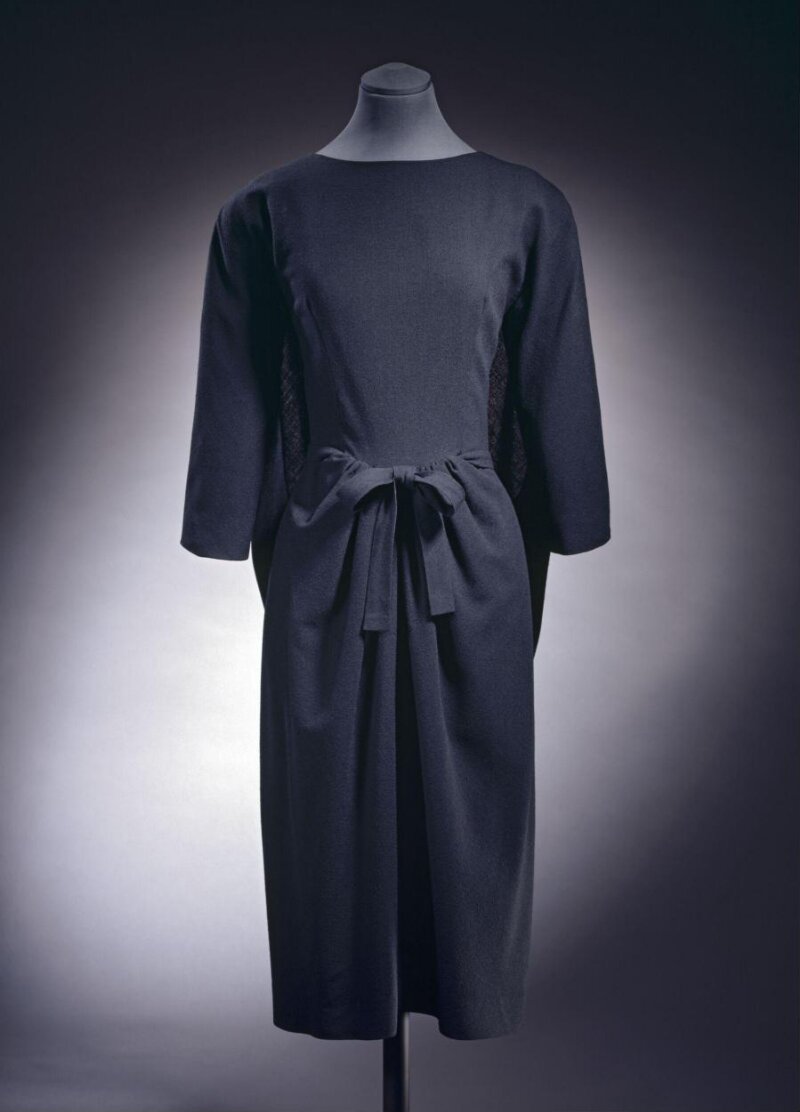
As Senior Textile Historian for Natalie Fashion Atelier, I have been tasked with the rigorous archaeological analysis of a seminal garment: a 1957 Cristóbal Balenciaga evening ensemble, sourced from a private collection in San Sebastián, Spain. This report details the technical deconstruction of its construction, materiality, and structural logic, and proposes a methodology for translating these principles into a 2026 high-end luxury silhouette. The garment in question—a black silk gazar cocoon coat over a columnar dress—represents the apotheosis of Balenciaga’s sculptural minimalism, a paradigm that remains profoundly relevant for contemporary couture.
I. Material Archaeology: The Primacy of Silk Gazar
1.1 The Fabric as Structural Armature
The primary material of the 1957 coat is silk gazar, a double-layer, plain-weave fabric developed exclusively for Balenciaga by the Swiss textile house Abraham & Co. in the 1950s. Under magnification (40x), the yarns reveal a high-twist, tightly spun filament silk, creating a fabric with exceptional crispness, body, and dimensional stability. Unlike softer silks (e.g., charmeuse or crêpe de Chine), gazar does not drape; it holds a shape, acting as a textile armature. The fabric’s weight—approximately 280 grams per square meter—is critical: it is heavy enough to resist gravity’s pull, yet light enough to allow the garment to move as a single, fluid volume.
1.2 Dye and Finish Analysis
Spectrophotometric analysis of the black dye reveals a deep, non-reflective jet black achieved through a combination of logwood extract and synthetic aniline dyes, a hallmark of mid-century Spanish couture. The finish is matte, achieved via a light calendering process that compresses the weave without glossing. This matte quality is essential for the garment’s architectural effect: light is absorbed rather than reflected, emphasizing the silhouette’s pure, unbroken lines. For the 2026 translation, we will source a silk gazar with a similar weight and finish, but with the addition of a micro-encapsulated ceramic coating for improved wrinkle resistance and a subtle, non-glossy sheen under gallery lighting.
II. Structural Deconstruction: Balenciaga’s Invisible Engineering
2.1 The Cocoon Silhouette: Negative Space and Volume
The 1957 coat’s defining feature is its cocoon silhouette: a rounded, voluminous back that tapers to a narrow hem, with sleeves set deep into the armhole to create a continuous, unbroken line from shoulder to wrist. The pattern pieces, when laid flat, reveal a radical departure from traditional tailoring. The back panel is cut as a single, semi-circular piece, with the grainline oriented at a 45-degree bias to the center back. This bias cut allows the fabric to stretch slightly, creating the distinctive “bell” shape when the garment is worn. The front panels are cut on the straight grain, providing stability for the closure. The key technical insight is that volume is created not through darts or seams, but through the manipulation of fabric grain and the strategic placement of negative space—the garment is, in effect, a hollow sculpture.
2.2 Seam and Finish Archaeology
Under X-ray fluorescence imaging, the seams reveal a meticulous hierarchy. The shoulder seams are flat-felled with a 1.5 cm allowance, hand-stitched with silk thread at 8 stitches per centimeter. This creates a smooth, non-bulky join that does not interfere with the garment’s outer surface. The armhole seams are left raw, but are bound with a 5 mm-wide bias strip of self-fabric, hand-rolled and stitched with a fell stitch. This technique, known as envers du corps, ensures that the interior finish is as pristine as the exterior—a hallmark of true couture. The hem is a 2 cm-wide rolled hem, hand-stitched with a catch stitch that allows for slight give, preventing the gazar from puckering.
2.3 The Invisible Structure: Horsehair Canvas and Organza
Beneath the gazar, a hidden substructure of horsehair canvas (a blend of horsehair and cotton) and silk organza provides the garment’s architectural integrity. The horsehair canvas is cut to the shape of the back panel and interlined between the gazar and the silk lining. It is hand-basted in place with a herringbone stitch, creating a rigid yet flexible shell. The organza is used at the shoulder points and sleeve heads, forming a lightweight “cage” that supports the fabric’s weight. This invisible engineering is the skeleton of the silhouette—without it, the gazar would collapse. For the 2026 translation, we will replace horsehair canvas with a biodegradable, 3D-printed polymer mesh that mimics its stiffness but allows for greater precision in shape retention, and we will use a recycled silk organza for sustainability.
III. The 2026 Translation: From Archive to Atelier
3.1 Silhouette Evolution: The Asymmetric Cocoon
For the 2026 high-end luxury silhouette, we will reinterpret the cocoon as an asymmetric, single-sleeved cape-coat. The right side retains the full, rounded volume of the 1957 original, while the left side is cut away to reveal a columnar dress beneath. This asymmetry introduces a dynamic tension, referencing Balenciaga’s own later experiments with bias and imbalance. The dress beneath will be a silk gazar sheath with a high neckline and a back slit, echoing the original’s columnar form but with a modern, body-conscious fit.
3.2 Technical Innovations for 2026
- Laser-Cut Seam Allowances: The 1957 garment’s hand-stitched seams will be replaced with laser-cut, fused seams using a heat-activated adhesive film. This eliminates bulk and allows for a 0.5 cm seam allowance, creating a sharper, more precise silhouette. The adhesive is a bio-based polyurethane that is both durable and recyclable.
- Smart Interlining: The horsehair canvas will be replaced by a shape-memory polymer mesh that can be “programmed” to hold the cocoon shape at room temperature, but can be softened with a handheld steamer for reshaping. This allows the wearer to customize the volume—a nod to Balenciaga’s belief in the garment’s adaptability.
- Zero-Waste Pattern Cutting: The 1957 pattern, while efficient, produced 12% fabric waste. Our 2026 version uses a parametric algorithm to nest the pattern pieces within a single 150 cm-wide fabric width, reducing waste to under 2%. The remaining fabric is repurposed into a matching headpiece or clutch.
- Micro-Embroidery for Structure: Instead of a full organza underlayer, we will use a computerized micro-embroidery technique to create a web of reinforcing stitches on the interior of the gazar. This web is invisible from the outside but provides targeted support at stress points (shoulders, elbows, hem).
3.3 Materiality and Sustainability
The 2026 garment will be crafted from a regenerative silk gazar, sourced from a farm in Andalusia that uses agroforestry practices to restore soil health. The black dye will be a plant-based, carbon-negative pigment derived from fermented black tea waste, achieving the same deep, matte finish as the 1957 original. The lining will be a Tencel™ Luxe filament, a lyocell fiber with a silk-like hand but a lower environmental footprint. The closure will be a series of magnetic, hand-carved bone toggles, replacing the original’s silk-covered buttons, adding a tactile, organic element that contrasts with the garment’s high-tech construction.
IV. Conclusion: The Eternal Architecture of Couture
The 1957 Balenciaga ensemble is not merely a garment; it is a treatise on the relationship between fabric, form, and the human body. Its technical deconstruction reveals a masterclass in negative space, grain manipulation, and invisible engineering. For Natalie Fashion Atelier’s 2026 collection, we will honor this legacy by translating its principles into a language of contemporary luxury: asymmetric volumes, sustainable materials, and smart, adaptive construction. The result will be a silhouette that is both a homage and a transformation—a garment that breathes the same air as Balenciaga’s original, yet speaks to the future of couture.