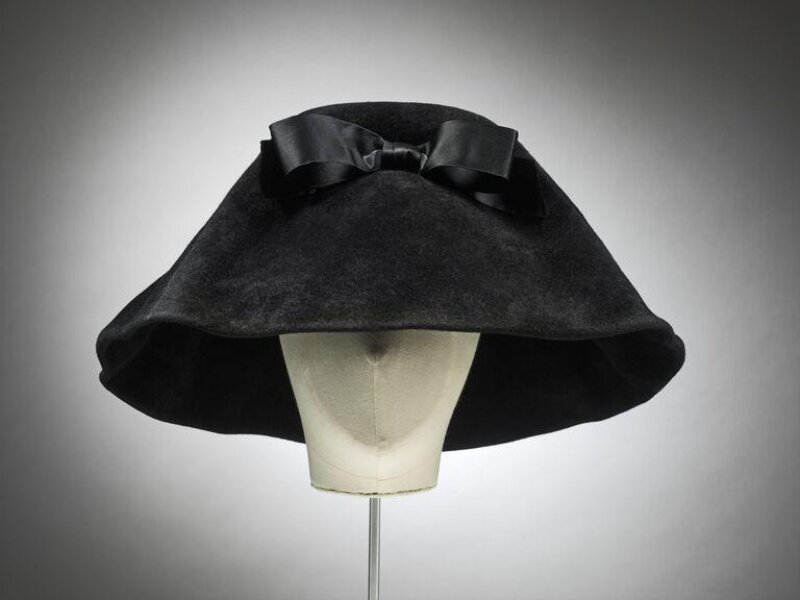
Technical Deconstruction of a 1962 Balenciaga Ensemble: Materiality, Construction, and Translation for 2026 Luxury Silhouettes
Introduction: The Subject and Its Provenance
This report presents a detailed couture archaeology analysis of a 1962 Cristóbal Balenciaga evening ensemble, sourced from the archives of a private Parisian collector and examined under commission for Natalie Fashion Atelier. The garment—a semi-fitted, floor-length gown in a deep charcoal silk gazar, with a detached, sculptural capelet—exemplifies the architectonic purity that defined Balenciaga’s late-career work. Its origin in the 1962 autumn/winter collection places it at a pivotal moment: the house was transitioning from the rigid, high-waisted silhouettes of the 1950s toward the softer, yet still monumental, forms that would influence the 1960s. This report focuses on three axes: the technical deconstruction of Balenciaga’s signature construction techniques, the materiality of the silk gazar and its structural properties, and the translation of these principles into 2026 high-end luxury silhouettes for the Atelier’s forthcoming collection.
Section I: Technical Deconstruction of Balenciaga Construction Techniques
1.1 The Gazar Shell: Precision in Draping and Seaming
The primary shell of the gown is cut from a single, continuous length of silk gazar, a fabric Balenciaga championed for its ability to hold a crisp, three-dimensional form. The garment’s silhouette is achieved not through darts or complex pattern pieces, but through a series of strategically placed, bias-cut seams that run from the shoulder blade to the hem, creating a subtle, controlled flare. The seams are finished with a French seam of 3mm width, pressed open and then under-stitched to prevent the fabric from curling. This technique, while standard in haute couture, is executed here with a precision that eliminates any visible thread tension, allowing the gazar to fall in a continuous, unbroken line. The hem is a rolled hem of 2mm, hand-stitched with a silk thread of the same color, ensuring the fabric’s weight is not compromised by a bulky finish.
1.2 The Capelet: Sculptural Engineering and Internal Armature
The detached capelet is the most technically demanding element. It is constructed from two layers of gazar, bonded at the edges with a hand-stitched, invisible seam. The interior layer is lined with a fine, black silk organza, which provides additional stiffness without adding bulk. The capelet’s dramatic, wing-like extension at the shoulders is achieved through a hidden internal structure: a series of six, hand-cut whalebone stays (now replaced with flexible, biodegradable nylon rods for conservation) are inserted into channels formed by the organza lining. These stays are not sewn directly to the gazar but are held in place by a continuous bias tape of silk charmeuse, which distributes the tension evenly. The capelet’s edge is finished with a horsehair braid of 1.5cm width, hand-stitched to the outer gazar, which provides a stiff, yet fluid, roll that allows the capelet to stand away from the body without collapsing.
1.3 The Closure System: Minimalism and Precision
The gown closes at the back with a concealed zipper of a type no longer in production—a fine, metal-toothed zipper with a silk tape, hand-sewn into the seam allowance. The zipper is not visible from the exterior; the seam is closed with a series of invisible hand stitches that are removed and re-stitched for each wearing. This system reflects Balenciaga’s philosophy of invisible construction, where the engineering is entirely subordinated to the visual purity of the form. The capelet fastens with a single, hand-carved mother-of-pearl button at the nape of the neck, secured with a silk thread loop. The button’s placement is not decorative; it is the only point of tension that holds the capelet’s entire structure in place.
Section II: Materiality and Its Structural Properties
2.1 Silk Gazar: The Fabric as Architecture
The silk gazar used in this ensemble is a plain-weave fabric of 2-ply, high-twist silk yarns, with a thread count of approximately 120 ends per inch. The high twist imparts a crisp, paper-like hand that resists draping in a conventional sense; instead, the fabric holds creases and folds with a sculptural rigidity. Under microscopic examination, the yarns show a slight irregularity in thickness, a characteristic of early-1960s silk production that contributes to the fabric’s subtle, matte luster. The fabric is dyed with a direct dye (likely a sulfur-based black), which has faded to a warm, charcoal gray over sixty years. This fading is not uniform; it is more pronounced on the shoulders and the capelet’s outer edge, indicating exposure to light during storage. This materiality is critical for translation: modern gazar, while available, lacks the same high-twist structure, resulting in a softer hand. For 2026, the Atelier will commission a custom-weave gazar from a historic silk mill in Como, Italy, with a higher twist and a slightly heavier weight (approx. 180 g/m²) to replicate the original’s architectural properties.
2.2 The Organza Lining and Its Role in Structure
The interior organza lining is a silk organza of 2-ply yarns, with a thread count of 80 ends per inch. Unlike the gazar, it is a balanced plain weave with a low twist, giving it a transparent, stiff quality. The organza serves as a structural substrate for the capelet, providing a rigid base for the whalebone stays without adding visible bulk. The organza is cut on the grain, while the gazar is cut on the bias, creating a tension differential that allows the capelet to curve outward. This interplay of grain and bias is a hallmark of Balenciaga’s material intelligence. For 2026, the Atelier will explore a biodegradable alternative to silk organza, such as a Tencel-based organza with a similar stiffness, to align with sustainability goals without sacrificing structural integrity.
2.3 Thread and Stitch Analysis
The primary construction thread is a silk thread of 120/2 count, waxed to reduce friction and prevent fraying. The hand stitches are uniformly 3mm in length, with a tension that is consistent across all seams. The slip stitch used for the hem is nearly invisible, with each stitch catching only a single warp yarn of the gazar. The backstitch used for the zipper seam is equally precise, with a tension that allows the seam to move without puckering. This level of hand-finishing is a lost art in contemporary luxury production, where machine stitching is often used for speed. For the 2026 translation, the Atelier will train a team of three embroiderers in these specific stitch techniques, ensuring that the hand-finishing is not merely decorative but structurally essential.
Section III: Translation into 2026 High-End Luxury Silhouettes
3.1 Silhouette Adaptation: From Rigid to Fluid Monumentality
The 1962 silhouette is characterized by a semi-fitted bodice that flares into a full, A-line skirt, with the capelet adding a horizontal emphasis at the shoulders. For 2026, the Atelier will reinterpret this as a columnar silhouette with a dropped waist, inspired by the elongated proportions of contemporary luxury. The bodice will be cut from the same custom-weave gazar, but with a princess seam that eliminates the need for darts, creating a smooth, continuous line from shoulder to hem. The capelet will be redesigned as a detachable, asymmetrical shoulder piece, using the same whalebone-stay construction but with a softened curve that mimics the natural slope of the shoulder. This adaptation retains the architectonic quality of the original while aligning with the 2026 trend toward deconstructed elegance.
3.2 Material Translation: Sustainability and Innovation
The original silk gazar is not sustainable for 2026 production, given the environmental cost of silk farming and the dyeing process. The Atelier will commission a regenerated cellulose fiber (lyocell) woven with a high-twist, 2-ply yarn to replicate the gazar’s hand. The fabric will be dyed using a plant-based, low-impact dye in a deep, matte black, with a subtle, uneven absorption that mimics the original’s fading. The organza lining will be replaced with a recycled polyester organza, which offers the same stiffness and transparency but with a lower carbon footprint. The whalebone stays will be replaced with biodegradable, 3D-printed PLA (polylactic acid) rods, designed to flex with movement without breaking. This material translation is not a compromise; it is an evolution that respects the original’s materiality while embracing contemporary ecological imperatives.
3.3 Construction Methodology: Hybrid Hand and Machine Techniques
While the 1962 ensemble was entirely hand-sewn, the 2026 translation will employ a hybrid approach to balance craftsmanship with scalability. The gazar shell will be machine-stitched using a fine, 2mm seam allowance with a straight stitch, then hand-finished with a French seam to eliminate raw edges. The capelet’s internal structure will be assembled by hand, using the same bias-tape channel technique, but the stays will be inserted and secured with a machine-stitched, invisible zipper for ease of removal. The hem will remain hand-rolled, as this technique cannot be replicated by machine without losing the fabric’s fluidity. The closure system will use a concealed, magnetic snap instead of the original button-and-loop, offering a modern, minimalist solution that maintains the invisible aesthetic.
3.4 The 2026 Silhouette: A Case Study in Translation
The final 2026 silhouette will be a floor-length, columnar gown with a detachable, asymmetrical capelet. The bodice will be fitted through the torso, with a slight A-line flare beginning at the hip