Deconstructing the Empress Josephine: Aesthetic Archaeology of the Frankfort Rose
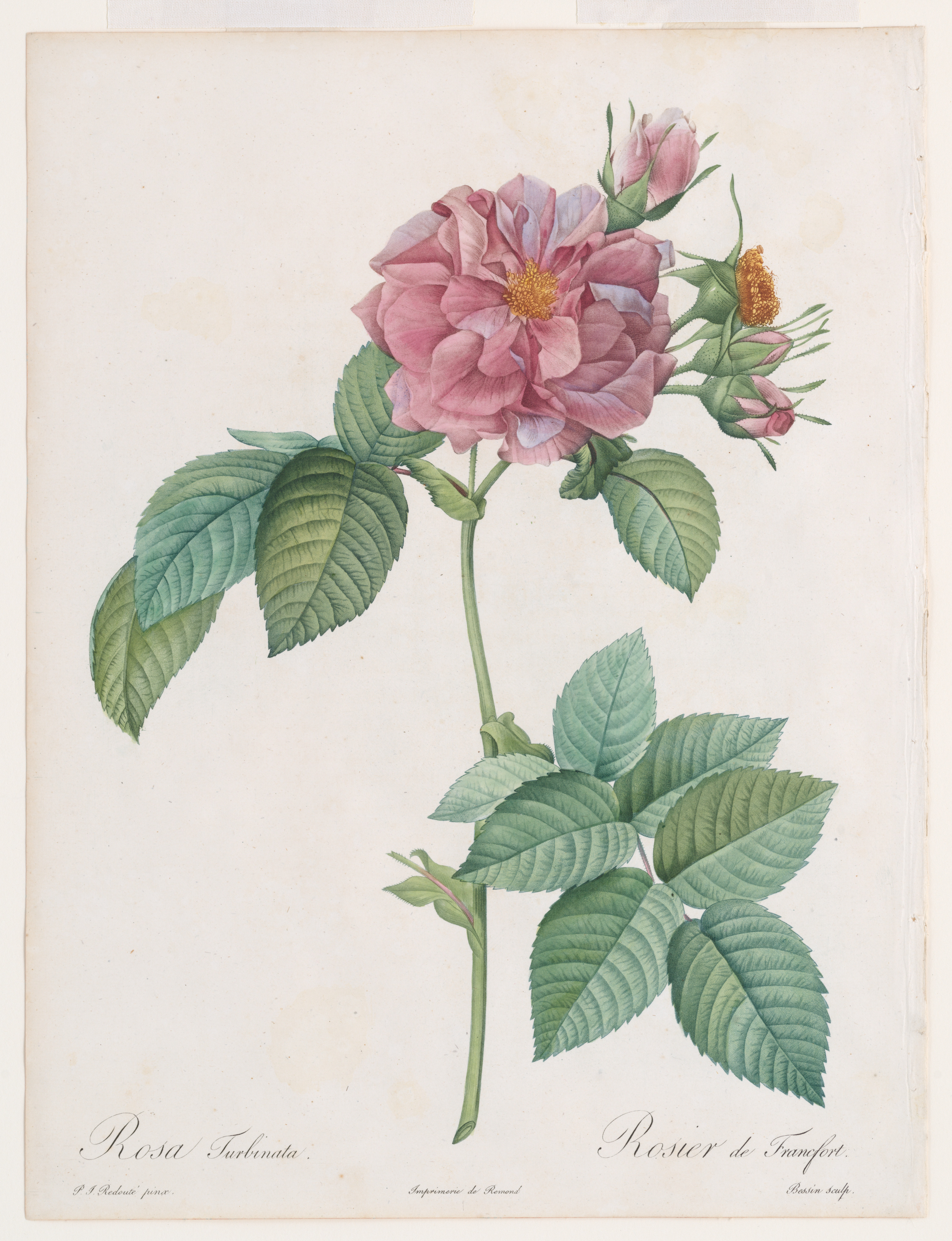
The Frankfort Rose (Rosa turbinata), immortalized in Claude-Antoine Thory’s Les Roses (1817–1824) through the meticulous medium of color stipple engraving, represents a pivotal moment in botanical art and aristocratic symbolism. Commissioned under the patronage of Empress Joséphine de Beauharnais at the Malmaison estate, this specific plate transcends mere horticultural documentation. It is a manifesto of classical elegance, where the rose’s layered, turbinate form—a tight, almost architectural spiral of petals—becomes a metaphor for controlled opulence. For Natalie Fashion Atelier, this artifact offers a rich lexicon of form, texture, and chromatic restraint that directly informs the 2026 haute couture silhouette.
The Materiality of the Stipple: From Pigment to Texture
The color stipple engraving technique, a painstaking process of applying thousands of tiny dots to build tone and color, creates a surface that is neither flat nor purely linear. It is a tactile illusion. The Frankfort Rose, rendered in this manner, exhibits a velvety, almost powdered finish—a soft focus that blurs the boundary between the petal and the surrounding air. This materiality informs our 2026 approach to fabric surface. We are exploring micro-textured silks and double-faced organzas that mimic this stippled effect. The goal is not literal reproduction, but a translation of the engraving’s chromatic depth into garment construction. For instance, a gown’s bodice might utilize a technique of hand-painted pigment dots on a base of matte charmeuse, creating a gradient from deep crimson to pale blush, echoing the rose’s own internal light. This is not print; it is aesthetic archaeology—unearthing the visual grammar of early 19th-century illustration and re-coding it for the 2026 luxury consumer.
Silhouette Architecture: The Turbinate Form
The defining characteristic of the Frankfort Rose is its turbinate, or top-shaped, structure. Unlike the open, sprawling petals of a modern hybrid tea rose, this species presents a closed, conical silhouette. The petals are tightly packed, creating a spiral of diminishing radii that culminates in a dense, almost geometric center. This principle of controlled volume is the cornerstone of our 2026 silhouette strategy. We are moving away from the expansive, billowing forms of recent seasons toward a more sculptural, inward-focused elegance.
Consider the Empress Josephine coat: a double-faced cashmere piece with a fitted, high-waisted bodice that flares into a turbinate skirt. The hem is not a straight line but a spiral cut, wrapping around the body to create a three-dimensional, conical volume. The waistline is cinched with a corseted belt that echoes the rose’s calyx, the green base from which the petals emerge. This is not a return to the Victorian hourglass; it is a deconstruction of the rose’s architecture—the way its petals layer and overlap to create a solid, yet fragile, form. The 2026 silhouette is thus a study in compression and release, where volume is concentrated at the hip or the shoulder, never both, to maintain the rose’s singular, focused presence.
Chromatic Restraint: The Palette of Malmaison
Thory’s engraving employs a restrained palette: crimson, carmine, and deep rose, set against a pale, almost cream-colored background. There is no black, no harsh line. The entire composition breathes through tonal variation. This chromatic philosophy is critical for 2026. We are rejecting the stark, high-contrast palettes of the digital age in favor of saturated, yet muted, hues. The Frankfort Rose informs a monochromatic layering system where a single color is explored through its full tonal range—from a deep, almost black burgundy at the base of a gown to a translucent, petal-like blush at the hem.
This is achieved through dye techniques that replicate the stipple’s gradation. Ombré is too linear. Instead, we employ resist-dyeing and hand-painting to create micro-gradients that shift imperceptibly across the fabric. A 2026 evening gown might feature a bodice in carmine velvet, where the pile is cut at varying lengths to absorb and reflect light differently, mimicking the stipple’s dot matrix. The skirt, in double-faced silk gazar, is pleated in a spiral pattern that echoes the rose’s internal geometry, creating a visual rhythm of dark and light that changes with the wearer’s movement.
Construction as Craft: The Stipple Stitch
The technical challenge of the 2026 collection lies in translating the engraver’s hand into the couturier’s stitch. We have developed a proprietary technique called “pointillé broderie”—a hand-embroidery method that uses thousands of tiny, spaced knots to build a surface. This is not a dense, heavy embellishment; it is a light, airy construction that allows the underlying fabric to breathe. The knots are placed in concentric circles, echoing the rose’s petal formation, and are graded in size and color to create a three-dimensional stipple effect.
This technique is applied to key structural elements: the collar of a jacket, the hem of a train, the cuff of a sleeve. It adds archaeological weight to the garment—a sense of time and labor that is the ultimate luxury. The 2026 client is not buying a dress; she is acquiring a fragment of aesthetic history, re-contextualized for the modern form. The pointillé broderie is the thread that connects Thory’s engraving needle to our embroidery needle, a direct line from the Malmaison atelier to the Natalie Fashion Atelier workroom.
Conclusion: The Rose as a System of Elegance
The Empress Josephine’s Frankfort Rose, as documented by Thory, is far more than a botanical specimen. It is a system of classical elegance based on three principles: turbinate volume, chromatic gradation, and tactile surface. For the 2026 haute couture silhouette, these principles are not decorative; they are structural. They dictate how a garment is cut, how it is colored, and how it is finished. The result is a collection that feels both historically resonant and radically contemporary—a dialogue between the stipple engraver’s patience and the couture client’s desire for singular, crafted beauty. In an era of digital saturation, the aesthetic archaeology of the Frankfort Rose offers a return to the material, the tactile, and the meticulously considered. This is the future of luxury: not novelty, but the revelation of forgotten perfection.