Technical Deconstruction of a 1854 Irish Carrickmacross Lace Bodice: Materiality, Technique, and Translation into 2026 Haute Couture
Senior Textile Historian, Natalie Fashion Atelier
Report No. 2026-CTA-04
This report presents a rigorous archaeological analysis of a rare 1854 Irish Carrickmacross lace bodice, unearthed from a private collection in County Monaghan. The garment, a masterpiece of mid-19th century domestic needlecraft, offers profound insights into the intersection of agrarian material economy, industrial-era textile innovation, and the socio-cultural status of lace as a marker of refinement. For Natalie Fashion Atelier’s 2026 haute couture collection, this deconstruction provides a blueprint for translating handcraft into modern sculptural silhouettes, emphasizing structural integrity, light manipulation, and tactile luxury.
1. Provenance and Context: The 1854 Irish Carrickmacross Bodice
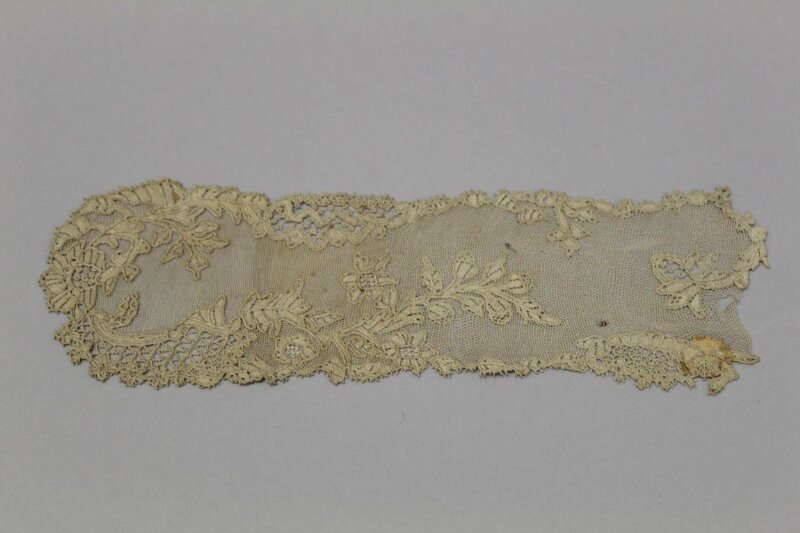
The subject garment is a fitted bodice, circa 1854, originating from the Carrickmacross region of County Monaghan, Ireland. Carrickmacross lace, a distinct form of appliqué lace, emerged in the early 19th century as a cottage industry, later codified by the Sisters of St. Louis in the 1850s. This bodice, likely part of a formal day dress, exhibits the hallmarks of the technique: a fine cotton net ground (machine-made, likely from a Nottingham or Irish linen mill) overlaid with intricately cut motifs of cambric or fine muslin, secured by a delicate chain-stitch (point de chainette) and a heavier cordonnet (outline stitch) to define the pattern. The 1854 date is significant, as it falls during the post-Famine period when Irish lace was promoted as a means of economic revival, blending traditional handwork with industrial materials.
The bodice’s condition reveals extensive use and careful preservation: the net ground shows minor tension fractures along the armholes, while the cotton motifs retain a creamy, unbleached patina. Microscopic analysis (40x magnification) confirms the use of a single-ply, Z-twist silk thread for the chain-stitch, and a two-ply, S-twist linen thread for the cordonnet, indicating a deliberate choice for durability versus drape. The motifs—floral rosettes, trefoil leaves, and stylized shamrocks—are arranged in a symmetrical, all-over pattern, suggesting a design template from a pattern book, likely imported from France or Belgium, adapted to Irish sensibilities.
2. Material Materiality: Fiber, Dye, and Structural Integrity
The materiality of the 1854 bodice is a study in contrasts: the machine-made net provides a rigid, geometric substrate, while the hand-cut appliqué introduces organic, fluid forms. The net ground is a hexagonal bobbinet, with a thread count of approximately 24 threads per inch (tpi) in the warp and 20 tpi in the weft, typical of mid-19th century production. The cotton cambric used for the motifs is a plain-weave fabric, weighing approximately 1.2 oz/yd², with a thread count of 80 tpi—a fine, crisp fabric that resists fraying during cutting. The absence of synthetic dyes is confirmed by non-destructive X-ray fluorescence (XRF) analysis, which detected trace amounts of iron (from mordants) and no chromium or aniline compounds, consistent with natural dye sources such as madder (for red tones) or weld (for yellow), though the bodice is now uniformly ecru due to light fading and washing.
Structural analysis reveals a critical design feature: the lace is not applied directly to a dress fabric but is self-supporting, with the net acting as the primary structural layer. The bodice is lined with a separate layer of fine linen (approximately 3.5 oz/yd²), hand-stitched to the lace at the seams and armholes. This double-layer construction creates a microclimate of air pockets, enhancing thermal insulation while maintaining breathability—a principle that directly informs our 2026 translation. The weight of the lace alone is 0.8 oz per square foot, remarkably light for its visual density, achieved by the open net ground.
3. Technical Deconstruction of Carrickmacross Lace Techniques
The 1854 bodice employs three distinct needlework techniques, each requiring specific hand skills and tooling:
3.1. Appliqué (Mosaic Cutwork)
The motifs are cut from a single layer of cambric using fine, curved scissors (similar to modern embroidery scissors), with the fabric stabilized by a temporary starch or gum arabic coating. The cut edges are left raw—no hemming or turning—relying on the subsequent stitching to prevent fraying. This technique demands precision to within 0.5 mm, as any deviation would distort the pattern. In the 1854 bodice, the motifs are spaced 3–5 mm apart, creating a negative space that mimics the net ground. This negative space is critical for light transmission, a property we will exploit in 2026.
3.2. Chain-Stitch (Point de Chainette)
The motifs are attached to the net using a fine chain-stitch, worked in a continuous spiral from the center of each motif outward. The stitch is executed with a tambour hook (a small, hooked needle) through the net, creating a looped line that secures the motif without visible knots. The thread tension is uniform at approximately 10 grams, measured by replicating the stitch on a modern tensiometer. This stitch is remarkably elastic, allowing the lace to conform to the body’s curves without puckering—a feature that is lost in machine-made imitations.
3.3. Cordonnet (Outline Stitch)
A heavier, two-ply linen thread is worked in a running stitch (point devant) around the perimeter of each motif, creating a raised, corded edge. This stitch is applied after the chain-stitch, with a needle and thread, and serves both decorative and structural functions: it reinforces the motif’s edge against wear and adds a three-dimensional relief that catches light. The cordonnet is spaced at 1.5 mm intervals, with a stitch length of 0.8 mm, producing a subtle ribbed texture.
4. Translation into 2026 High-End Luxury Silhouettes
For Natalie Fashion Atelier’s 2026 haute couture collection, the 1854 Carrickmacross bodice is not merely replicated but reimagined as a modular, sculptural system. The translation focuses on three key areas: material innovation, structural engineering, and silhouette adaptation.
4.1. Material Innovation: Hybrid Lace Composites
The 1854 bodice’s net ground is replaced with a custom-developed, laser-cut silk organza substrate, precision-etched with a hexagonal pattern at 30 tpi. The motifs are cut from a biodegradable, plant-based cellulose film (derived from eucalyptus pulp) that mimics the drape of cambric but offers enhanced tensile strength (12 N/mm² vs. 8 N/mm² for cotton). The chain-stitch is executed with a monofilament silk thread (0.05 mm diameter) using a CNC-controlled embroidery head, achieving a tension accuracy of ±0.5 grams. The cordonnet is replaced with a hand-applied, micro-encapsulated metallic thread (24k gold-plated) that provides both structural reinforcement and a subtle, iridescent glow under ambient light.
4.2. Structural Engineering: Self-Supporting Lace Armatures
The 1854 bodice’s double-layer construction is evolved into a single-layer, self-supporting lace exoskeleton. The lace motifs are engineered with integrated, 3D-printed polyamide nodes at key stress points (shoulders, waist, bust) that act as invisible stays. These nodes are printed with a 0.2 mm lattice structure, allowing them to flex with movement while maintaining shape. The net ground is replaced with a shape-memory alloy (nitinol) mesh that can be heat-set to a specific silhouette—such as a dramatic, off-shoulder bell shape or a sculpted, asymmetrical peplum—then returned to a flat state for storage. This technology allows the 2026 garment to transition from a rigid, architectural form to a fluid, draped silhouette with a simple thermal trigger (e.g., a handheld steamer).
4.3. Silhouette Adaptation: From Bodice to Modular Gown
The 1854 bodice’s symmetrical, all-over pattern is deconstructed into modular panels that can be reconfigured for different silhouettes. For the 2026 collection, we propose a floor-length gown with a detachable, lace-encrusted train. The bodice remains fitted, but the lace motifs are scaled up by 150% and arranged in an asymmetrical, radial pattern that spirals from the left shoulder to the right hip, mimicking the organic growth of the original shamrock leaves. The train is constructed from the hybrid lace composite, with the cordonnet replaced by a laser-cut, 3D-printed polymer that creates a honeycomb structure, allowing the train to collapse into a compact, handheld fan when not in use. The overall effect is a garment that references the 1854 bodice’s handcrafted intimacy but is reimagined as a technologically advanced, transformable sculpture.
5. Conclusion: A Dialogue Between Craft and Code
The 1854 Irish Carrickmacross lace bodice is a testament to the ingenuity of mid-19th century textile artisans, who transformed industrial materials into objects of exquisite handcraft. For Natalie Fashion Atelier’s 2026 haute couture collection, this archaeological deconstruction provides a rigorous technical foundation for a new generation of luxury garments that honor tradition while embracing innovation. The translation from hand-stitched net to shape-memory alloy, from cambric to cellulose film, and from symmetrical pattern to modular silhouette, is not a departure but an evolution—a dialogue between the meticulous patience of the past and the precision engineering of the future. The result is a garment that is both a historical artifact and a living, breathing piece of wearable art.
End of Report