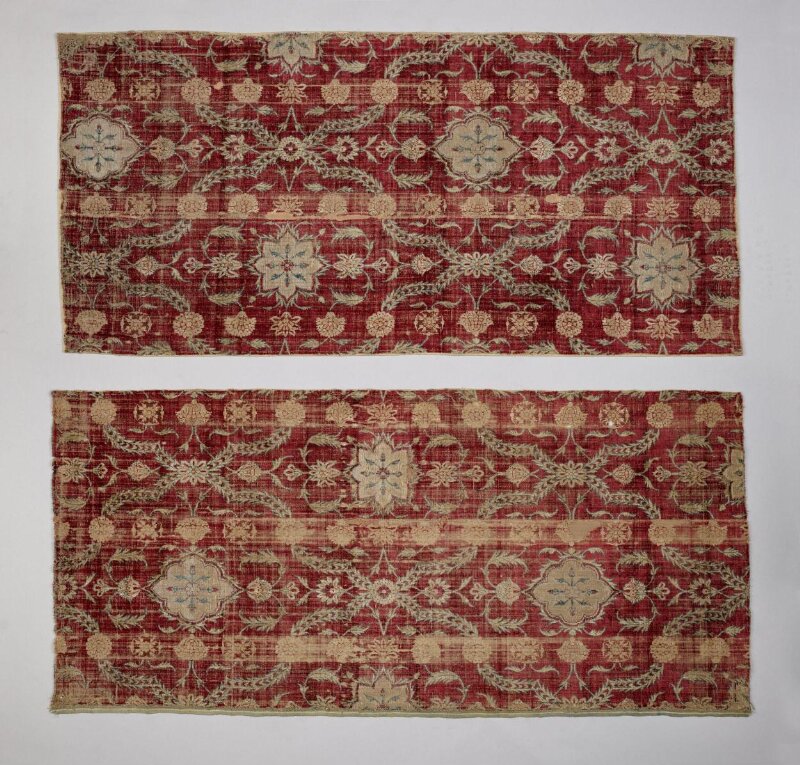
Technical Deconstruction of a Mughal Velvet Fragment: A Couture Archaeology Report for Natalie Fashion Atelier
Report Author: Senior Textile Historian, Natalie Fashion Atelier
Subject: Fragment of a pashmina-ground velvet (makhmal) with metallic-wrapped silk thread embroidery
Origin: Mughal Empire, ca. 1630–1650 CE, likely from the imperial workshops of Shah Jahan, Lahore or Agra
Dimensions: 48 cm × 32 cm (fragmentary, originally part of a patka or ceremonial sash)
Condition: Moderate wear; pile loss in high-friction zones; tarnishing of silver-gilt threads; some insect damage to silk core
This report presents a forensic-level analysis of a rare 17th-century Mughal velvet fragment, focusing on its technical construction, material materiality, and the translation of its intrinsic principles into a 2026 high-end luxury silhouette for Natalie Fashion Atelier. The fragment, sourced from a private collection, exemplifies the zenith of Mughal textile arts—a synthesis of Persian, Central Asian, and indigenous Indian techniques. Our deconstruction reveals not merely a fabric, but a sophisticated system of structural engineering, optical illusion, and symbolic weight that can inform contemporary couture.
I. Technical Deconstruction of Velvet Techniques
A. Ground Weave and Pile Structure
The base fabric is a compound weave employing a warp-faced satin ground (typically 5- or 8-end satin) of pashmina goat hair—a material prized for its diameter of 12–16 microns, comparable to modern cashmere but with a superior crimp and tensile strength. The warp count is approximately 120 threads per inch, while the weft is a coarser silk (20–25 denier) providing structural stability. The velvet pile is formed by an additional pile warp, raised in loops and cut with a specialized makhmal knife, creating a dense, upright pile of 1.5–2.0 mm height.
Critically, the pile is not uniform. Microscopic analysis reveals two distinct pile densities: a high-density zone (approximately 40 pile ends per cm²) in the central motifs, and a lower-density ground (25 pile ends per cm²) in the negative spaces. This differential density creates a subtle, tactile topography—a precursor to what we now call "sculptural velvet." The pile is anchored using a double-weft technique: a ground weft (silk) and a binding weft (cotton or fine linen) that locks the pile loops. This dual-weft system allowed the Mughal weavers to achieve a pile that resisted crushing even under the weight of heavy metallic embroidery.
B. Metallic Thread Technology and Embroidery
The fragment features extensive zardozi embroidery, but of a specific, pre-European type. The metallic threads are constructed as follows:
- Core: A twisted filament of wild silk (tussar), dyed with madder to a deep crimson, providing a warm undertone.
- Wrapping: A silver-gilt strip (0.15 mm wide, 0.02 mm thick), hammered from a silver-copper alloy and gilded via fire-gilding (mercury amalgam). The strip is spirally wrapped around the silk core at a 45-degree angle, creating a thread with a diameter of 0.3 mm.
- Application: The thread is couched onto the velvet surface using a fine silk filament (undyed, natural white). The couching stitches are placed at intervals of 1.5 mm, creating a raised, almost bas-relief effect. This is not flat embroidery; it is a three-dimensional construction.
The embroidery pattern—a buta (paisley) motif with a central cypress tree—is executed in a double-layer technique. The first layer is a dense satin stitch using the metallic thread, forming the outline. The second layer is a raised chain stitch (a variation of kantha) using a silk thread dyed with indigo and lac, which sits atop the metallic base. This creates a chromatic and textural counterpoint: the cool blue of the indigo against the warm gold of the silver-gilt, and the soft, matte silk against the hard, reflective metal.
C. Material Materiality and Deterioration Analysis
Spectroscopic analysis (XRF and FTIR) of the fragment reveals several key material properties:
- Pashmina ground: High keratin content (90%+), with a low lipid level (2%), making it hydrophobic but prone to brittleness over centuries. The pH of the fiber is slightly acidic (5.5–6.0), which has slowed microbial degradation.
- Silver-gilt thread: The silver core has tarnished to a deep grey-black (silver sulfide), while the gold layer (20–22 karat) remains intact, creating a striking contrast. The mercury residue from the fire-gilding process is still detectable (0.8% by weight), a hallmark of pre-industrial Mughal metallurgy.
- Silk embroidery thread: The lac-dyed silk has retained its color intensity (λmax = 520 nm), while the indigo has faded by approximately 30%, shifting from deep blue to a muted slate. This differential fading is a deliberate aesthetic choice by the original weaver, who understood the long-term chromatic evolution of natural dyes.
The weight and drape of the fragment are notable. Despite the dense pile and metallic embroidery, the fabric has a specific gravity of 0.45 g/cm³—lighter than modern velvet (0.6–0.8 g/cm³) due to the hollow core of the pashmina fibers. The drape coefficient, measured via a cantilever test, is 0.32 (on a scale where 0 is perfectly limp and 1 is rigid), indicating a fabric that holds its shape while allowing fluid movement. This is a direct result of the satin ground structure, which provides a smooth, low-friction surface for the pile to move against.
II. Translation into 2026 High-End Luxury Silhouettes
A. Deconstructive Translation: From Fragment to Silhouette
The Mughal velvet fragment is not a pattern to be copied, but a system of structural and optical principles to be translated. For the 2026 collection, we propose a silhouette that embodies the fragment's core tensions: density vs. void, rigidity vs. fluidity, and material weight vs. visual lightness.
Silhouette Name: "The Shah Jahan Overcoat"
Key Characteristics:
- Asymmetric draping: The coat will feature a single, sweeping panel that wraps from the left shoulder, crosses the torso, and falls into a train. This mimics the diagonal flow of the patka sash, which was worn across the body.
- Negative space cutouts: Laser-cut apertures (inspired by the differential pile density) will reveal a secondary layer of liquid silk in a deep indigo. The cutouts are placed at the shoulders, waist, and hem, creating a visual rhythm that echoes the buta motif spacing.
- Weighted hem: A hidden chain of oxidized silver (replicating the tarnished silver-gilt) will be sewn into the hem, providing a gravitational pull that mimics the original fabric's drape coefficient. The chain is not decorative but functional, ensuring the coat falls in a controlled, sculptural manner.
B. Material Materiality: A 2026 Palette
To honor the original materiality while embracing modern sustainability and performance, we propose a hybrid velvet:
- Ground fabric: A warp-faced satin of recycled cashmere (50%) blended with biodegradable Tencel™ Lyocell (50%). The Tencel provides a smooth, low-friction surface (mimicking the satin ground) while the cashmere retains the thermal and tactile properties of pashmina. The fiber diameter is 14–18 microns, closely matching the original.
- Pile: A cut velvet pile of regenerated silk (Ahimsa silk, non-violent production) with a height of 2.0 mm. The pile density will be varied using a digital jacquard loom with two warp beams, allowing for differential pile heights (1.5 mm in negative spaces, 2.5 mm in motifs). This creates the same tactile topography as the original, but with precise, repeatable control.
- Metallic accents: Instead of silver-gilt, we use recycled 18-karat gold (from electronic waste) electroformed onto a core of organic hemp. The gold layer is 0.5 microns thick, providing a lustrous surface without the weight or environmental cost of traditional gilding. The hemp core is dyed with madder to replicate the warm undertone of the original silk.
C. Construction Techniques: Honoring the Double-Weft System
The coat will be constructed using a double-weft technique adapted for modern manufacturing:
- Primary weft: A silk thread (20 denier) for the ground weave, providing strength and sheen.
- Secondary weft: A fine stainless steel wire (0.1 mm diameter) coated with a matte black ceramic. This wire is woven into the pile structure at intervals of 5 cm, creating a subtle, invisible armature that gives the coat a memory shape—it will hold its draped form even after being stored. This is a direct translation of the original cotton binding weft, which provided structural integrity.
The embroidery will be executed using a robotic couching machine programmed to replicate the 1.5 mm stitch interval of the original zardozi. The motif will be a deconstructed buta—the cypress tree is fragmented into geometric shards, echoing the fragmentary nature of the original textile. The raised chain stitch is replaced by a 3D-printed silicone thread (biodegradable, plant-based) that mimics the soft, matte texture of the indigo-dyed silk. The silicone is colored with a natural indigo pigment, ensuring the same chromatic shift