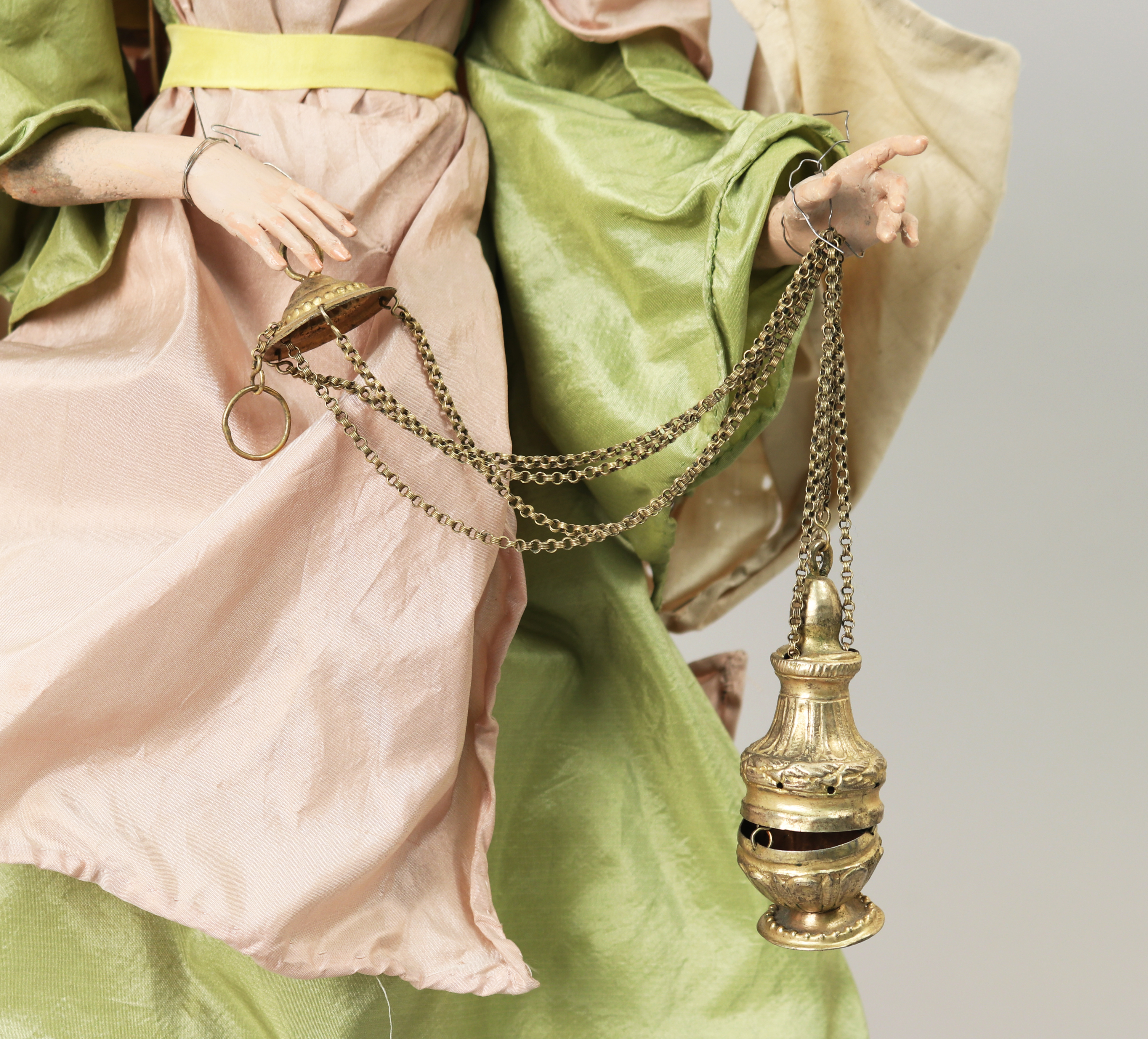
The Censer as Silhouette: Silver Gilt and the Architecture of 2026 Haute Couture
The censer, a vessel of ritual and reverence, transcends its liturgical origins to become a profound artifact for aesthetic archaeology. Within the archives of Natalie Fashion Atelier, we isolate this object not for its spiritual function, but for its formal purity. A silver gilt censer—with its domed lid, pierced lantern, and suspended chains—presents a masterclass in volume, negative space, and kinetic elegance. For the 2026 haute couture season, this global heritage piece informs a new lexicon of luxury silhouettes: one where structured opulence meets ethereal movement, where metallic weight is rendered as air.
Deconstructing the Classical Elegance of the Silver Gilt Censer
The classical elegance of a silver gilt censer is not found in ornament alone, but in the precise tension between its components. The dome, often a hemisphere of hammered metal, establishes a primary volume—a protective, enclosing shape. The pierced lantern, a filigree of geometric or floral cutouts, introduces light and shadow, transforming solid metal into a lattice of breathable structure. The chains, articulated links of silver gilt, dictate the object’s kinetic potential, allowing the vessel to swing, to hover, to ascend. The gilt surface itself, a layer of gold fused to silver, creates a luminous, reflective skin that captures and diffuses ambient light.
This is not a static object. It is a machine for generating atmosphere. The censer’s elegance arises from its dual nature: it is simultaneously a fortress of precious metal and a conduit for the intangible. The smoke that escapes its perforations is the ghost of materiality, a reminder that even the most solid form can yield to vapor. For the atelier, this duality is the critical insight. The 2026 silhouette must not choose between structure and dissolution; it must embody both.
Materiality: Silver Gilt as a Textile and Structural Paradigm
Silver gilt, as a material, is a study in contradictions. It is heavy yet reflective, rigid yet capable of being drawn into the finest wire. In haute couture, we translate this materiality through two distinct lenses: surface treatment and structural engineering.
Surface Treatment: The luminous, mirror-like quality of gilt is reimagined through liquid metal finishes on silk gazar and organza. A couture gown for 2026 will not merely be gold; it will be silver gilt—a base of silver-toned micro-sequins or metallic thread (the silver), overlaid with a sheer, iridescent gold lamé (the gilt). This layering creates a shifting, depthless surface that catches light from every angle, mimicking the censer’s reflective skin. The effect is not flat gilding, but a volumetric luminosity that changes with the wearer’s movement.
Structural Engineering: The censer’s dome and lantern inform the silhouette’s architecture. We deconstruct the dome into a sculptural bustier—a rigid, boned shell of silver-gilt brocade or metallic leather, forming a protective carapace over the torso. This is not a corset that constricts; it is a censer-carapace that defines a new shoulder-to-hip line: broad, rounded, and weighty in appearance, yet engineered with lightweight titanium boning and laser-cut perforations to ensure breathability and ease of movement.
The pierced lantern becomes the negative-space lattice of the silhouette. We translate the filigree cutouts into strategic cutwork and laser-etched panels on a column skirt or a floor-sweeping coat. These perforations are not decorative; they are structural release points, allowing the fabric to breathe and the body to be glimpsed through the garment. The silver gilt finish is applied selectively, with the cutouts revealing a matte, silver underlayer, creating a chiaroscuro effect that echoes the censer’s interplay of light and shadow.
Informing the 2026 Silhouette: From Dome to Drape
The 2026 haute couture silhouette, as informed by the censer, is a study in controlled volume and kinetic suspension. We identify three primary archetypes derived from the artifact.
Archetype One: The Domed Torso. The primary volume of the censer—the dome—dictates a new upper-body silhouette. This is a rounded, cocoon-like shoulder that extends outward and forward, creating a protective, almost architectural frame. The bustier is constructed as a monolithic shell of silver-gilt leather, with a high, closed neckline and a rounded hem that sits just below the bust. The back is left open, a single, sweeping curve of exposed skin, contrasting the solid front. This is not a soft drape; it is a hard, metallic volume that demands attention.
Archetype Two: The Lantern Skirt. Below the domed torso, the silhouette transitions into the lantern skirt—a column of fabric that is solid at the hips, then opens into a structured, bell-like flare at the hem. The lantern effect is achieved through hidden horsehair braid and internal hoops, creating a silhouette that is narrow at the apex and expansive at the base. The fabric—a silver-gilt jacquard or a liquid metal crepe—is perforated with a geometric lattice pattern, allowing the inner lining (a pale silver silk) to peek through. The skirt’s movement is not a fluid swish; it is a controlled, swinging arc, reminiscent of the censer’s pendulum motion.
Archetype Three: The Chain Suspension. The censer’s chains are translated into the silhouette’s kinetic infrastructure. Fine, articulated chains of sterling silver and gold-plated brass are used as structural straps that suspend the skirt from the bustier, or as draped, swinging elements that cascade from the shoulders. A gown might feature a chain-mail back, where hundreds of individually linked silver-gilt rings create a flexible, shimmering surface that moves with the body. Alternatively, a single, heavy chain might serve as a dramatic necklace, its links echoing the censer’s suspension system, anchoring the entire ensemble with a sense of ritual weight.
The 2026 Couture Manifesto: Weight as Presence, Not Burden
The silver gilt censer teaches us that presence is not a function of mass, but of intention. The 2026 haute couture silhouette from Natalie Fashion Atelier will not be heavy, even when it appears monumental. The domed bustier is engineered with carbon fiber and micro-perforated leather. The lantern skirt uses lightweight, metallic-coated tulle. The chains are hollow, articulated, and precisely balanced. The wearer experiences the garment as a second skin of precious metal—a luminous, protective architecture that moves with a controlled, swinging grace.
This is not a nostalgic revival of medieval or ecclesiastical form. It is a deconstruction of classical elegance through the lens of modern material science. The censer’s function—to release fragrance into the air—informs the silhouette’s ultimate purpose: to release the wearer from the constraints of static luxury. The 2026 woman is not a statue; she is a vessel in motion. Her silhouette is a dome of light, a lantern of shadow, a chain of precious metal swinging through the space of the world. The silver gilt is not a finish; it is a philosophy of luminous, kinetic presence.