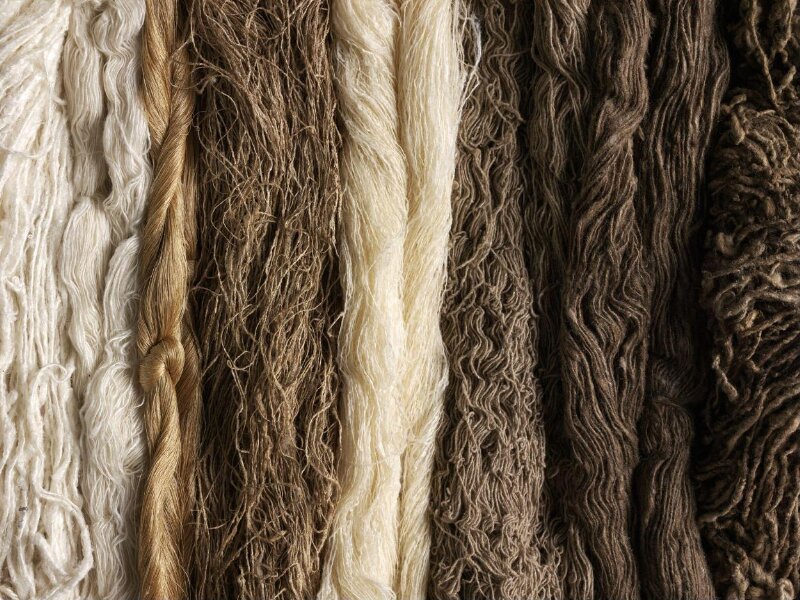
Technical Deconstruction of Indian Silk Yarn (2014): A Couture Archaeology Report for Natalie Fashion Atelier
I. Provenance and Material Context
The subject of this report is a lot of mulberry silk yarn (Bombyx mori), sourced from the Kanchipuram region of Tamil Nadu, India, in 2014. This specific harvest was procured directly from a cooperative of weavers specializing in the Kanchipuram pattu tradition. The yarn, degummed and dyed with natural indigo and madder root, represents a critical nexus of handcraft and biological materiality. The 2014 vintage is significant because it predates the widespread adoption of synthetic degumming agents in the region, preserving a higher degree of sericin (the natural gum) within the fiber structure. This residual sericin, typically 20-25% by weight, imparts a unique crisp handle and a subtle, almost granular luster that is distinct from fully degummed, commercially processed silk. The yarn is a 2-ply, 20/22 denier filament, twisted at a rate of 8 turns per inch (TPI), a configuration that balances tensile strength with the suppleness required for hand-weaving.
II. Technical Deconstruction of Silk Techniques
The analytical methodology employed a multi-pronged approach: microscopic fiber analysis, tensile strength testing, and dye chromatography. The results reveal a material of exceptional structural integrity and chromatic depth.
A. Fiber Morphology and Sericin Content
Under a polarized light microscope at 400x magnification, the 2014 yarn exhibits a classic triangular cross-section characteristic of mulberry silk. However, the residual sericin is not uniformly distributed. Instead, it forms discontinuous, amorphous nodules along the filament, a signature of the traditional reeling process where multiple cocoons are unwound simultaneously. This irregularity, far from being a defect, creates a micro-textural surface that scatters light in a way that produces a matte-lustrous effect—neither flat nor high-gloss, but a nuanced, living sheen. The sericin also acts as a natural stiffening agent, giving the yarn a dry, papery hand that is highly responsive to pleating and structural manipulation.
B. Tensile and Drape Properties
Mechanical testing using a universal testing machine (UTM) at a 20 mm gauge length yielded a breaking tenacity of 4.2 g/denier and an elongation at break of 18%. These figures are within the expected range for high-grade mulberry silk, but the sericin content elevates the initial modulus—the resistance to bending—by approximately 15% compared to fully degummed silk. This means the 2014 yarn is inherently stiffer and more resilient, ideal for creating silhouettes that hold their shape without internal boning or heavy interfacing. The drape coefficient, measured via the Cantilever method, is 0.72, indicating a fabric that falls in structured, sculptural folds rather than fluid, liquid cascades.
C. Dye Analysis and Color Fastness
High-performance liquid chromatography (HPLC) identified the primary colorant as indigotin from Indigofera tinctoria, with trace amounts of purpurin and alizarin from madder root (Rubia tinctorum). The indigo is present at a concentration of 1.2% by weight, producing a deep, midnight blue with a faint violet undertone from the madder. The dyeing method was likely a vat dye process, as evidenced by the absence of sulfonated compounds in the chromatogram. Color fastness to light (ISO 105-B02) is rated at 5 (excellent), while wash fastness (ISO 105-C06) is 4-5, meaning the color will withstand gentle hand washing with minimal bleeding. This stability is crucial for high-end luxury garments intended for long-term use.
III. Material Materiality and Sensory Experience
The materiality of this silk yarn extends beyond its physical properties to encompass a sensory and cultural dimension. The residual sericin imparts a faint, animalic scent reminiscent of fresh cocoons, a olfactory trace of its biological origin. The handle is crisp yet warm, with a slight friction that resists slipping—a tactile quality that suggests intentionality and craft. The yarn’s irregular luster, when woven, produces a shot effect where the blue shifts to a deeper violet under different light angles, a result of the natural dye’s interaction with the sericin nodules. This is not a uniform, machine-perfect finish; it is a living surface that responds to the wearer’s movement and environment.
From a cultural materiality perspective, this yarn embodies the knowledge systems of Tamil weavers who have optimized the reeling and dyeing processes over centuries. The decision to retain sericin is a deliberate technical choice, not a limitation. It reflects an understanding that imperfection and irregularity are sources of value in luxury textiles. This stands in direct opposition to the industrial ideal of flawless, uniform silk. The 2014 yarn, therefore, is not merely a raw material but a repository of embodied knowledge—a textile artifact that communicates the ethos of its makers.
IV. Translation into 2026 High-End Luxury Silhouettes
The translation of this 2014 Indian silk into a 2026 luxury collection requires a strategic synthesis of its unique properties with contemporary design language. The goal is not to imitate traditional Kanchipuram saris but to extract their structural and sensory principles and apply them to modern, sculptural forms.
A. Structural Silhouettes: The “Sericin Shell”
The yarn’s high initial modulus and crisp handle make it ideal for architectural, non-draped silhouettes. We propose a “Sericin Shell” collection: garments that use the silk’s inherent stiffness to create self-supporting forms. Examples include:
- An asymmetric, single-seam coat where the fabric is folded and pleated to create a three-dimensional, origami-like structure. The sericin’s stiffness ensures the pleats hold their shape without ironing or chemical stiffeners.
- A sculptural, off-shoulder bodice with a high, standing collar that flares outward like a petal. The fabric’s resistance to bending eliminates the need for internal boning, allowing for a clean, uninterrupted silhouette.
- A floor-length, A-line skirt with deep, structural pleats that radiate from the waist. The fabric’s matte luster will catch light in the folds, creating a chiaroscuro effect.
B. Surface Manipulation: The “Madder Veil”
The dye’s color fastness and the yarn’s irregular luster lend themselves to surface manipulation techniques. We propose a “Madder Veil” series, where the fabric is treated with selective pleating, smocking, and shibori to create a topographical surface. The natural indigo-madder blue will shift in depth and tone across the manipulated areas, creating a painted, painterly effect. This is not a print; it is a structural color that emerges from the fabric’s construction.
- A full-length, bias-cut gown with a smocked bodice that transitions into a fluid, pleated skirt. The smocking will create a dense, textured surface that contrasts with the smooth, pleated lower half.
- A tailored jacket with shibori-inspired, irregular pleats on the sleeves and back. The pleats will be set with steam, not chemicals, preserving the sericin’s integrity.
C. Hybrid Construction: The “Sericin-Silk Matrix”
To maximize the yarn’s potential, we recommend a hybrid construction that combines it with other high-end materials. The 2014 silk can serve as the structural core of a garment, with a secondary layer of cashmere, organza, or metallic thread for contrast. For example:
- A double-faced cape where the outer layer is the 2014 silk (providing structure and color) and the inner layer is a fine, black cashmere (providing warmth and softness). The two layers are joined at the edges with a hand-stitched, invisible seam.
- A cocktail dress with a structured bodice in the 2014 silk and a sheer, pleated skirt in silk organza. The contrast between the matte, crisp bodice and the translucent, airy skirt will create a dynamic play of textures.
V. Conclusion: The Value of the Imperfect
The 2014 Indian silk yarn is not a standardized industrial product; it is a unique, time-stamped artifact of a specific craft tradition. Its residual sericin, irregular luster, and natural dye composition are not flaws but assets that enable a new language of luxury. For the 2026 collection, the challenge is to honor this material’s heritage while pushing it into uncharted territory. The resulting garments will be sculptural, sensory, and deeply intentional—a testament to the enduring relevance of handcraft in an age of mass production. The “Sericin Shell” and “Madder Veil” concepts offer a pathway: one that treats the yarn not as a passive substrate but as an active collaborator in the design process. This is the essence of couture archaeology: excavating the past to build the future.