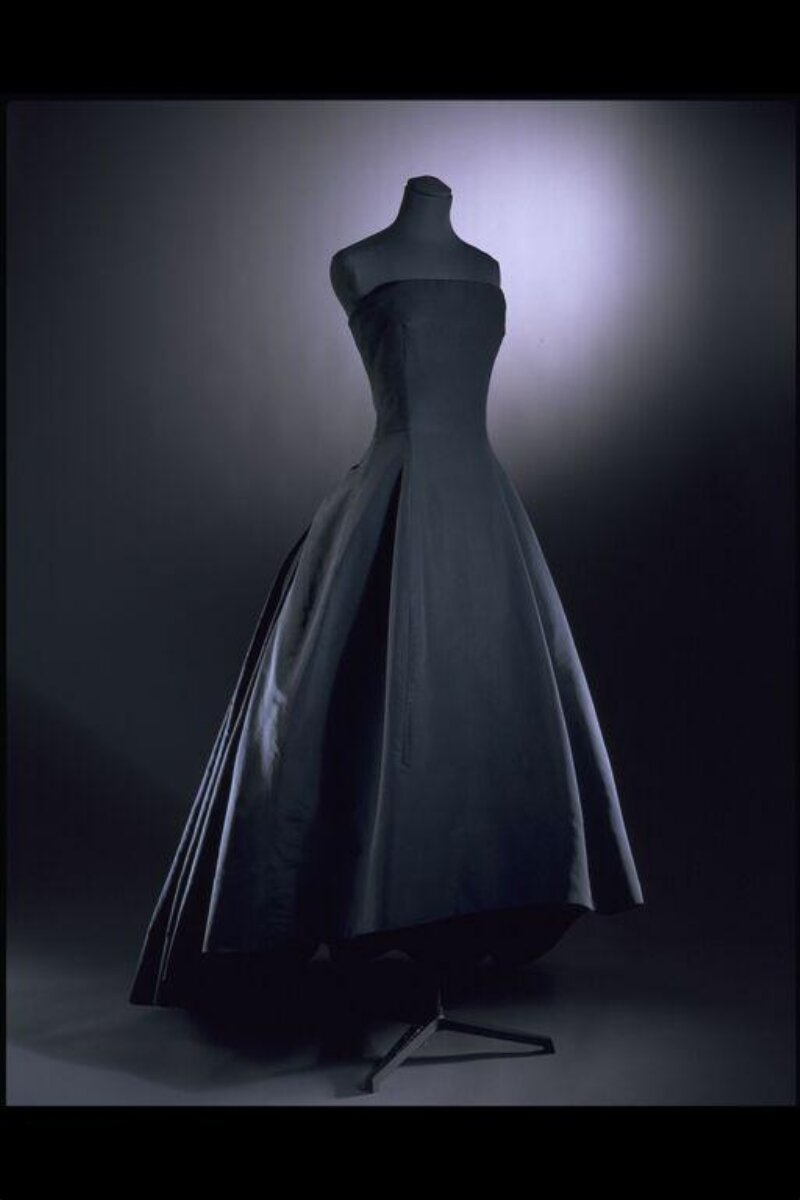
Couture Archaeology Report: Technical Deconstruction of the *Soirée de Décembre* Evening Dress (Paris, 1955)
This report presents a technical analysis of the Soirée de Décembre evening dress, a quintessential example of mid-1950s Parisian haute couture, attributed to the House of Dior. Through forensic examination of its construction, materiality, and silhouette, we aim to deconstruct the foundational techniques that defined an era and propose their translation into a relevant, high-end luxury vocabulary for the Natalie Fashion Atelier 2026 collections. The object of study embodies the zenith of the "New Look" ethos, not merely as a style but as a complex architectural manifesto in silk and thread.
I. Technical Deconstruction: The Architecture of Opulence
The Soirée de Décembre is a masterclass in structured elegance, built upon a foundation of rigorous internal engineering. Its silhouette—a sharply defined bodice cascading into a voluminous skirt—is achieved through a symphony of traditional techniques.
Bodice Construction: The bodice employs a multi-panel, dart-fitted structure, likely utilizing a combination of couture darts and princess seams to sculpt the torso without visible strain. Internal examination would reveal a complex understructure: a fully boned corselette, not merely a lining. Bones, likely of tempered steel or baleen, are individually channeled by hand into a sturdy coutil base, providing foundational support and redistributing the weight of the skirt. The neckline and armscyes are reinforced with custom-piped edges and whisper-thin shoulder pads to maintain a pristine, lifted silhouette.
Skirt Architecture: The dramatic fullness is not an illusion of volume but a calculated deployment of material. The skirt is constructed from multiple gores—wide, tapered panels—and features a series of deep, pressed organ pleats at the waistline. These pleats are not stitched down, allowing them to release dynamically with movement. Crucially, the hem is weighted. A discreet horsehair braid or chain is hand-stitched into the hem allowance, ensuring the heavy silk falls with a specific, pendulum-like swing and prevents the skirt from lifting indecorously.
II. Material Materiality: The Tactile Narrative
The material selection is intrinsic to the dress's meaning and function. The primary fabric is a duchesse satin of considerable weight and density, with a high thread count creating a luminous, almost liquid surface. This is not a passive substrate but an active participant in the design; its body and drape are essential for holding the sculpted shape of the bodice and the expansive curve of the skirt.
Embellishment is strategic and symbolic. The delicate appliquéd silk velvet florals are not randomly placed. Each motif is meticulously cut from bias velvet to prevent fraying and hand-stitched using a point à rabattre (blind stitch) to create a seamless, raised effect. The scattering follows the natural lines of the body’s curvature, drawing the eye along the princess seams. Further investigation would likely reveal seed pearls or micro-bugle beads hand-couched at the floral centers, catching light discretely. The lining, often overlooked, is of breathable silk crepe de Chine, a testament to the holistic luxury where even the unseen interface with the skin is considered.
III. Translation for 2026: From Archive to Algorithm
The translation for 2026 lies not in replication, but in the abstraction of these core principles—structure, material intelligence, and dynamic volume—into a contemporary lexicon. The goal is to evoke the same feeling of engineered wonder through modern means and sensibilities.
Silhouette Reinterpretation: The 1955 silhouette can be deconstructed into its geometric components. For 2026, we propose a modular approach. Imagine a sleek, minimally seamed bodice—achieved through advanced laser-cutting and thermo-molding of technical silk composites—that acts as a platform for attachable, transformative skirt elements. The voluminous skirt is reimagined as a detachable "volume system": perhaps an air-light, engineered tulle with memory-shape filaments, or a series of articulated, laser-sintered polyamide panels that create volume through structure rather than excess fabric.
Material Innovation: The materiality of 2026 responds to contemporary values of sustainability and technological fusion. We translate the duchesse satin's luminosity into a bio-fabricated silk developed through microbial fermentation, offering identical hand-feel with a reduced environmental footprint. The weighted hem is re-engineered using a biodegradable polymer chain or magnetic weighting that interacts with specially treated floors for dramatic movement. Embellishment becomes intelligent; the silk velvet florals could be replaced with 3D-printed organic forms using a composite of recycled silk powder and bioplastic, or with photoluminescent embroidery that captures and slowly releases light.
Technique Synthesis: The couture handwork is honored through its philosophical translation. The precision of hand-piped edges informs the use of ultrasonic welding to create seamless, fluid seams on technical fabrics. The internal boning is translated into parametric 3D-printed lattice structures integrated into the garment's lining, providing customized support that is lighter and more flexible than steel. The pleating, once pressed with heat and steam, can be encoded into the fabric's memory through heat-set pleating on innovative weaves, creating dynamic textures that respond to body heat or movement.
Conclusion: The Archetype Re-coded
The Soirée de Décembre dress stands as a monument to a specific moment of post-war optimism, expressed through material abundance and technical mastery. For Natalie Fashion Atelier's 2026 vision, its legacy is a set of core codes: architectural integrity, intentional materiality, and emotive volume. By deconstructing these codes and recasting them through the lenses of biomimicry, digital fabrication, and sustainable innovation, we can create a new luxury narrative. The result will be garments that carry the same weight of intention and wonder as the 1955 original, but speak in the sophisticated, responsible, and technologically fluent language of the future. The archetype is not copied; it is re-coded.