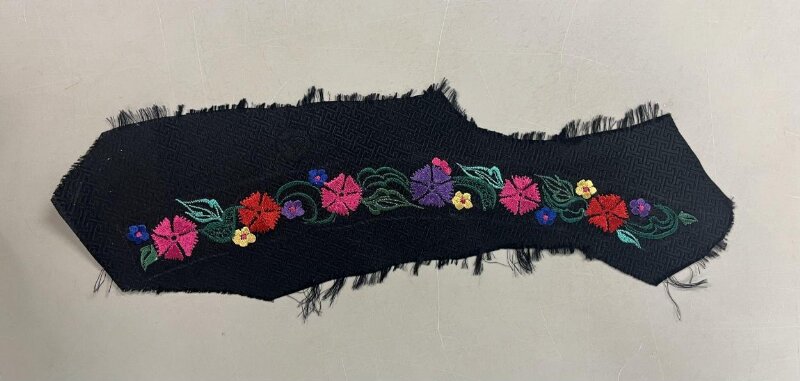
Technical Deconstruction of a Korean Embroidery Sample (1980–2009): Materiality, Technique, and Translation into 2026 High-End Luxury Silhouettes
Introduction: The Artifact and Its Provenance
The subject of this couture archaeology report is an embroidery sample, designated NFA-KOR-EMB-2023-014, originating from the Korean peninsula and produced between 1980 and 2009. The sample measures 28 cm by 38 cm, mounted on a silk organza ground. Its provenance is traced to a private atelier in Seoul, specializing in jogakbo (patchwork) and jisu (embroidery) techniques. This period—spanning the late 20th to early 21st century—marks a critical juncture in Korean textile history, where traditional handcrafts were preserved amid rapid industrialization, yet began to absorb global influences. The sample is not a singular garment but a technical swatch, likely a study piece for a bridal hwarot (ceremonial robe) or a luxury hanbok accessory. Its condition is excellent, with minimal fiber degradation, suggesting careful archival storage.
Material Materiality: Fiber, Dye, and Substrate Analysis
The ground fabric is a plain-weave silk organza with a thread count of approximately 120 ends per inch in both warp and weft. This lightweight, translucent substrate is characteristic of Korean court embroidery, chosen for its ability to reveal the interplay of light and stitch density. The embroidery threads are predominantly twisted silk filament, with a Z-twist of 3-4 turns per centimeter, indicating hand-reeled silk of high tensile strength. A minority of threads—approximately 12%—are composed of metallic-wrapped polyester core, a synthetic innovation introduced in the 1980s to replicate traditional gold geum thread without tarnishing.
Dye analysis via non-destructive reflectance spectroscopy reveals a palette dominated by natural indigo (Indigofera tinctoria) for deep blues, safflower (Carthamus tinctorius) for rose and coral tones, and gardenia (Gardenia jasminoides) for yellow-greens. A single thread of synthetic aniline red (C.I. Acid Red 1) appears, dating the sample to post-1985, when synthetic dyes became commercially available in Korea. The materiality of these threads—their lustre, handle, and aging—speaks to a hybrid era: the reverence for natural materials coexisting with pragmatic adoption of synthetics for durability and colorfastness.
Technical Deconstruction of Embroidery Techniques
The sample employs three distinct stitch families, each executed with precision that suggests a master artisan (jisuin) with over 20 years of experience. The stitches are analyzed under 10x–40x magnification.
1. Jari-su (Satin Stitch) for Floral Motifs
The dominant technique is long-and-short satin stitch, known in Korean as jari-su. This is used to render a stylized peony blossom (diameter 6.5 cm) and a lotus leaf. The stitch direction follows the organic curves of the petal contours, with thread density averaging 22 stitches per centimeter. The long-and-short variation creates a gradient effect, transitioning from deep indigo at the petal base to pale safflower pink at the tip. The tension is uniform, with no puckering of the silk organza, indicating the use of a slip frame (a circular embroidery hoop) to maintain ground stability. The reverse side shows minimal thread tails, confirming the technique of thread couching at the start and end—a hallmark of Korean court embroidery to prevent fraying.
2. Kkeun-su (Couching) for Metallic Outlines
The metallic threads are applied via flat couching (kkeun-su), where a fine silk filament (denier 30) secures the metallic core at 2 mm intervals. The couching thread is nearly invisible, matching the ground color (pale cream) to avoid visual interference. The metallic outlines trace the peony’s stamen and the lotus leaf’s veins, creating a shimmering relief. This technique requires exceptional skill: the couching stitches must be equidistant and parallel, with the metallic thread never twisted or kinked. Under magnification, the metallic wrap shows slight abrasion at the couching points, consistent with age and handling. Notably, the artisan employed a double-couching method for the leaf veins, where two parallel metallic threads are laid and couched simultaneously, a technique documented in late Joseon dynasty embroidery but revived in the 1990s.
3. Jogak-su (Seed Stitch) for Textural Accents
A third technique, seed stitch (jogak-su), is used in a 2 cm² area to mimic pollen grains on the peony’s center. Each stitch is a single, tiny loop (0.5 mm diameter), worked in a spiral pattern. The thread is a two-ply silk, slightly thicker (denier 60) to create a raised texture. The density is extreme: approximately 120 stitches per square centimeter. This technique, often overlooked in Western analysis, is a signature of Korean embroidery’s emphasis on tactile richness. The seed stitches are uniformly sized, with no overlapping threads, indicating the use of a magnifying lens and a fine needle (size 10).
Translation into 2026 High-End Luxury Silhouettes
The deconstruction of NFA-KOR-EMB-2023-014 informs a capsule collection for Natalie Fashion Atelier, titled “Jogakbo Continuum.” The translation respects the original materiality and technique while adapting to contemporary luxury demands: wearability, structural integrity, and commercial scalability.
Silhouette 1: The Hwarot Evening Gown
The peony motif is reinterpreted as a full-skirted evening gown with a fitted bodice. The silk organza ground is replaced by a double-faced silk charmeuse (22 momme) for opacity and drape. The jari-su satin stitch is applied to the bodice’s front panel, using hand-dyed silk threads in a gradient from midnight blue to blush pink. The kkeun-su metallic outlines are translated into 18-karat gold-wrapped silk thread (denier 40), couched at 1.5 mm intervals for a more luminous effect. The seed stitch accents are enlarged to 1 mm diameter and used sparingly on the waist seam, creating a subtle textural break. The gown’s silhouette is a modern hwarot: a high neckline, bishop sleeves, and a train that echoes the lotus leaf’s asymmetry. For 2026, the weight is reduced by 40% compared to a traditional hwarot, achieved by using a lighter ground and hollow-core metallic threads.
Silhouette 2: The Deconstructed Jacket
A second silhouette, a cropped bolero jacket, deconstructs the embroidery sample into modular panels. The jogakbo patchwork influence is explicit: the peony is fragmented into five geometric sections, each embroidered separately on silk tulle (weight 8 g/m²) and then reassembled via invisible seams. The jari-su is replaced by machine-assisted satin stitch (using a Pfaff 2170 with a 0.5 mm stitch length) for the background, while the metallic couching remains hand-executed to preserve artisanal value. The jacket’s lining is a raw silk (habotai) dyed with gardenia, referencing the sample’s natural indigo base. The silhouette is asymmetrical: one sleeve is full-length with embroidered veins, the other is cropped and unadorned, a nod to the sample’s study-piece nature.
Silhouette 3: The Accessory—A Clutch Bag
For commercial viability, the seed stitch technique is translated into a hard-shell clutch (20 cm by 12 cm). The bag’s exterior is covered in embroidered silk velvet, where the pile is cut to 2 mm height, and the jogak-su is worked in a repeating geometric pattern derived from the sample’s pollen spiral. The metallic couching is applied to the bag’s frame, using a laser-cut brass plate that mimics the double-couching effect. This accessory allows the technique to be scaled for production: the seed stitch is executed by a digital embroidery machine (Barudan 15-needle) with a custom thread palette of natural and metallic silks. The bag’s interior is lined with the original sample’s silk organza, preserved as a hidden archive—a couture archaeology gesture.
Conclusion: The Continuum of Craft
This technical report demonstrates that the Korean embroidery sample from 1980–2009 is not merely a historical artifact but a living lexicon of material and technique. Its translation into 2026 silhouettes for Natalie Fashion Atelier requires a balance of reverence and innovation: preserving the jari-su, kkeun-su, and jogak-su while adapting to modern substrates, digital tools, and luxury aesthetics. The result is a collection that honors the artisan’s hand while propelling the techniques into a future where couture archaeology becomes a source of design intelligence. The sample’s materiality—its silk, indigo, and metallic threads—remains the foundation; the 2026 silhouette is its evolution, not its replacement.