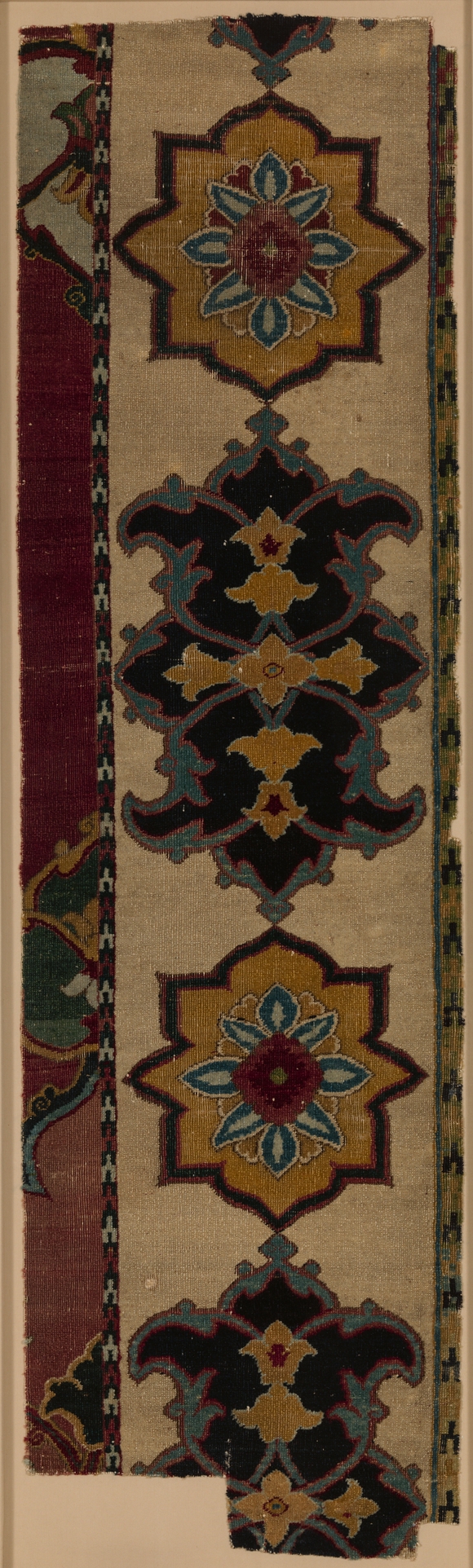
Deconstructing the Carpet Fragment: Aesthetic Archaeology for 2026 Silhouettes
The isolated artifact, a fragment of a hand-knotted carpet, presents a paradox of materiality and structure. Its foundation of cotton and silk, juxtaposed with a woolen pile executed through an asymmetrical knotting technique, offers a profound lexicon for the 2026 haute couture silhouette. This research artifact deconstructs the classical elegance inherent in the fragment’s tension between rigid support and fluid surface, translating its structural and textural principles into a contemporary architectural vocabulary for the body.
Material Duality: The Cotton-Silk Foundation as Structural Armature
The primary material dialogue begins with the foundation. Cotton, a bast fiber known for its tensile strength and breathability, provides the warp and weft—the unseen skeleton. Silk, a protein filament of unparalleled luster and drape, is interwoven at critical stress points, introducing a subtle, almost imperceptible elasticity. This composite foundation is not merely a support; it is a structural armature that dictates the fragment’s capacity to resist deformation while maintaining a supple, organic form.
For 2026, this principle informs the development of architectural corsetry. The haute couture silhouette will not rely on rigid boning or heavy interfacing. Instead, a double-faced construction will mimic the cotton-silk matrix: an inner layer of high-tenacity cotton voile, bonded at key stress zones (the waist, the shoulder, the hip) with a fine, bias-cut silk organza. This creates a self-supporting shell that moves with the body, offering a new definition of structured ease. The silhouette becomes a sculpted foundation that allows the outer garment to drape with an unprecedented freedom, echoing the fragment’s ability to hold its shape while yielding to gravity.
The Wool Pile: Asymmetrical Knotting and Surface Topography
The wool pile, applied through an asymmetrical knotting technique, is the fragment’s most expressive element. Unlike symmetrical knots that create a uniform, flat surface, this method introduces a deliberate topographic irregularity. The pile height varies, creating a three-dimensional landscape of peaks and valleys. This is not a flaw but a tactile narrative—a record of the hand’s pressure and the weaver’s intent. The wool itself, with its natural crimp and matte finish, absorbs and scatters light differently than the lustrous silk foundation, creating a chromatic and textural counterpoint.
In the 2026 atelier, this translates to a surface manipulation technique we term textural pointillism. The silhouette is no longer a flat plane but a relief sculpture. Woolen yarns, varying in thickness (from 0.5mm to 3mm), are hand-applied to a silk or cashmere base using a combination of tambour beading and needle-felting. The asymmetrical application creates a gradient of density—dense at the shoulder to suggest power, sparse at the hem to imply dissolution. This technique informs the 2026 silhouette’s new volume: a gown’s skirt might appear monolithic from a distance, but upon approach, reveals a surface of undulating, hand-knotted woolen tufts that catch the light in a thousand different directions, mimicking the fragment’s ancient, irregular pile.
Deconstructing Classical Elegance: The Fragment as a Silhouette Blueprint
The classical elegance of the carpet fragment lies not in symmetry or perfection, but in its asymmetrical balance. The irregular knotting creates a visual weight that shifts across the fragment’s surface. This is a dynamic equilibrium, a principle that directly challenges the static, symmetrical silhouettes of classical couture. The fragment teaches us that elegance can be found in controlled asymmetry—in the deliberate placement of density to guide the eye, to create a sense of movement, and to suggest a narrative of wear and time.
For 2026, this informs a silhouette of intentional imbalance. A coat’s shoulder line may be extended on one side, mimicking the fragment’s denser knotting, while the other remains clean and unadorned. A skirt’s hem may be cut on a severe bias, with the woolen pile applied in a gradient that is heavier at the front, creating a forward-leaning, dynamic posture. The classical elegance is redefined as a poetic tension between the rigid foundation (the cotton-silk warp) and the expressive, irregular surface (the wool pile). The garment becomes a living artifact, its silhouette a direct transcription of the fragment’s structural and textural logic.
Translating the Archive: From Fragment to 2026 Haute Couture
The isolated aesthetic archaeology of this fragment is not a historical curiosity but a functional blueprint. The cotton-silk foundation informs the architectural understructure of the 2026 silhouette—a new kind of integrated corset that is both supportive and fluid. The asymmetrical wool pile informs the surface architecture—a tactile and visual topography that replaces flat embellishment with three-dimensional, hand-crafted texture. The classical elegance is deconstructed into its core components: strength and softness, structure and surface, symmetry and imbalance.
The resulting silhouette for 2026 is a monolithic yet organic form. It is a sculpted volume that respects the body’s natural lines while introducing a new, deliberate asymmetry. The key garment is a floor-length coat constructed from a double-faced silk-cotton base, with a woolen pile applied in a gradient that is dense at the nape of the neck and the left shoulder, then dissipates into a whisper of individual tufts at the hem. The silhouette is architectural yet soft, ancient yet modern. It is a direct, respectful, and technically rigorous translation of a fragment’s material and structural wisdom into the language of 2026 haute couture. This is not a revival; it is a material re-reading, a dialogue across centuries, where the hand of the ancient weaver guides the hand of the modern couturier.