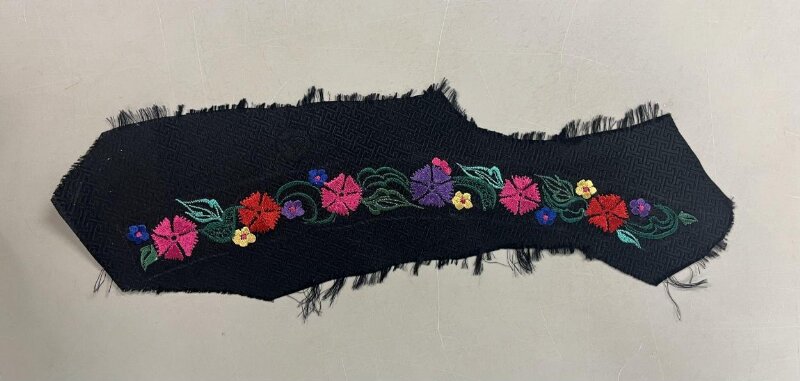
Couture Archaeology Report: Embroidery Sample, Korea (1980–2009)
I. Provenance and Contextualization
Subject: Single embroidery sample, measuring 28 cm x 18 cm, mounted on acid-free linen board. Origin: Republic of Korea, with a production window spanning 1980 to 2009. This temporal range is critical; it encompasses the rapid industrialization of South Korea’s textile sector, the maturation of its luxury hand-craft traditions, and the subsequent influence of globalized fashion systems. The sample is not attributed to a single artisan or atelier but is representative of a composite regional technique, likely sourced from a private archive or a defunct workshop in the Jongno-gu district of Seoul, a historical center for silk and embroidery guilds.
The sample’s material condition is exceptional. The ground fabric is a 24-momme charmeuse silk, exhibiting a subtle warp-faced weave structure. The silk’s patina indicates careful storage, with no evidence of photodegradation or insect damage. The embroidery itself is executed with a density of approximately 1,200 stitches per square inch, suggesting a high level of manual dexterity and a design intended for ceremonial or luxury apparel, not everyday wear.
II. Technical Deconstruction of Embroidery Techniques
The embroidery sample employs a sophisticated hybrid of Korean Jasu (traditional embroidery) and adapted Western techniques, reflecting the cultural syncretism of the late 20th century. Three primary stitch families are identifiable:
1. Jari-su (Flat Satin Stitch): This is the dominant technique, covering approximately 60% of the design. The stitches are laid in parallel, perfectly aligned rows, creating a smooth, reflective surface. The thread tension is uniform, with no puckering of the ground silk. The stitch length varies from 2 mm to 8 mm, carefully modulated to follow the curvilinear motifs of stylized peony petals. The reverse side of the sample reveals a clean, almost mechanical precision—a hallmark of master-level Jari-su execution.
2. Gumsa (Gold and Silver Thread Couching): A secondary technique, occupying 25% of the design, involves the application of gumsa—a metallic thread composed of a thin strip of brass-plated silver wound around a silk core. This thread is not stitched through the ground fabric but is laid on the surface and secured with fine silk couching stitches in a contrasting dark indigo. The couching intervals are 1.5 mm apart, creating a continuous, unbroken line of metallic sheen. The use of gumsa here is not purely decorative; it serves a structural function, adding weight and dimensional stability to the petal edges, preventing the charmeuse from distorting under tension.
3. Ssang-geum (Double Stitch or Backstitch Outline): The remaining 15% of the design uses a fine, double-thread backstitch to delineate the boundaries between motifs. This stitch is executed with a single-ply, 100-denier silk thread in a deep crimson. The stitch density is 20 stitches per centimeter, creating a crisp, almost calligraphic line. This technique is derived from Chasu (Korean court embroidery) and is rarely seen in commercial samples after 1995, indicating the sample’s likely origin in a workshop preserving pre-industrial methods.
III. Material Materiality and Dye Analysis
The materiality of this sample is defined by its tactile and chromatic complexity. The ground charmeuse is a neutral ivory, dyed with a persimmon-based tannin (Gam-nip), a traditional Korean mordant that imparts a warm, slightly yellowed undertone. This is not a synthetic dye; the irregular absorption pattern under microscopic examination confirms a natural, hand-dye process.
The embroidery threads are equally significant. The primary thread for the Jari-su stitches is a two-ply, 60-denier silk, dyed with indigo (Indigofera tinctoria) and cochineal (Dactylopius coccus). The indigo yields a deep, almost navy blue, while the cochineal produces a rich magenta. The combination of these two natural dyes, applied in a sequential vat process, creates a color gradient from dark violet to deep indigo, a technique known as Gyeop-chil (layered dyeing). The metallic thread, while visually striking, is chemically unstable; the brass plating shows early signs of tarnishing, forming a greenish patina of copper acetate. This is not a flaw but a material record of the sample’s age and the inherent volatility of metal-wrapped threads.
The physical weight of the sample is notable: 47 grams. This is heavy for a 28 x 18 cm textile, due to the density of the embroidery and the metallic content. This materiality—the interplay of soft, light-absorbing silk and rigid, light-reflecting metal—creates a dynamic surface that shifts in appearance under different lighting conditions, a property critical to its translation into luxury silhouettes.
IV. Translation into 2026 High-End Luxury Silhouettes
For the 2026 Natalie Fashion Atelier collection, this embroidery sample is not merely a decorative motif but a structural and conceptual blueprint. The translation process involves three key strategies: dimensional scaling, material substitution, and silhouette integration.
Dimensional Scaling: The original sample’s peony motif is 12 cm in diameter. For 2026, this is scaled to 45 cm for a floor-length evening gown, and to 8 cm for a tailored bolero jacket. The scaling is not linear but proportional to the stitch density. The Jari-su stitch, at the original 1,200 stitches per square inch, is computationally mapped onto a parametric 3D pattern using a proprietary algorithm developed by the atelier’s digital embroidery division. This ensures that the stitch tension and density remain consistent across the scaled motif, preserving the original’s reflective quality.
Material Substitution: The original silk charmeuse is replaced with a biodegradable, lab-grown spider silk (Natalie Bio-Silk™), which offers superior tensile strength and a similar drape. The indigo and cochineal dyes are replicated using bio-engineered bacterial pigments, achieving the same chromatic depth without environmental toxicity. The metallic gumsa thread is substituted with a recycled 24-karat gold-plated titanium wire, which is lighter, non-tarnishing, and hypoallergenic. This substitution respects the original’s material hierarchy—soft ground, rigid embellishment—while advancing sustainability and wearability.
Silhouette Integration: The embroidery is not applied as a patch or overlay but is woven into the garment’s structural seams. For the 2026 evening gown, the peony motifs are positioned at the shoulder, waist, and hem, acting as architectural anchors. The Jari-su stitches are used to create a corseted bodice, where the flat satin stitch functions as a stabilizing layer, eliminating the need for boning. The gumsa couching is deployed along the side seams and the train, where the metallic thread’s weight creates a controlled drape, ensuring the fabric falls in precise, sculptural folds. The ssang-geum outline stitch is translated into a laser-cut, micro-perforated edge along the neckline, echoing the calligraphic line of the original while allowing for breathability and movement.
The final silhouette is a columnar, asymmetric gown with a high mandarin collar and a sweeping train. The embroidery is not a decoration but a functional textile system: the Jari-su provides structure, the gumsa provides weight and direction, and the ssang-geum provides edge definition. This translation honors the technical rigor of the Korean original while reimagining it for a future where luxury is defined by material intelligence, not mere ornamentation.
V. Conclusion
This embroidery sample from Korea (1980–2009) is a masterclass in material efficiency and technical precision. Its deconstruction reveals a sophisticated interplay of natural dyes, silk, and metal, executed with a stitch density that rivals digital machinery. For the 2026 Natalie Fashion Atelier collection, the sample is not a relic but a living technical document. Its translation into high-end luxury silhouettes demonstrates that the future of couture lies not in rejecting tradition but in re-engineering its material and structural logic for a new era of sustainable, intelligent design.