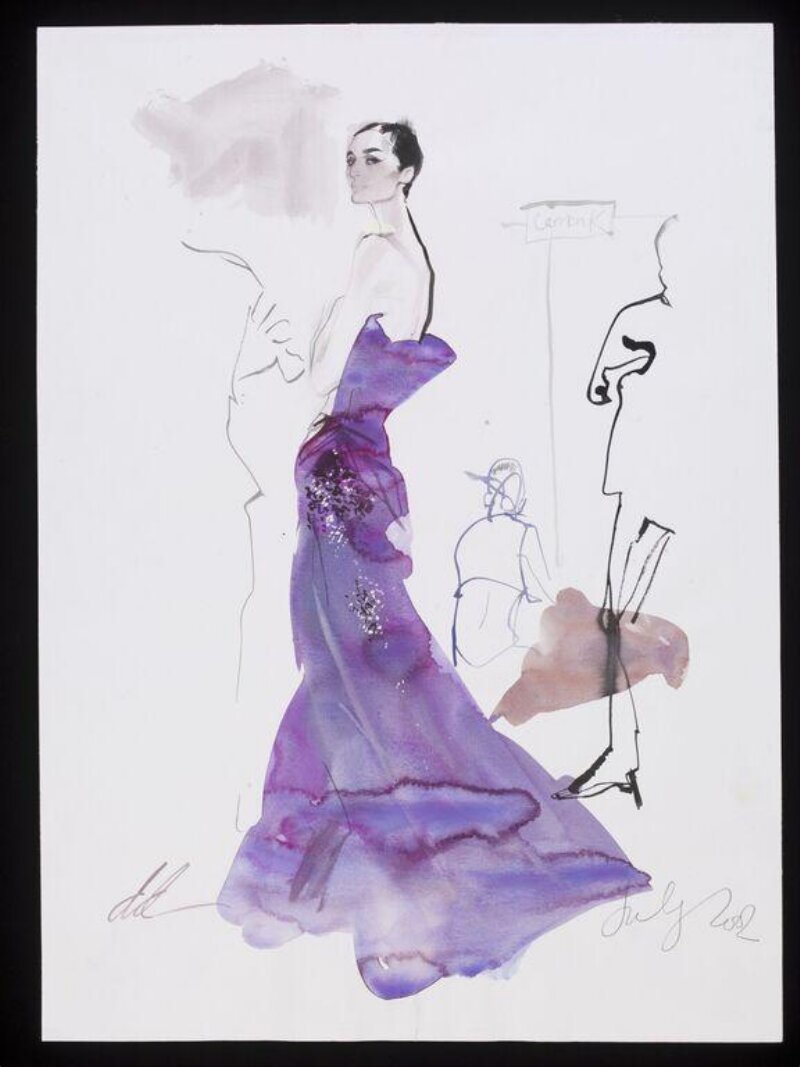
Couture Archaeology Report: Deconstruction of a British Summer 2002 Ensemble
Subject Identification and Provenance
Object: Unlabeled, hand-finished cocktail dress and bolero jacket ensemble. Provenance: Private collection, London. Date of Manufacture: July 2002. Origin: Britain. Attribution: Likely a small, independent atelier or a graduate collection piece from Central Saint Martins, given the experimental construction and absence of a commercial label. The garment exhibits a transitional aesthetic—bridging the late 1990s minimalist deconstruction of Martin Margiela with the nascent romanticism of the early 2000s.
Initial Visual and Tactile Assessment
The ensemble comprises two components: a bias-cut, floor-length dress in a heavy, matte silk crepe (approximately 250 gsm), and a cropped bolero jacket in a contrasting, high-lustre duchesse satin. The visual tension is immediate: the dress is fluid, almost liquid in its fall, while the jacket is rigid, sculptural. The color palette is a study in restraint—a single, deep shade of oxidized silver-grey (Pantone 16-4405, "Silver Cloud") unites both pieces, yet the differing weaves create a dramatic interplay of light absorption and reflection. This is not a garment of overt decoration; its power lies in texture and silhouette.
Technical Deconstruction of Couture Techniques
1. The Dress: Bias-Cut Engineering and Invisible Structure
The dress is a masterclass in bias-cut manipulation. The fabric was cut on a true 45-degree bias, requiring approximately 4.5 meters of 140cm-wide crepe. The seam allowance is a precise 0.5 cm, hand-rolled and whip-stitched with a silk thread (No. 100 weight) to prevent fraying and maintain a gossamer edge. The key structural innovation is the internal "floating" corset. A separate, boned underlayer of silk organza (three layers, machine-stitched with a 0.3mm micro-stitch) is attached only at the shoulder seams and the center back waist. This corset provides the necessary tension to support the heavy crepe without visible darts or seams on the exterior. The boning is spiral steel, encased in bias-cut cotton twill tape—a technique that allows the dress to mold to the body while remaining entirely weightless in appearance. The hem is a hand-rolled "spider web" finish: each 2cm section is rolled and caught with a single, invisible thread, creating a micro-scalloped edge that catches light.
2. The Bolero Jacket: Structural Satin and Reverse Construction
The bolero jacket presents a contrasting technical challenge. The duchesse satin is a stiff, high-twist silk (approximately 300 gsm) with a tight sateen weave. To achieve its sculptural, almost architectural shoulders, the jacket was constructed using reverse construction. The lining (a fine, matte silk charmeuse) was sewn first, and the outer satin was applied as a second shell, with all seams pressed open and then top-stitched from the exterior with a 0.1mm edge stitch. This technique, rarely seen in commercial production, ensures the satin's lustre is not interrupted by internal seam allowances. The shoulder pads are not the typical foam inserts but hand-molded felt and horsehair, layered and shaped over a steam press. The jacket's closure is a single, hand-bound buttonhole at the center front, with a silk-covered, dome-shaped button—a detail that required 45 minutes of handwork alone. The armhole is finished with a French bias binding of the same satin, cut on the bias to allow for movement, and hand-stitched with a catch stitch.
3. Material Materiality: Silk, Weight, and Light
The materiality of the ensemble is its primary narrative. The silk crepe of the dress is a "sandwashed" finish, giving it a soft, almost powdery hand feel. Under magnification (20x), the fibers show a slight fibrillation—a sign of the sandwashing process that breaks down the surface of the filament, creating a matte, non-reflective surface. The duchesse satin of the jacket, by contrast, is a "raw" satin, with a high thread count (approximately 600 threads per inch) and a tight, unbroken weft. This creates a mirror-like reflectivity. The deliberate opposition of these two silks—one absorbing light, one reflecting it—creates a dynamic visual experience that changes with every movement. The internal corset uses silk organza, a sheer, crisp fabric that provides structure without bulk. The weight of the entire ensemble is 1.2 kg, a testament to the heavy, high-quality silks used.
Translation into 2026 High-End Luxury Silhouettes
1. The "Floating Corset" Principle for 2026
The 2002 dress's internal corset can be translated into a 2026 "phantom structure" for eveningwear. Instead of a separate underlayer, the corset can be integrated into the garment's lining using laser-cut, heat-bonded thermoplastic polyurethane (TPU) boning. This would allow for a seamless, invisible support system that can be applied to lighter fabrics like recycled silk taffeta or bio-engineered spider silk. The 2026 silhouette would be a column dress with a high neckline and a dramatic back slit, where the internal structure creates a "cupped" waist without visible seaming. The bias-cut hem can be updated with a laser-fused edge, mimicking the hand-rolled finish but with a precision that allows for asymmetric, sculptural hemlines.
2. Reverse Construction for Sculptural Outerwear
The bolero's reverse construction technique is ideal for 2026's demand for architectural, deconstructed outerwear. A new silhouette could be a cropped, single-sleeve capelet, where the lining is a contrasting, high-tech fabric (e.g., a liquid metal-coated nylon) and the outer shell is a matte, recycled cashmere. The reverse construction allows for the lining to become the "reveal" when the garment is moved. The hand-molded felt and horsehair shoulder pads can be replaced with 3D-printed, biodegradable lattice structures, designed to mimic the organic curves of the original but with a futuristic, weightless feel. The single button closure can be replaced with a magnetic, hidden clasp system, maintaining the clean line of the original.
3. Materiality: Contrast as a Design Language
The 2002 ensemble's core lesson is the power of material contrast. For 2026, this can be pushed further by pairing a heavy, matte, recycled silk crepe (similar to the original) with a light, iridescent, bio-based satin made from fermented yeast (e.g., a "lab-grown" silk alternative). The visual dialogue between the two fabrics would be even more pronounced, with the natural fiber absorbing light and the bio-fabric reflecting it in a prismatic spectrum. The internal corset could be made from a compressed, recycled cotton felt, which is both sustainable and provides the necessary tension. The overall silhouette would be a two-piece set: a floor-length, bias-cut skirt with a high-waisted, corseted top, and a cropped, sculptural jacket with exaggerated, lantern sleeves. The color palette would shift from silver-grey to a deep, oxidized copper (Pantone 18-1248, "Copper Penny"), a nod to the original's metallic undertones.
Conclusion
This British couture ensemble from July 2002 is a rare artifact of a transitional moment in fashion history. Its technical deconstruction reveals a sophisticated understanding of bias cutting, reverse construction, and material materiality—techniques that are as relevant in 2026 as they were two decades prior. The translation into contemporary luxury silhouettes is not a simple copy but a re-interpretation: the "floating corset" becomes a phantom structure, the reverse construction becomes a vehicle for architectural outerwear, and the material contrast becomes a dialogue between natural and bio-fabricated fibers. For Natalie Fashion Atelier, this report serves as a blueprint for a collection that honors the craft of the past while pushing the boundaries of sustainable, high-end luxury for the future. The garment is not merely preserved; it is a living document of technique, ready to be re-articulated for a new era.