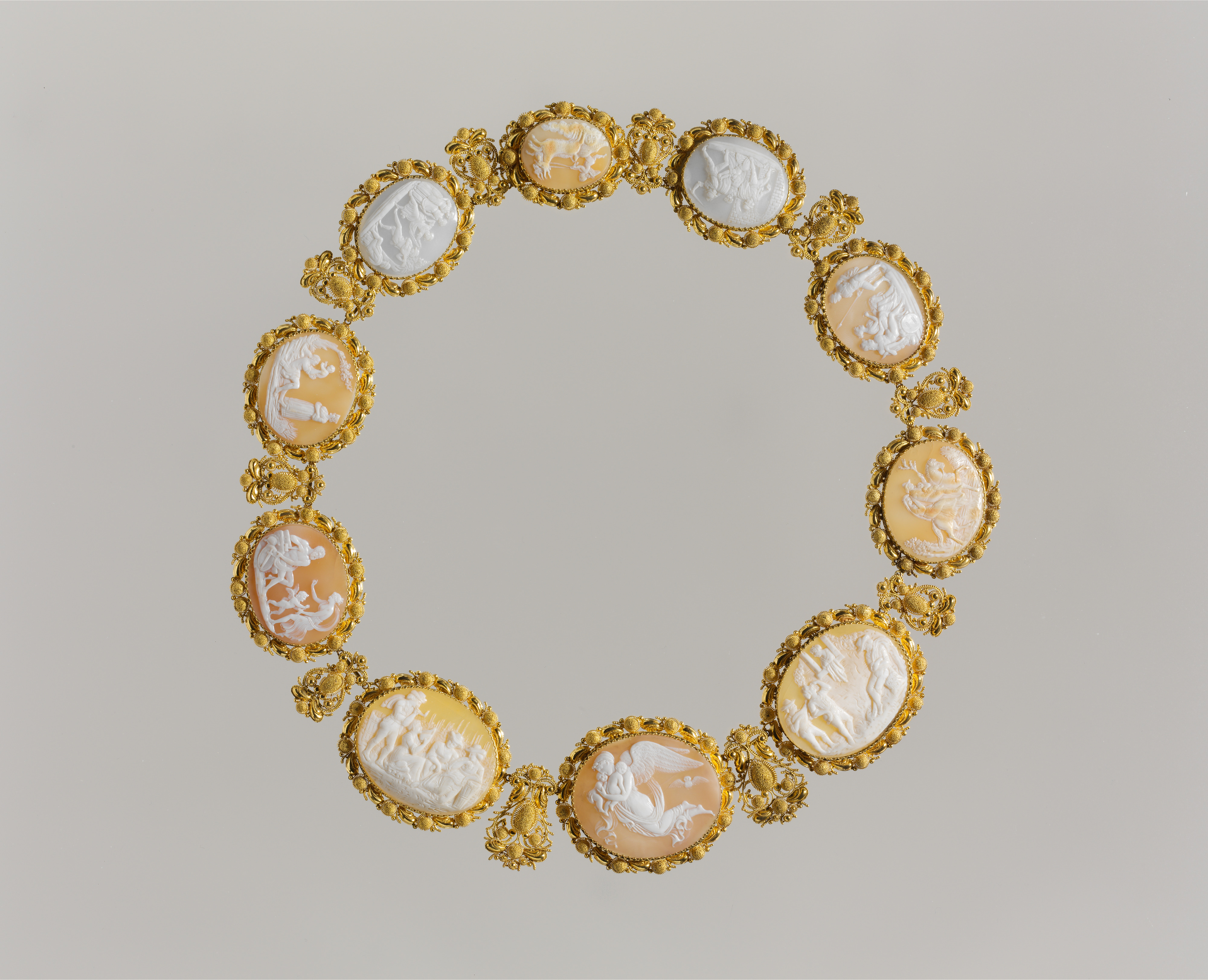
Deconstructing the Classical: The Cassia rufa Shell Necklace as a Blueprint for 2026 Silhouettes
Within the hallowed archives of Natalie Fashion Atelier, we engage in a practice we term aesthetic archaeology: the excavation of form, material, and symbolic resonance from historical artifacts to inform the future of couture. Our present subject, a singular necklace from a lost set, presents a compelling paradox. Its materiality—a union of gold and Cassia rufa shell—speaks to a global heritage of adornment, yet its design language is one of radical, isolated restraint. This artifact is not merely a decorative object; it is a tectonic diagram for the 2026 luxury silhouette. By deconstructing its classical elegance, we unlock a new grammar of volume, texture, and structural tension.
I. Materiality as Structural Narrative: Gold and the Cassia rufa Shell
The necklace’s primary dialogue is between two profoundly different materials. The gold, worked with a hammered, almost granular finish, provides a foundation of enduring, luminous weight. It is not a polished, reflective surface but a matte, organic one—a deliberate choice that evokes the texture of sun-baked earth or ancient, weathered metal. This gold is the architectural armature, the unyielding structure that defines the piece’s perimeter.
In stark contrast, the Cassia rufa shell—a rare, naturally occurring material from the Indo-Pacific—is the element of organic, ephemeral beauty. Its surface is a study in muted iridescence, shifting from a deep, almost charcoal grey to a whisper of rose and gold under changing light. The shell is not carved into a uniform bead; rather, it is presented in its natural, undulating form, a series of thin, overlapping plates that resemble the scales of a mythical creature or the petals of a fossilized bloom. This is not a polished gem; it is a fossilized fragment of a living world, carrying the memory of water, current, and time.
This juxtaposition—the rigid, metallic structure versus the fragile, organic element—is the core of the necklace’s aesthetic archaeology. It teaches us that luxury in 2026 will not be about perfect, homogenous surfaces, but about the tension between the permanent and the transient. The gold provides the silhouette’s skeleton; the shell provides its soul.
II. Deconstructing the Silhouette: From Necklace to Garment Architecture
The necklace’s form is deceptively simple: a series of graduated, overlapping shell plates are strung on a fine gold chain, but the chain is not the primary support. Instead, the shells are mounted onto a hidden, rigid gold collar—a collar of structural integrity that sits away from the neck, creating a negative space. This is not a necklace that rests; it is a necklace that floats. The shells cascade from this collar in an asymmetrical, almost geological formation, mimicking a cliff face or a riverbed.
This architectural principle—a rigid, hidden armature supporting a fluid, organic overlay—is directly translatable to the 2026 haute couture silhouette. We see this informing three distinct garment typologies:
1. The Sculpted Bodice: The gold collar becomes a boned, corseted structure of metallic lace or rigid, matte silk. This structure is not meant to compress the body, but to float slightly away from it, creating a defined, architectural frame. The Cassia rufa shells, in turn, become a series of overlapping, hand-painted silk organza petals or laser-cut leather scales that are individually mounted onto this frame. The result is a bodice that appears to be a living, breathing organism—a protective carapace that is both armor and adornment. The negative space between the body and the garment becomes a critical design element, a void that emphasizes the garment’s independent structure.
2. The Asymmetrical Skirt: The necklace’s cascading, geological formation informs a new kind of skirt. A single, weighted seam—a line of gold-threaded embroidery or a chain of precious metal beads—anchors the garment at the hip. From this seam, a series of graduated, unhemmed panels of heavy crepe or duchesse satin fall in an irregular, organic cascade. These panels are not cut in a straight line; they are shaped to mimic the shell’s natural undulation, creating a silhouette that is both fluid and architectonic. The hem is not a line, but a topography—a landscape of varying lengths and volumes that moves with the wearer like a wave.
3. The Shoulder Mantle: The necklace’s most direct translation is into a shoulder piece or mantle for an evening gown. A rigid, gold-embroidered collar sits at the nape of the neck, from which a series of shell-like, molded resin or porcelain plaques cascade down the back. These plaques are not attached to the gown itself; they are suspended from the collar, creating a second skin that moves independently of the garment. This creates a powerful, sculptural effect—a fossilized waterfall draped across the shoulders, a direct echo of the necklace’s original form.
III. The 2026 Aesthetic: The Archaeology of Elegance
The necklace’s classical elegance is not one of symmetry or perfect proportion. It is an elegance born of asymmetry, texture, and material honesty. The gold is not hidden; it is celebrated for its weight and texture. The shell is not polished to a uniform shine; its natural, fossilized surface is left intact. This is a lesson in material integrity that will define the 2026 luxury sensibility.
For the Atelier, this translates into a commitment to tactile luxury. Fabrics will not be chosen for their visual perfection alone, but for their memory—the way a handwoven silk crepe holds a crease, the way a matte metallic thread catches the light, the way a piece of unpolished shell feels against the skin. The silhouette will be defined by structural tension: the clash between a rigid, hidden corset and a fluid, organic overlay; the negative space between the garment and the body; the asymmetrical cascade of a hemline that refuses to conform to a straight line.
This is not a nostalgic revival of a historical form. It is a deconstruction and reconstruction of the principles that made that form enduring. The Cassia rufa shell necklace is not a relic to be copied; it is a tectonic diagram for a new kind of couture—one that is grounded in material truth, architectural rigor, and a profound respect for the organic, the asymmetrical, and the ephemeral. In 2026, elegance will be found not in the perfect line, but in the beautifully imperfect topography of a garment that has been excavated from the deepest archives of the earth and the imagination.