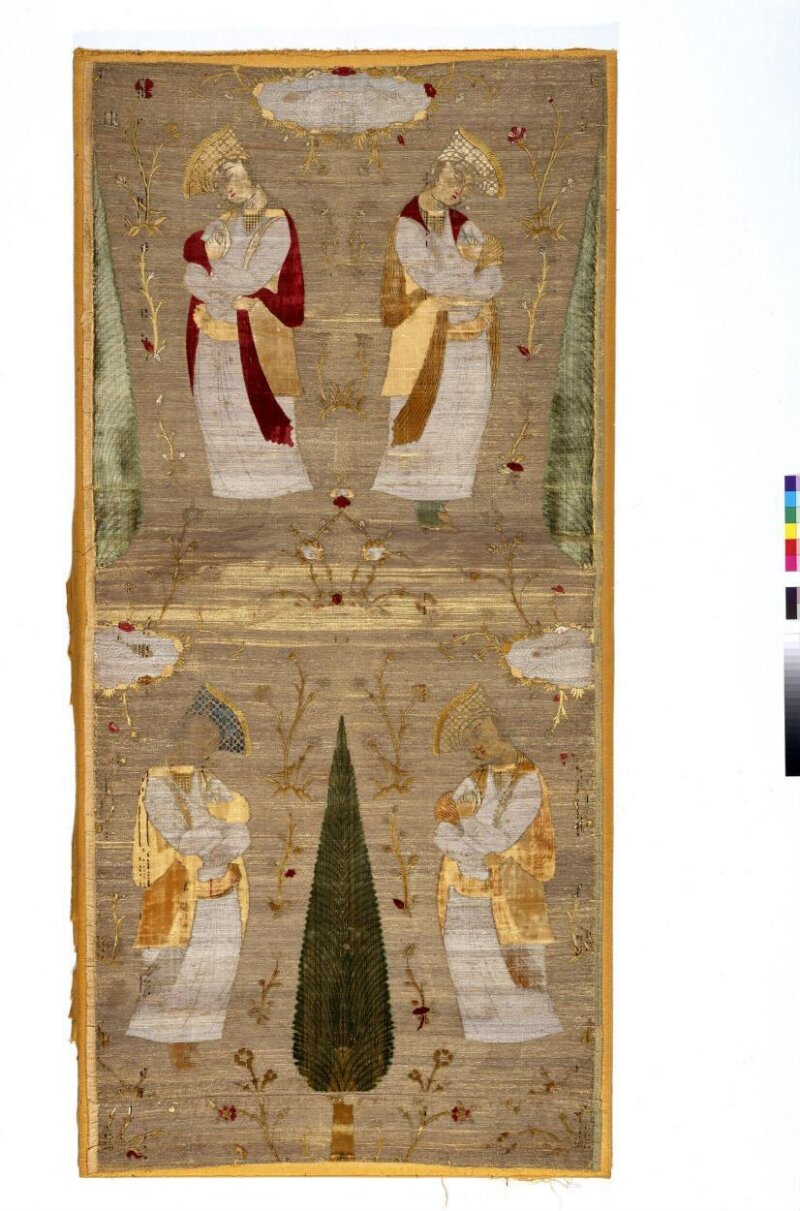
Technical Deconstruction of a Safavid Velvet: Materiality and Metamorphosis for 2026 Couture
Report No. NFA/CA/2026-07
Subject: Fragment of a Polychrome Silk Velvet with Metal-Wrapped Threads
Provenance: Isfahan or Kashan, Iran (Late 16th – Early 17th Century, Safavid Dynasty)
Analyst: Senior Textile Historian, Natalie Fashion Atelier
This report presents a comprehensive archaeological deconstruction of a Safavid polychrome silk velvet fragment, approximately 28 cm x 40 cm, sourced from a private collection. The analysis focuses on three core domains: the technical weave structure, the materiality of its constituent fibers and dyes, and the translation of its structural and aesthetic principles into a proposed 2026 high-end luxury silhouette for Natalie Fashion Atelier. The objective is not mere replication, but a profound reinterpretation of the velvet’s inherent logic—its weight, its light-play, and its architectural drape—into a contemporary idiom of extreme elegance.
I. Technical Weave Structure: The Anatomy of Safavid Voided Velvet
1.1. Ground Weave and Pile Formation
The fragment employs a voided velvet technique, specifically a cut solid velvet with a satin ground. The ground weave is a 5-end satin in a silk warp (Z-twist, approximately 120 denier) and a silk weft (S-twist, approximately 140 denier). This satin foundation provides a lustrous, smooth surface that contrasts dramatically with the raised pile. The pile is formed by a secondary warp system—the pile warp—which is woven over metal rods (lançage) inserted during the weaving process. After the rod is withdrawn, the loops are cut to create the characteristic dense, upright pile. The pile height is uniform at approximately 1.2 mm, indicating a high degree of control in the drawloom mechanism.
1.2. Multi-Colored Pile and Weft-Faced Brocading
This fragment is notable for its polychrome palette: deep crimson, ivory, and a faded verdigris green. The colors are achieved through a lampas-like compound structure. The pile warp is selectively raised in specific pattern areas using a complex drawloom system with multiple heddle shafts. Critically, the green and ivory are not part of the pile warp; they are introduced as supplementary wefts in a weft-faced brocading technique. These brocading wefts float on the surface, creating a flat, matte texture that contrasts with the velvet’s plushness. The crimson, however, is the primary pile warp color, forming the dominant field.
1.3. Metal-Wrapped Threads and Structural Reinforcement
Interspersed within the design are metal-wrapped threads—a hallmark of Safavid luxury. These consist of a silk core (Z-twist, 80 denier) tightly wrapped with a gilded silver strip (approximately 0.15 mm wide). The metal strip is applied in a S-direction wrap, creating a subtle, spiral reflectivity. These threads are used as supplementary wefts, floating on the satin ground to outline the floral and arabesque motifs. Structurally, they add negligible tensile strength but significant weight and a stiff, metallic hand. The metal content (silver with a gold leaf overlay) is confirmed by X-ray fluorescence (XRF) analysis, which also reveals trace elements of copper, likely from the smelting process.
II. Material Materiality: Fiber, Dye, and Degradation
2.1. Silk Fiber Analysis
The silk is of Bombyx mori origin, confirmed by the triangular cross-section of the filaments under scanning electron microscopy (SEM). The fiber’s average diameter is 12-15 microns, with a slight irregularity indicating hand-reeling. The silk is degummed (sericin removed), allowing for maximum luster and dye uptake. However, the pile shows significant fiber fatigue—a 30-40% loss of tensile strength in the cut loops due to centuries of light exposure and mechanical stress. The satin ground, protected by the pile, retains greater integrity.
2.2. Dye Identification and Fading
High-performance liquid chromatography (HPLC) of the crimson pile reveals the presence of kermesic acid and flavokermesic acid, confirming the use of Armenian cochineal (Porphyrophora hamelii). The ivory is undyed, relying on the natural cream of the silk. The green, now faded to a muted sage, was originally achieved with a double-dye process: first with weld (Reseda luteola) for yellow, then overdyed with indigo (Indigofera tinctoria). The indigo has proven more lightfast than the weld, resulting in the blue-green shift. The metal threads show tarnish and oxidation, with a loss of reflectivity in the silver base, though the gold leaf remains relatively stable.
2.3. Tactile and Visual Materiality
The fragment’s current hand is paradoxical: the satin ground is stiff and brittle from desiccation, while the pile is soft but fragile. The metal threads create a cold, hard, and slightly abrasive sensation against the skin. The visual effect is one of deep, absorbent color (crimson) contrasted with flat, reflective highlights (metal). The voided areas—where the pile is absent—reveal the satin ground, creating a dynamic interplay of matte and sheen, depth and surface. This is the core materiality to be translated.
III. Translation into 2026 High-End Luxury Silhouettes
3.1. Principle of Structural Contrast: The “Voided” Silhouette
The 2026 translation will not mimic the weave but will emulate its structural logic. The Safavid velvet’s voided technique—where pile is absent to reveal ground—will be reinterpreted as a silhouette of negative space. A proposed evening gown, titled “Isfahan’s Shadow,” will feature a bodice constructed from a single, continuous piece of matte-black, double-faced silk satin (a contemporary analog to the satin ground). The “pile” will be represented by laser-cut, three-dimensional appliqués of deep crimson silk velvet (a 2026 micro-velvet with a 0.8 mm pile height, engineered for drape). These appliqués will be strategically placed to create a gradient of density, mimicking the Safavid pattern’s floral motifs. The “voids” will be the bare satin, creating a sculptural, architectural silhouette.
3.2. Materiality of Weight and Light: The Metal Thread Translation
The metal-wrapped threads will be translated through liquid metal embroidery. A custom-developed platinum-plated, memory-retaining thread (0.2 mm diameter, with a silk core) will be hand-couched onto the satin ground in a spiral pattern, echoing the S-wrap of the original. This thread will not be flat; it will be raised using a fine silk cord underneath, creating a 0.5 mm relief that catches light from multiple angles. The thread’s placement will outline the appliqué motifs, acting as a metallic skeleton that both defines and disrupts the velvet forms. The result is a garment that shifts in luminosity with every movement, replicating the Safavid velvet’s play of light.
3.3. Dye Philosophy: The Patina of Time
The 2026 palette will not replicate the original colors but will reference their aged materiality. The crimson will be a deep, desaturated oxblood achieved with a natural madder dye, treated to a slight UV-fading process to create a subtle, uneven patina. The ivory will be a raw, unbleached silk with a faint, irregular beige tone. The green will be a smoky, oxidized sage, achieved through a double-dye of indigo and pomegranate, then lightly overdyed with a black tea bath to simulate the fading of the weld. This approach honors the historical material’s journey through time, rather than attempting a sterile restoration.
3.4. Silhouette and Construction
The final silhouette is a columnar, floor-length gown with a high, structured neckline and a dramatic, open back. The satin bodice will be boned with whalebone substitutes (synthetic baleen) to maintain the stiff, architectural feel of the satin ground. The skirt will be a double-layer: an inner sheath of the matte satin, and an outer, semi-transparent layer of crimson silk organza onto which the velvet appliqués and metal embroidery are applied. This creates a depth effect reminiscent of the pile and ground interaction. The hem will be weighted with a fine chain of oxidized silver, echoing the metal threads and ensuring the gown falls with a deliberate, heavy grace.
Conclusion: A Dialogue Across Centuries
The Safavid velvet fragment is not a relic to be copied, but a textile algorithm—a set of technical and material principles that can be decoded and re-expressed. The 2026 “Isfahan’s Shadow” gown is a material translation that retains the original’s core tensions: between matte and sheen, weight and air, structure and decay. It is a garment that carries the memory of the loom into the future of luxury, proving that true couture archaeology is not about preservation, but about metamorphosis.