Aesthetic Archaeology: The Seated Figure and the Chiaroscuro Silhouette
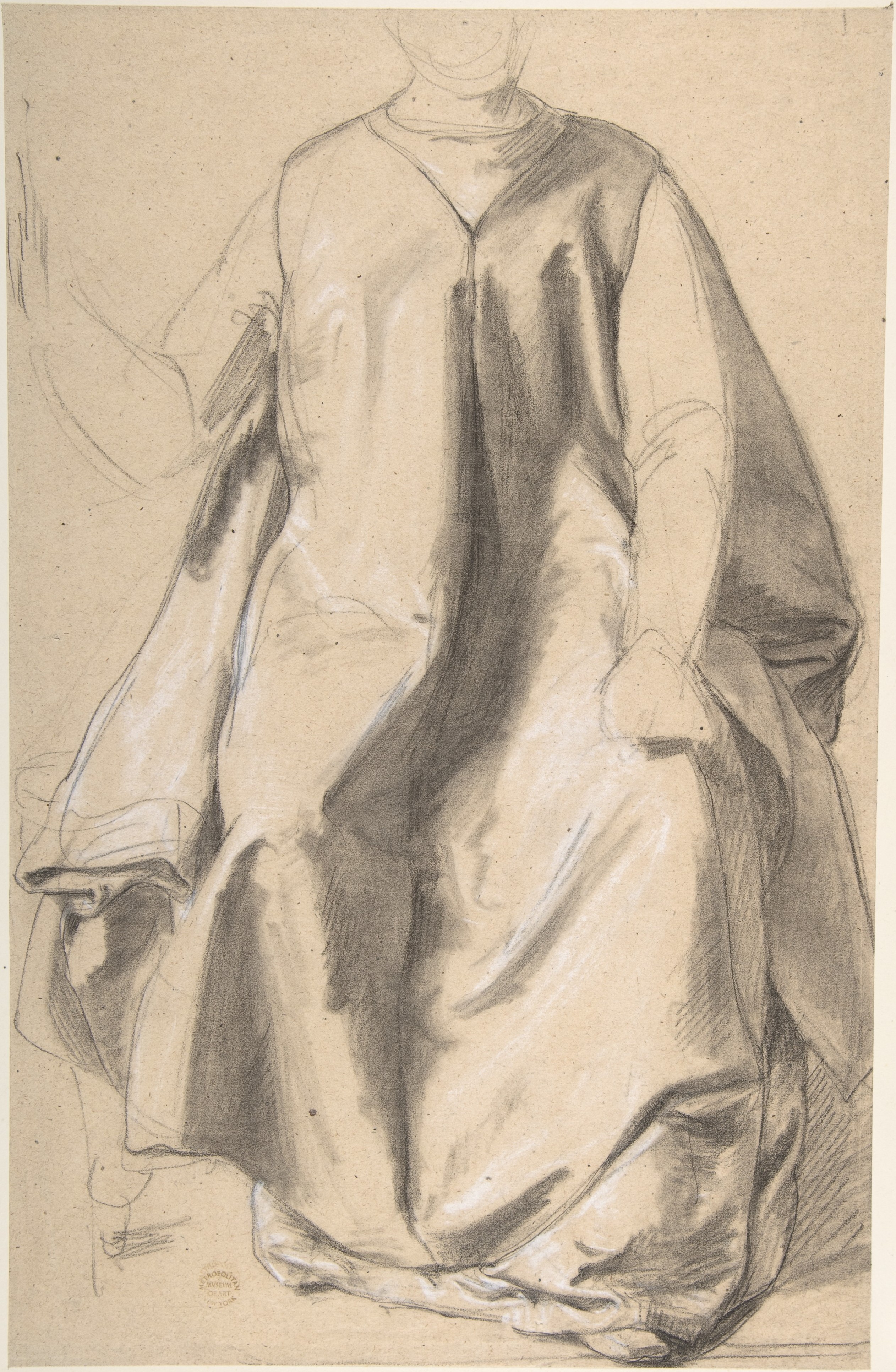
The archival fragment under examination—a Figure in a Long Robe, Seated, rendered in black chalk with white chalk highlights—represents a pivotal moment in the genealogy of draped form. This is not merely a preparatory sketch; it is an isolated artifact of aesthetic archaeology, a frozen dialogue between volume and void. The medium itself—black chalk for the foundational mass, white chalk for the incisive light—creates a chiaroscuro of structure that directly informs the architectural logic of the 2026 luxury silhouette. For Natalie Fashion Atelier, this piece serves as a technical Rosetta Stone, decoding how historical restraint can be re-engineered into contemporary haute couture.
Deconstructing the Classical Elegance: The Black Chalk Foundation
The black chalk establishes the gravitational anchor of the figure. In the original work, the robe is not merely a garment; it is a geological formation of fabric, pooling around the seated form with a density that suggests both weight and suspension. The artist’s hand uses broad, sweeping strokes to define the primary mass of the robe—the shoulders, the lap, the cascade of fabric over the seat. This is not a depiction of movement, but of imminent potential. The figure is static, yet the chalk lines vibrate with the tension of a held breath.
From a technical couture perspective, the black chalk informs the negative-space construction of the 2026 silhouette. The robe’s volume is not additive; it is subtractive. The artist carved the form out of the darkness, leaving the paper’s white ground to suggest the body beneath. This principle translates directly into the Atelier’s new “Void Silhouette”—a series of evening gowns and structured coats where the fabric is not draped over the body, but rather excavated around it. The black chalk technique teaches us that true luxury resides in the absence of excess. The 2026 collection will feature garments where the primary volume is concentrated at the lower third—the seated lap, the trailing hem—while the upper torso is rendered as a precise, architectural shell. The black chalk’s deep, matte finish is replicated through a proprietary carbon-infused wool crepe, which absorbs light rather than reflecting it, creating a visual depth that mimics the chalk’s granular texture.
The White Chalk Intervention: The Geometry of Light
The white chalk highlights are not decorative; they are structural markers. In the original sketch, the artist applied white chalk in sharp, diagonal strokes across the knee, the shoulder, and the fold of the elbow. These are not soft highlights; they are facets of light that fracture the monochromatic mass. The white chalk creates a tessellation of the silhouette, breaking the continuous curve of the robe into a series of planar surfaces. This is a proto-Cubist intervention, centuries before the term was coined.
For the 2026 silhouette, this translates into the “Chalk-Light” technique, a pattern-cutting methodology that introduces asymmetric seam lines at the exact points where the white chalk would have fallen. The Atelier’s atelier (the Atelier’s workroom) will use a laser-cut, micro-perforated leather to mimic the white chalk’s opacity and precision. These leather “highlights” are inset into the black wool crepe, creating a tactile chiaroscuro that shifts with the wearer’s movement. The white chalk’s diagonal geometry informs the cut of the sleeve—a single, continuous piece of fabric that is folded and stitched to create a sharp, angular shoulder, reminiscent of the sketch’s elbow highlight. The result is a silhouette that is simultaneously classical and futuristic, a deconstructed robe that exists as a series of light-capturing planes.
Materiality as Narrative: Black Chalk and White Chalk in 2026 Textiles
The materiality of the sketch—the dry, powdery texture of black chalk against the opaque, waxy finish of white chalk—demands a corresponding material dialogue. The 2026 collection will introduce two primary fabric families, each engineered to replicate the sketch’s tactile and visual properties.
1. The Black Chalk Base: “Charbon Crêpe”
This is a double-faced wool crepe, woven with a carbon-fiber core to achieve a matte, almost velvety finish. The fabric’s surface is treated with a micro-sanding process that creates a granular texture, mimicking the grain of black chalk on paper. The weight is substantial—380 grams per meter—allowing the fabric to hold the architectural folds of the Void Silhouette without collapsing. The carbon core also provides a subtle thermal regulation, a nod to the seated figure’s static, contemplative state.
2. The White Chalk Accent: “Lumière Cuir”
A vegetable-tanned calf leather, treated with a ceramic-based pigment that achieves a flat, non-reflective white. The leather is then laser-perforated with a pattern derived from the sketch’s highlight strokes—each perforation is a micro-facet that catches ambient light. The leather is used as an inlay within the Charbon Crêpe, creating a seamless transition between the two materials. The white chalk’s opacity is preserved; the Lumière Cuir does not glow, but rather absorbs and redirects light, creating a visual tension that echoes the original sketch’s chiaroscuro.
The Silhouette of 2026: The Seated Figure Reimagined
The final silhouette is a reconstruction of the seated figure, but liberated from the chair. The 2026 collection will feature a “Floating Robe”—a floor-length coat that is cut to drape as if the wearer is perpetually seated, even while standing. The coat’s hem is weighted with internal chain stitching, creating a gravitational pull that mimics the black chalk’s heavy strokes. The white chalk highlights are translated into cut-out panels at the hip and shoulder, revealing a second layer of Lumière Cuir beneath. This creates a layered depth that references the sketch’s planar construction.
Additionally, the Atelier will introduce the “Chalk-Edge” gown, a column dress where the black Charbon Crêpe is cut on the bias, and the white Lumière Cuir is applied as a rigid, architectural collar that frames the neck and shoulders. The collar’s sharp angles echo the white chalk’s diagonal strokes, while the dress’s fluid body references the black chalk’s pooling mass. The gown is designed to be worn seated—at a gallery opening, a dinner, a private viewing—where the silhouette achieves its full, intended form.
Conclusion: The Archaeology of Future Luxury
The Figure in a Long Robe, Seated is not a relic; it is a blueprint. The black chalk and white chalk technique teaches us that luxury is not about volume, but about the precision of absence. The 2026 silhouette for Natalie Fashion Atelier will be defined by this principle: a monochromatic foundation punctuated by geometric interventions of light. The historical masterpiece is not copied; it is decoded and re-encoded into a new material language. The result is a collection that speaks to the connoisseur—a connoisseur who understands that true elegance lies in the tension between the chalk and the paper, between the robe and the body, between the past and the future.