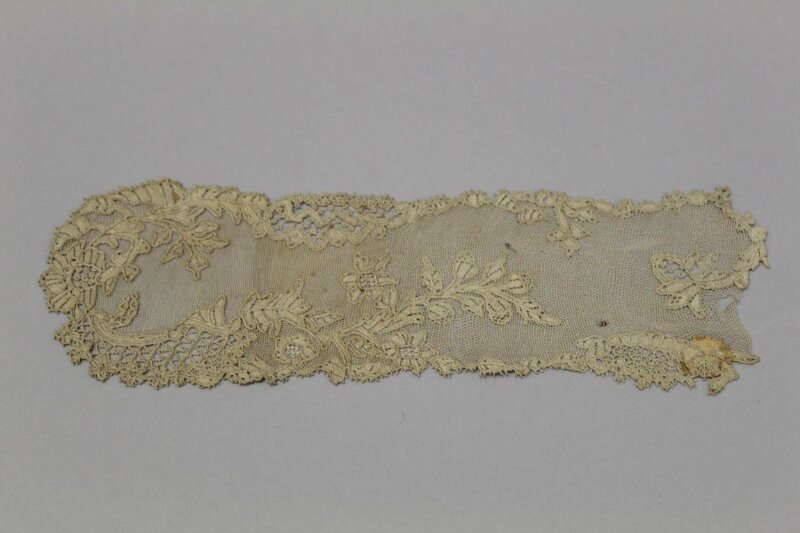
Couture Archaeology Report: The Carrickmacross Lace Revival
Subject: Carrickmacross Lace Appliqué & Guipure (c. 1854) Origin: County Monaghan, Ireland Analyst: Senior Textile Historian, Natalie Fashion Atelier Date: [Current Date] Projected Translation Season: Autumn-Winter 2026 High Couture
1. Technical Deconstruction & Historical Materiality
The specimen, originating from the foundational period of Irish lace-making revival, represents a sophisticated hybrid technique. Carrickmacross is not a needlepoint or bobbin lace, but an appliqué and guipure method, a distinction critical to its modern reinterpretation. The process is architecturally binary:
Stage One: The Appliqué. A fine muslin or net (traditionally cotton) is layered over a heavier silk or satin ground. The floral or arabesque design, drawn on paper, is placed beneath. The artisan then outlines the pattern by couching a finer thread onto the muslin, securing it with minute, invisible stitches. The excess muslin within the design is then meticulously cut away (à jour), leaving the motif anchored only by the couched thread. This creates a delicate, graphic silhouette against a potentially contrasting ground.
Stage Two: The Guipure. The true technical marvel lies in the fillings. The open spaces within and between the appliquéd motifs are filled with a series of needle-run stitches—bars, brides, and loops—worked directly onto the net ground. These form a self-supporting mesh (guipure), often with intricate geometric or textural variations (honeycomb, spiderweb). The result is a fabric of profound duality: the substantial, graphic appliqué and the ethereal, connective tissue of the guipure net.
Materiality: The 1854 context dictates materials of their era: unbleached cotton thread for its strength and matte finish, linen net for stability, and occasional silk satin grounds for luxury. The materiality is defined by tactile contrast—the crisp, raised appliqué against the sheer, structured net. The colour, almost exclusively ivory or ecru, focuses the eye purely on form, shadow, and texture, creating a sculptural effect reliant on ambient light.
2. Structural Analysis for Contemporary Translation
For translation into 2026 luxury silhouettes, we move beyond mere motif replication to a deconstruction of its core structural principles:
Principle A: The Floating Plane. The appliqué exists in a plane separate from the ground, connected by thread. This suggests modern techniques of 3D laser-cut organza layers, suspended on nearly invisible silicone monofilaments from a base garment, creating a dynamic, kinetic shadow-play as the wearer moves.
Principle B: The Structural Mesh. The guipure is not decorative but integral, a load-bearing lattice. This translates to technical lace engineered from ultra-fine, high-tensile polymers or fused metallic threads, capable of supporting minimalist silhouettes without underlying structure. Imagine a column gown where the entire bodice is a Carrickmacross-inspired architectural mesh, providing both coverage and transparency through its own integrity.
Principle C: Positive/Negative Space as Design. The à jour cutting is an act of deliberate removal. Modern interpretation could employ precision ultrasonic cutting on thermo-reactive fabrics, where removed sections contract to create a raised, rolled edge, mimicking the couched outline, or where the "negative" space is filled with a sheer, contrasting membrane of bio-silk.
3. Translation into 2026 High-End Luxury Silhouettes
The 2026 translation honours the artefact’s soul—its handmade paradox of strength and delicacy—through hyper-modern execution and silhouette.
Silhouette 1: The Architectural Column
A floor-length gown with a clean, sculptural line. The torso is rendered in a reinterpreted guipure using a bonded blend of matte ceramic micro-threads and silk, forming a rigid, self-supporting cuirass that graduates into softer appliqué at the hips. The appliqué motifs—abstracted from traditional shamrock and vine—are crafted from laser-sintered titanium coated in pearlescent resin, applied to a base of liquid wool crepe. The silhouette is a direct dialogue between the rigid (guipure) and the fluid (appliqué), between human form and architectural exoskeleton.
Silhouette 2: The Deconstructed Tailoring
A sharp, single-breasted blazer and wide-leg trouser set. The jacket’s entire back panel and lapels become the "ground" for a monumental, asymmetrical Carrickmacross-inspired panel. Traditional muslin is replaced with micro-pleated georgette, appliquéd with motifs cut from the jacket’s own wool-mohair fabric, creating a trompe l'oeil effect of fabric consuming itself. The guipure fillings are executed in chain-stitch embroidery via robotic looms, using thread with a core of shape-memory alloy, allowing the lace pattern to subtly change form with body temperature.
Silhouette 3: The Kinetic Sphere Gown
An evening gown comprising a simple silk slip dress over which a full-circle, floor-length overskirt of modular lace panels is worn. Each panel is a modern Carrickmacross "sample": large-scale appliqués of bioluminescent silk (treated with non-toxic, light-emitting proteins) on a ground of electrospun nano-fiber net. The guipure bridges are made of clear, flexible silicone tubing. The overskirt is engineered to rotate slowly with movement, transforming the gown into a dynamic display of light, shadow, and structural lace, a literal translation of the original’s dependence on ambient light into active luminescence.
4. Conclusion: The Archaeologist's Hand
The 1854 Carrickmacross specimen is not a relic, but a blueprint. Its value lies in its compound technique and philosophical approach to material contrast. For the 2026 Natalie Atelier collection, the translation is not pastiche but a process of technical molecular gastronomy: extracting the core principles (floating plane, structural mesh, positive/negative space) and recombining them with the material lexicon of the future. We preserve the haute main of the Irish convent workroom through the precision of AI-assisted design and robotic embroidery, ensuring each piece carries the ghost of the hand, amplified by the tools of tomorrow. The result will be a collection where heritage is not worn as surface, but engineered as structure—a true couture archaeology.