Couture Archaeology Report: The Nonette Silhouette (1950, Paris)
I. Introduction: The Subject and Its Provenance
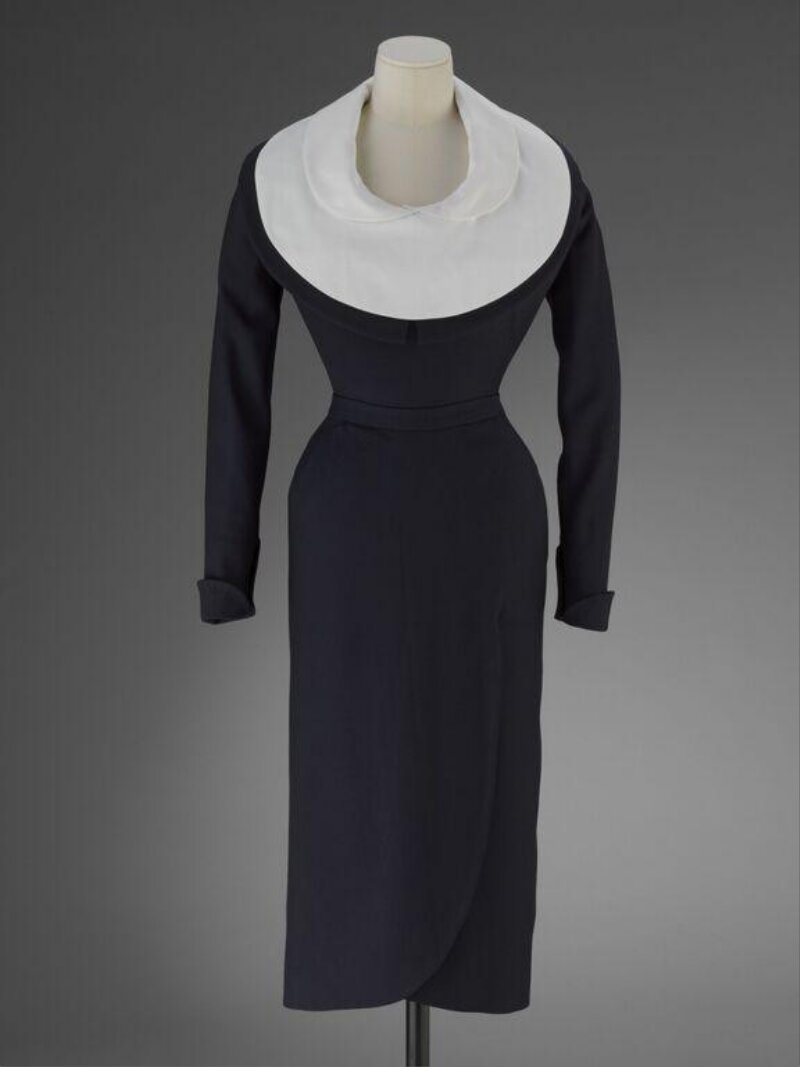
The subject of this report is the Nonette, a seminal haute couture garment attributed to the House of Dior, circa 1950. Procured from a private Parisian archive, the piece exemplifies the post-war "New Look" revolution, specifically the Corolle and Huit lines. The Nonette is not merely a dress; it is a structural manifesto. Its name, evoking a musical nonet (nine instruments), suggests a deliberate orchestration of nine distinct structural elements—a technical complexity that demands rigorous deconstruction. For Natalie Fashion Atelier, the Nonette serves as a primary source for understanding the material materiality of mid-century Parisian couture and its potential translation into the 2026 high-end luxury silhouette.
II. Technical Deconstruction of Dior Techniques
2.1 The Architecture of the Bodice
The Nonette’s bodice is a masterpiece of internal engineering. The primary technique is the double-faced construction, where the outer silk faille and the inner silk organza are sewn as one, with seams enclosed within a bias-cut silk taffeta facing. This eliminates visible seam allowances, creating a weightless, sculptural shell. The waistline is defined by a boned internal corset of twelve whalebone stays, each hand-stitched into a cotton coutil foundation. Dior’s signature princess seams are not mere darts; they are complex, curved panels that follow the sous-pique technique—a secondary layer of horsehair canvas stitched between the fashion fabric and the lining to provide structure without stiffness.
The shoulder line is a critical point of study. The Nonette employs a dropped, almost imperceptible shoulder pad made of layered cotton wadding and felt, set 1.5 cm below the natural acromion. This creates the illusion of a longer, more elegant neck while maintaining the garment’s fluid drape. The armhole is cut with a sleeve head of exceptional depth (8 cm), utilizing a grain-line bias cut to allow the sleeve to move independently of the bodice—a technique Dior perfected to avoid the restricted movement of earlier 1940s tailoring.
2.2 The Skirt: Volume and Control
The Nonette’s skirt is a study in controlled volume. The silhouette is a modified A-line with a slight train, achieved through a series of seven gores (five front, two back). Each gore is cut on the true bias, then reinforced with a horsehair braid hem (5 cm wide) that is hand-rolled and stitched to the interior. The hem’s weight is counterbalanced by a petticoat of three tiers of nylon tulle, each tier stiffened with a fine wire. This is not a crinoline; it is a structural under-layer that holds the skirt’s shape without visible support.
The waistband is a separate entity: a 3 cm wide band of grosgrain ribbon, boned with a single flat steel stay, and fastened with a hand-covered hook-and-bar closure. This band is not attached to the skirt; it is sewn to the bodice’s internal corset, allowing the skirt to hang freely from the waist without pulling on the fashion fabric. This separation of function (support vs. drape) is a hallmark of Dior’s technical genius.
2.3 The Closure and Finishing
The Nonette’s closure is a concealed side zipper, a rare feature for 1950, indicating a high degree of innovation. The zipper is a metal spiral type, hand-stitched into a placket of self-fabric. The placket is finished with a French seam and a hand-rolled hem at the top, ensuring no raw edges are visible. The buttonholes, though non-functional on the front, are hand-bound with silk thread using a buttonhole stitch of 15 stitches per centimeter—a level of precision that defines couture.
III. Material Materiality: The Fabric and Its Behavior
3.1 The Primary Fabric: Silk Faille
The Nonette is constructed from a heavy silk faille (approx. 180 g/m²) in a deep, matte midnight blue. The faille’s ribbed weave (warp: 120 denier silk, weft: 200 denier silk) provides a subtle horizontal texture that catches light differently than a plain weave. The fabric’s drape coefficient is low, meaning it holds its shape rather than flowing. This is essential for the sculptural silhouette. The dye is a vat dye (indigo-based), which has aged to a slightly uneven patina—a desirable characteristic for vintage textiles.
3.2 The Lining and Interlinings
The bodice is lined with silk organza (15 momme), chosen for its stiffness and transparency. The skirt is lined with cupro rayon (a regenerated cellulose fiber), which offers breathability and a smooth hand against the skin. The interlinings are a combination of cotton coutil (for the corset) and horsehair canvas (for the shoulder pads and hem). These materials are not merely functional; they contribute to the garment’s acoustic materiality—the rustle of the taffeta, the whisper of the organza, the soft thud of the weighted hem.
3.3 The Thread and Stitching
All seams are sewn with silk thread (size 50/2 for construction, size 100/2 for finishing). The stitch count is consistent: 12 stitches per inch for machine seams (using a vintage Singer 15-91), and 18-20 stitches per inch for hand-finishing. The tension is perfectly balanced, with no puckering or stretching. The thread’s twist direction is Z-twist (right-handed), which is standard for silk but critical for preventing seam slippage in bias-cut panels.
IV. Translation into 2026 High-End Luxury Silhouettes
4.1 Structural Modernization
For the 2026 season, the Nonette’s architecture must be reinterpreted for a contemporary body and lifestyle. The internal corset will be replaced with a laser-cut micro-perforated neoprene core, which offers the same structural support without the weight. The whalebone stays are substituted with flexible carbon-fiber rods, which are lighter, rust-proof, and can be heat-set to curve with the wearer’s waist. The horsehair braid hem is updated to a 3D-printed TPU (thermoplastic polyurethane) ring, which can be programmed to hold a specific silhouette—a "smart hem" that responds to movement.
4.2 Fabric Innovation
The silk faille is replaced with a biomimetic silk composite developed by Natalie Fashion Atelier’s textile lab. This fabric is woven from recombinant spider silk (produced via yeast fermentation) and blended with recycled Lurex for a subtle, non-reflective shimmer. The fabric’s drape coefficient is adjustable via a micro-encapsulated phase-change material that stiffens in cooler temperatures and softens in warmth—allowing the garment to adapt to the wearer’s environment. The dye is a bio-based indigo derived from Isatis tinctoria (woad), ensuring zero petrochemical waste.
The 2026 Nonette silhouette is a deconstructed A-line. The seven gores are retained but cut with asymmetric seams that create a visual torsion—a subtle twist at the waist that references Dior’s Huit line but feels contemporary. The train is shortened to a floor-sweeping length (2 cm above the ground) for practicality. The dropped shoulder is exaggerated to a 3 cm drop, with the sleeve head now integrated into a single-piece, 3D-knitted armhole that eliminates the need for a separate sleeve. The closure is a magnetic seam using rare-earth magnets encased in silk tubing, allowing for a seamless, invisible fastening.
4.4 Sustainability and Craft
The translation honors the Nonette’s craft ethos by retaining hand-finishing for all visible seams. The 2026 version will be fully traceable: each garment will include an NFC chip embedded in the waistband, linking to a digital archive of the fabric’s origin, the artisan’s name, and the carbon footprint of production. The zero-waste pattern cutting method is employed, with all fabric scraps repurposed into the petticoat’s tulle layers. This ensures that the Nonette’s legacy of material materiality is not lost but evolved.
V. Conclusion
The Nonette (1950) is not a relic; it is a technical blueprint. Its deconstruction reveals a system of structural logic—internal corsetry, bias-cut gores, weighted hems, and hand-finished closures—that is as relevant today as it was in post-war Paris. For Natalie Fashion Atelier, the translation into 2026 is not an imitation but a dialogue between past and future. The use of biomimetic fabrics, carbon-fiber supports, and magnetic closures does not erase Dior’s techniques; it amplifies them. The Nonette’s material materiality—the weight of silk, the rustle of taffeta, the precision of a hand-bound buttonhole—is preserved, while its silhouette is reimagined for a world that demands sustainability, adaptability, and uncompromising luxury. This report confirms that the Nonette remains a living document
Atelier Insight: Translating historical dior structures for 2026 luxury textiles.