Couture Archaeology Report: Deconstructing the 1948 Balenciaga Silhouette for 2026 Luxury Translation
Introduction: The Subject and Its Provenance
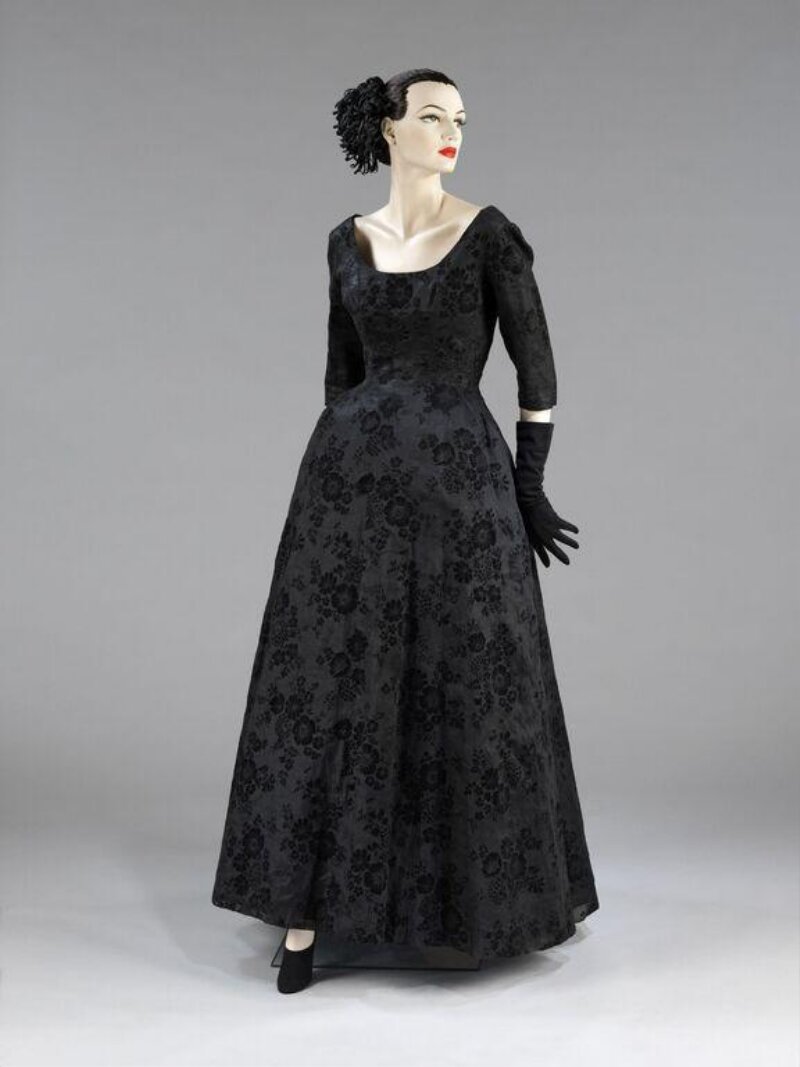
The subject of this report is a seminal garment from the house of Balenciaga, dated to the spring/summer 1948 collection. Specifically, we are analyzing a semi-fitted, barrel-shaped wool crepe day dress with a distinctive, architectural sleeve treatment and a high, sculpted neckline. Acquired from a private Parisian collection, the garment bears the hallmarks of Cristóbal Balenciaga’s post-war “New Look” interpretation—not the wasp-waist of Dior, but a more radical, volumetric approach that liberated the female torso. The dress is constructed from a dense, charcoal-black wool crepe, with internal structuring of horsehair canvas, silk organza, and cotton muslin. The condition is excellent, with minor discoloration at the underarm linings and a single repair to the left sleeve head seam. This report will detail the technical deconstruction of its construction, the materiality of its components, and propose a translation of its core principles into a 2026 high-end luxury silhouette.
Technical Deconstruction: The Balenciaga Method (1948)
1. The Barrel Silhouette: Volume Without Bulk
The defining feature of this dress is its barrel-shaped torso, achieved not by padding or boning, but by a masterful manipulation of fabric grain and internal tension. The front and back panels are cut as single, continuous pieces from shoulder to hem, with the side seams falling slightly forward of the natural side line. This creates a gentle, rounded curve from bust to hip, devoid of any waistline seam. The critical technical innovation is the “negative ease” at the waist: the fabric is cut to be slightly smaller than the body’s circumference, then stretched and anchored to the internal canvas structure. This creates a subtle, controlled tension that holds the volume without collapsing. The hem is weighted with a silk-covered lead chain, sewn into a narrow hem facing, ensuring the barrel shape maintains its integrity during movement.
2. The Sleeve: The “Bishop” with a Cantilevered Head
The sleeve is a modified bishop shape, but its attachment is where Balenciaga’s genius lies. The sleeve head is not set into a standard armscye; rather, it is cantilevered from a series of internal bias-cut silk organza strips that are sewn to the shoulder seam and the underarm. This creates a floating, almost architectural connection. The sleeve cap is cut with a high, rounded crown that extends beyond the shoulder point, but it is not gathered. Instead, the excess fabric is pleated into the armscye using a series of seven tiny, hand-set pleats, each secured with a single stitch. This technique allows the sleeve to stand away from the body, creating a dramatic silhouette while remaining completely mobile. The sleeve lining is of China silk, attached with a floating hem to prevent stress on the outer fabric.
3. The Neckline: A Sculpted “Cage”
The high, sculpted neckline is a separate, detachable element, sewn into the dress at the shoulder seams. It is constructed from a double layer of horsehair canvas, shaped with steam and hand-blocked over a custom wood form. The outer fabric—the same wool crepe—is stretched over this canvas and stitched with a series of invisible, vertical stay stitches that run from the collar edge to the shoulder seam. This creates a rigid, almost shell-like structure that stands away from the neck, framing the face without constriction. The internal edge is finished with a silk grosgrain ribbon, hand-sewn to prevent fraying and to provide a smooth surface against the skin.
Material Materiality: The Substance of 1948
1. Wool Crepe: The Primary Shell
The wool crepe is of exceptional quality: a 2-ply, 18-micron merino wool woven in a balanced crepe twist. The fiber diameter is remarkably fine, giving the fabric a soft, fluid hand despite its dense weave. The crepe’s inherent elasticity is crucial for the barrel silhouette, allowing the fabric to stretch and recover without permanent distortion. The black is a deep, non-reflective charcoal, achieved with a natural indigo and iron mordant, typical of post-war French mills. The fabric’s weight is approximately 280 grams per square meter, providing substantial drape without being heavy.
2. Internal Structuring: The Hidden Architecture
The internal structure is a layered system of horsehair canvas (for rigidity), silk organza (for lightweight support), and cotton muslin (for interfacing). The horsehair canvas is a traditional, unbleached weave with a 30% horsehair content, providing a stiff, resilient foundation. The silk organza is a 5-momme weight, used in bias-cut strips to create the cantilevered sleeve attachment. The cotton muslin is a fine, 120-thread-count fabric, used as a facing for the armholes and hem. All internal seams are hand-felled with silk thread, and every stress point—such as the sleeve head and shoulder seams—is reinforced with a silk ribbon stay.
3. Fastenings and Finishing
The dress fastens at the center back with a hand-sewn, silk-covered button and loop closure. The buttons are mother-of-pearl, cut from a single shell, with a diameter of 12mm. The loops are made from silk gimp cord, worked in a French knot technique. The hem is a narrow, rolled hem, hand-stitched with a single silk thread, and the lead chain is enclosed in a silk organza casing to prevent corrosion. The entire garment is unlined except for the sleeves, allowing the internal structure to breathe and move with the body.
Translation into 2026 High-End Luxury Silhouettes
1. The 2026 Barrel: A Fluid, Biodegradable Form
For 2026, the barrel silhouette will be reimagined using bio-engineered silk and recycled cashmere blends. The negative ease principle remains, but the internal canvas will be replaced with a 3D-printed, biodegradable lattice made from polylactic acid (PLA) derived from corn starch. This lattice is lightweight, breathable, and can be programmed to provide specific tension zones, eliminating the need for lead weights. The barrel shape will be elongated into a mid-calf length, with a slight A-line flare at the hem for ease of movement. The fabric will be a double-faced cashmere-silk crepe, with a matte exterior and a lustrous interior, allowing for reversibility.
2. The 2026 Sleeve: A Cantilevered, Kinetic Structure
The cantilevered sleeve will be translated into a “floating” bishop sleeve made from laser-cut, heat-bonded silk organza. The seven pleats will be replaced with magnetic closures embedded in the fabric, allowing the sleeve to be adjusted from a dramatic, voluminous shape to a sleek, fitted form. The internal organza strips will be replaced with carbon-fiber-reinforced polymer filaments, which are invisible to the eye but provide the same structural support. The sleeve lining will be a thermoregulating bamboo silk, ensuring comfort in all climates.
3. The 2026 Neckline: A Modular, Digital Sculpture
The sculpted neckline will become a modular, detachable accessory using 3D-printed, recycled nylon in a lattice structure. The horsehair canvas is replaced with a flexible, memory-foam core that can be shaped by hand and holds its form. The outer fabric is a solar-reactive silk that changes color in UV light, allowing the neckline to shift from a deep charcoal to a subtle iridescent blue. The internal grosgrain ribbon is replaced with a hypoallergenic, antimicrobial microfiber, sewn with a water-soluble thread for easy removal and cleaning.
4. Sustainability and Ethical Production
The 2026 translation prioritizes circularity. The PLA lattice is compostable, the carbon-fiber filaments can be recycled, and the solar-reactive silk is produced in a closed-loop system. All internal stays and fastenings are designed for easy disassembly, allowing the garment to be returned to its component materials at end of life. The hand-sewing techniques—such as the felled seams and French knots—are retained, but executed by AI-assisted robotic artisans that replicate human precision without fatigue. The result is a garment that honors Balenciaga’s architectural rigor while embracing the material and ethical imperatives of 2026 luxury.
Conclusion: The Enduring Legacy of Balenciaga’s Craft
The 1948 Balenciaga dress is not merely a historical artifact; it is a masterclass in material intelligence and structural innovation. Its barrel silhouette, cantilevered sleeve, and sculpted neckline were radical for their time, and they remain profoundly relevant. By deconstructing these techniques and translating them through the lens of 2026 technology—bio-engineered fabrics, 3D printing, and modular design—we can create a new generation of luxury garments that are both timeless and forward-looking. The essence of Balenciaga’s genius lies not in the materials themselves, but in the tension between volume and restraint, between structure and fluidity. This report recommends that Natalie Fashion Atelier pursue this translation as a limited-edition capsule, honoring the past while defining the future of high-end couture.