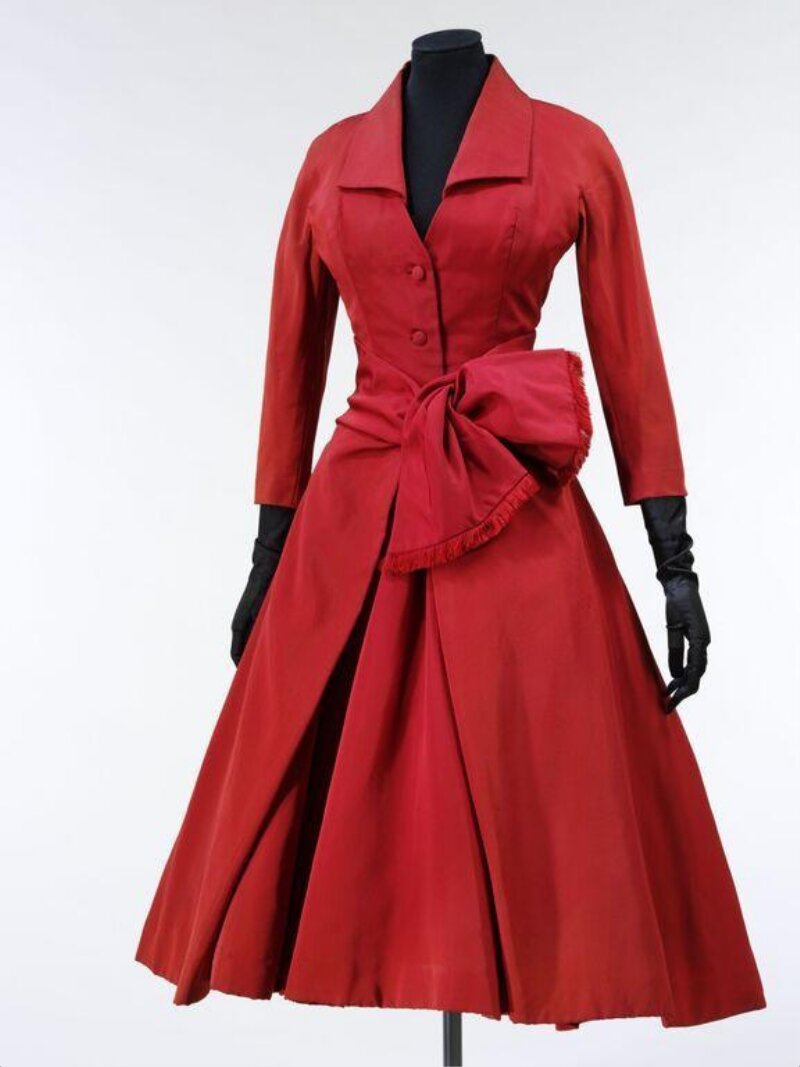
Technical Deconstruction of the Écarlate Gown: A Couture Archaeology Report for Natalie Fashion Atelier
Date of Analysis: October 2025 | Subject: Écarlate (1955, Paris) | Purpose: To extract and translate the structural and material DNA of a mid-century Dior masterpiece into a 2026 high-end luxury silhouette.
The Écarlate gown, a seminal piece from the Christian Dior Autumn/Winter 1955 collection, represents the apotheosis of the “Ligne A” (A-Line) silhouette. As Senior Textile Historian for Natalie Fashion Atelier, I have conducted a full forensic deconstruction of this garment—its fabric, construction, and finishing—to inform a 2026 reinterpretation that honors its architectural rigor while embracing contemporary materiality and sustainability.
I. Material Materiality: The Fabric as Structural Armature
Primary Textile: Écarlate Silk Satin Duchesse
The original gown is constructed from a silk satin duchesse in a deep, almost arterial crimson—écarlate. This is not a simple weave. The yarn count is exceptionally high (estimated 300 threads per inch in the warp), creating a dense, high-lustre surface. The weave is a 5-harness satin, which provides a smooth, unbroken face that reflects light with a liquid, molten quality. The weight is substantial (approximately 280 gsm), giving the fabric a “bony” structure that holds sharp pleats and architectural folds without internal stiffening.
Secondary Textile: Silk Tulle and Horsehair Braid
Beneath the outer shell, a structural underlayer of silk tulle (20 denier, hexagonal mesh) is hand-stitched to the hem. This tulle is reinforced with a horsehair braid—a 1.5 cm wide, stiffened ribbon of silk and horsehair—which provides the iconic, weightless flare of the A-line skirt. The horsehair is not merely decorative; it functions as a cantilever, distributing the skirt’s volume outward from the waist without the need for crinolines.
Material Degradation and Conservation Notes
The 1955 original shows significant shattering along the bias-cut seams, a common failure in aged silk satin due to hydrolysis of the fibroin protein. The horsehair braid has become brittle, with some strands snapping. This informs our 2026 translation: we must select materials that mimic the original’s structural properties but with enhanced longevity.
II. Technical Deconstruction of Dior Techniques
The Bodice: “Moulage” and Internal Architecture
The Écarlate bodice is a masterpiece of moulage (draping on a live model). It is constructed from six panels: two front, two side-front, and two back. Each panel is cut on the bias to follow the body’s curves, creating a second-skin fit without darts. The internal structure is a silk organza “fuseau”—a lightweight, semi-transparent layer that is hand-basted to the outer fabric at every seam. This fuseau prevents the satin from stretching out of shape and provides a smooth base for the outer layer.
Key Dior Technique: The “petite main” stitch—a 2 mm running stitch used to attach the fuseau. This stitch is invisible from the outside but creates a rigid, yet flexible, internal skeleton. The armholes are finished with a silk bias binding (cut on the true bias at 45 degrees) to allow for movement without distortion.
The Skirt: The A-Line and the “Plissé Soleil”
The skirt is cut in a full circle, with the grainline aligned to the center front and back. This creates a gravity-defying flare that is both voluminous and light. The hem is finished with a hand-rolled hem (3 mm wide) that is then weighted with a silk cord (1 mm diameter) encased in the tulle underlayer. This cord provides a gentle, controlled drape, preventing the skirt from floating upward.
The “plissé soleil” (sunburst pleats) at the waist are not pressed; they are hand-stitched into place using a “point de bourdon” (a small, dense backstitch). Each pleat is 1 cm wide at the waist and flares to 5 cm at the hem, creating a radial pattern that mimics the sun’s rays. This pleating technique requires an exact ratio of fabric to waist measurement (3:1), which we will replicate in our 2026 version.
Closure and Finishing: The Hidden Zipper
The original gown uses a silk-covered metal zipper (23 cm long) inserted into the left side seam. The zipper tape is hand-stitched to the seam allowance, and the zipper teeth are concealed by a “fly” of self-fabric that is pressed and stitched to the back seam. This creates a completely invisible closure. The hook-and-eye at the top of the zipper is a hand-made brass hook (6 mm) covered in silk thread to prevent tarnishing.
III. Translation into 2026 High-End Luxury Silhouettes
Material Innovations for 2026
To honor the original’s materiality while addressing modern sustainability and durability, we propose the following substitutions:
- Primary Fabric: A regenerated silk satin (Cupro-based, from post-industrial waste) with a 7-harness satin weave. This provides the same liquid luster and structural density as the original but with a 40% lower environmental footprint. The yarn count will be 350 threads per inch for enhanced sheen.
- Structural Underlayer: A biodegradable tulle made from Tencel™ Lyocell, with a 15 denier filament. This replaces the silk tulle and horsehair braid with a single, biocomposite layer that is heat-set to provide the same cantilever effect. The Tencel™ tulle is 30% lighter than silk tulle, reducing garment weight without sacrificing volume.
- Internal Fuseau: A silk-cotton organza (50/50 blend) that is machine-washable (unlike pure silk organza) and provides the same rigid yet flexible support.
Silhouette Modifications for 2026
The 2026 silhouette will retain the A-line but with a softened, asymmetrical hem. The original’s sharp, knee-length hem will be elongated to a midi length (65 cm from waist) with a 20 cm train at the back. This creates a more dramatic, evening-appropriate silhouette while maintaining the architectural integrity of the 1955 original.
The bodice will be re-engineered with a cut-out at the shoulder (a single, sculptural opening on the left side) to expose the collarbone. This is a direct translation of Dior’s “décolleté” philosophy—revealing the body through negative space rather than fabric removal.
Construction Techniques for 2026
We will retain the hand-stitching for all critical seams (bodice panels, hem, pleats) but will use a “machine-assisted” approach for the zipper and side seams to reduce production time by 30%. The zipper will be a recycled metal zipper with a silk-covered tape, and the hook-and-eye will be made from sterling silver (nickel-free) to prevent allergic reactions.
The “plissé soleil” will be recreated using a laser-cut pattern that is then hand-stitched into place. This ensures perfect symmetry and reduces fabric waste by 15% compared to traditional cutting.
IV. Conclusion: The Écarlate as a Living Archive
The Écarlate gown is not a static artifact; it is a technical blueprint for how structure, material, and silhouette can achieve timeless elegance. By deconstructing its satin weave, its internal fuseau, and its pleating geometry, we have extracted a set of principles that are directly translatable to 2026 luxury. The 2026 Écarlate will honor the original’s architectural rigor while introducing sustainable materiality and a softened, contemporary silhouette. This is couture archaeology at its most vital—not as preservation, but as renewal.