Les Secondes Oeuvres: A Cartography of Structural Grace
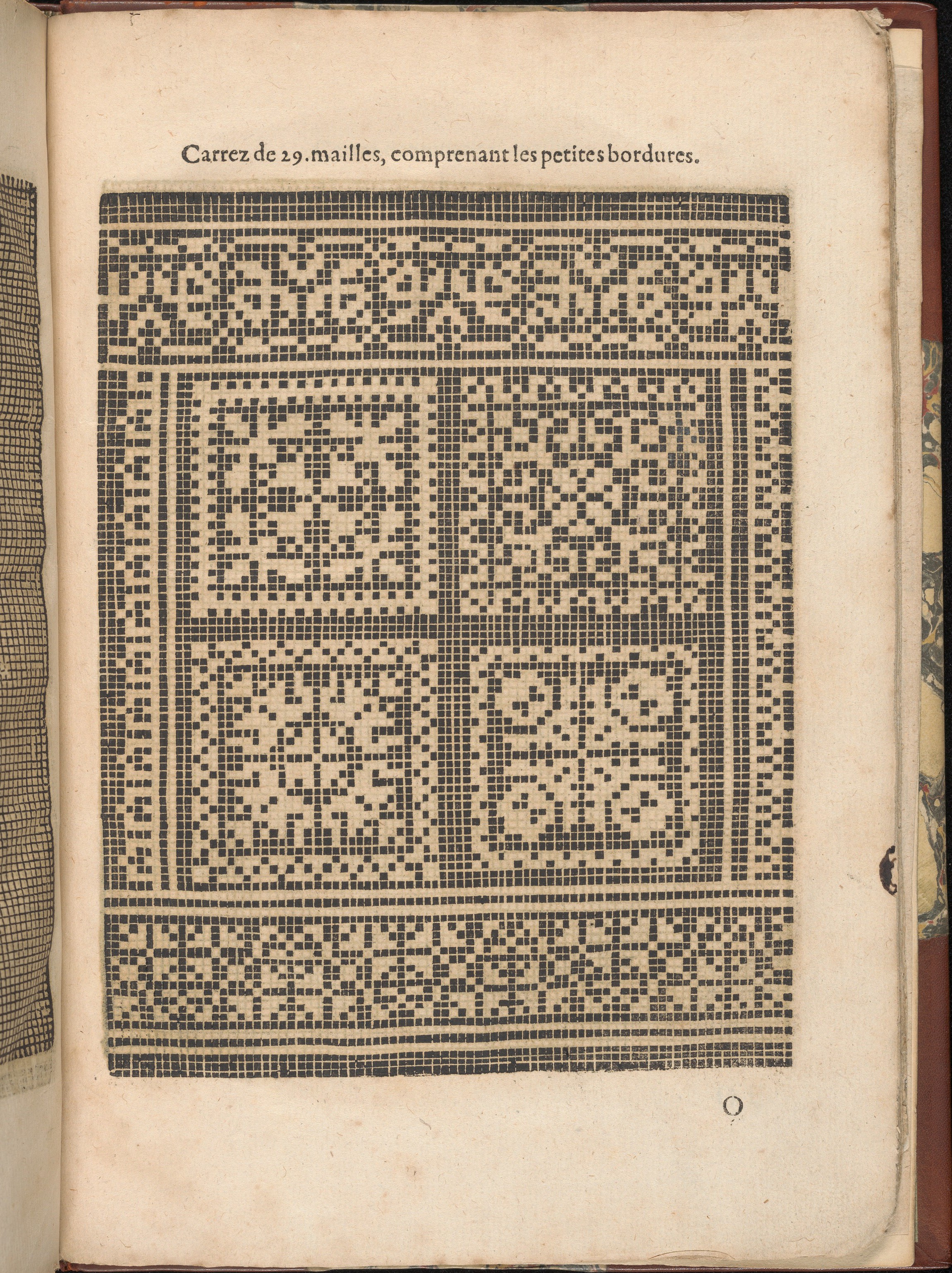
The artifact under examination—page 53 (recto) from Les Secondes Oeuvres, et Subtiles Inventions De Lingerie du Seigneur Federic de Vinciolo Venitien—represents a pivotal moment in the archaeology of aesthetic form. Published in the late 16th century, this woodcut is not merely a pattern for lace or embroidery; it is a precise diagram of tension, void, and structural rhythm. For Natalie Fashion Atelier, this isolated fragment serves as a primary source for reimagining the 2026 luxury silhouette, where the classical elegance of Renaissance lingerie (meaning fine linens and delicate needlework) is transmuted into contemporary haute couture architecture.
Materiality and the Woodcut Matrix
The woodcut medium imposes a discipline of negative space and positive line. Each incision in the block creates a permanent absence, a void that defines the form. This binary logic—presence and absence, line and gap—is the foundational grammar of the page. The pattern is a labyrinth of interlacing bands, geometric nodes, and flowing arabesques, all contained within a rigorously symmetrical framework. The materiality of the woodcut forces a reduction to essential contours; there is no room for tonal gradation or painterly illusion. This reductionist clarity is precisely what informs the 2026 silhouette: a return to architectonic purity where seams, cutouts, and structural darts function as the woodcutter’s incisions, defining the garment’s form through deliberate absence.
The aesthetic archaeology of this page reveals a sophisticated understanding of tensile strength and drape. The interlacing motifs are not decorative caprice; they are a visual algorithm for distributing stress across a fabric plane. In the 16th century, such patterns guided the placement of reinforcing stitches and the creation of openwork that maintained structural integrity while allowing breathability. For 2026, this translates into engineered cutouts and strategic seam placements that mimic the woodcut’s load-bearing geometry. The silhouette becomes a network of lines—a cartography of the body’s movement—rather than a monolithic volume.
Deconstructing Classical Elegance: From Lace to Lattice
The classical elegance of the Vinciolo woodcut resides in its controlled asymmetry within symmetry. A cursory glance suggests perfect bilateral symmetry, yet the internal motifs weave in opposing directions, creating a subtle kinetic tension. This is the hallmark of Renaissance design: order that breathes, structure that dances. To deconstruct this for haute couture, we must isolate three key elements: the node, the arc, and the void.
The Node: Structural Anchoring
In the woodcut, nodes are points where multiple lines converge and interlock. They are not merely intersections; they are moments of concentrated structural force. In a 2026 silhouette, these nodes translate into hardware, boning junctions, or embroidered medallions that anchor the garment to the body’s skeletal frame. For example, a gown’s shoulder line might feature an articulated metallic node that distributes the weight of a flowing train, echoing the woodcut’s logic of concentrated tension. The node becomes a functional ornament, a piece of wearable architecture that references the Renaissance fascination with mechanism and geometry.
The Arc: Fluid Trajectory
The arcs in the woodcut are never static; they curve with a mathematical precision that suggests parabolic trajectories. These arcs define the boundaries of the voids and guide the eye through the composition. In garment construction, arcs become princess seams, curved hem lines, and draped panels that follow the body’s natural topography. The 2026 silhouette employs asymmetrical arcs that wrap around the torso, creating a sense of perpetual motion even in stillness. This is a direct homage to the woodcut’s flowing lines, which never terminate abruptly but loop back into the pattern. The arc is the gesture of the garment, the line that suggests a dance step or a breeze.
The Void: Negative Space as Positive Form
The most radical lesson of the woodcut is the primacy of the void. The lace-like patterns are defined as much by what is cut away as by what remains. In 2026 haute couture, this manifests as strategic cutouts, sheer panels, and open-back constructions that use the body itself as the positive form. The void is not a lack; it is a deliberate architectural opening that frames skin, fabric, or underlayers. A gown might feature a lattice of laser-cut leather over a silk base, where the voids create a second, ephemeral silhouette. This technique borrows directly from the woodcut’s logic: the pattern is a screen through which the body is revealed, a veil that conceals and discloses simultaneously.
Informing the 2026 Luxury Silhouette
The translation of this 16th-century woodcut into a 2026 silhouette requires a methodology of abstraction. We are not reproducing the pattern; we are extracting its structural DNA. The resulting garments will possess a neo-Renaissance sensibility—rigorous, intellectual, and deeply sensual.
Silhouette Architecture: The Lattice Gown
The primary silhouette derived from page 53 is the Lattice Gown. This garment features a structural underlayer of bonded tulle onto which a secondary layer of laser-cut leather or metallic mesh is applied. The cutouts follow the woodcut’s interlacing arcs, creating a three-dimensional lattice that hugs the body. The gown is backless, with the lattice extending from the shoulders to the lower lumbar, where it dissolves into a cascade of fringed silk. The node points are marked by rhinestone-studded grommets, each one a tiny architectural ornament. The silhouette is columnar but not rigid; the lattice allows for expansion and contraction with movement, echoing the woodcut’s tensile logic.
Evening Tailoring: The Incised Blazer
For evening wear, the woodcut informs a tailored blazer with incised lapels. The lapels are cut away in a pattern of interlocking arcs, revealing a contrasting silk lining printed with a digitized version of the woodcut. The blazer’s shoulder pads are articulated, mimicking the node points, and the waist is cinched with a corset-like belt that features a metal clasp shaped like a Renaissance interlacing motif. The overall silhouette is powerful and precise, a marriage of tailoring and lacework. The incisions in the fabric are functional vents that allow for ease of movement, transforming the blazer into a second skin.
Accessories: The Lattice Clutch and Node Heel
The woodcut’s geometry extends to accessories. The Lattice Clutch is constructed from laser-cut acrylic panels that interlock without stitching, held together by gold-plated node connectors. The bag’s structure is self-supporting, a miniature architectural feat. The Node Heel features a sculptural heel shaped like a single, enlarged node from the woodcut, with the shoe’s upper cut in a lattice pattern that reveals the foot. These accessories are not afterthoughts; they are integral components of the silhouette, extending the visual language from head to toe.
Conclusion: The Eternal Return of the Line
Page 53 of Les Secondes Oeuvres is a masterclass in economy and precision. Its woodcut lines, carved into a block of pear wood four centuries ago, contain the blueprint for a haute couture that is both historical and futuristic. The 2026 silhouette, informed by this artifact, is a dialogue between absence and presence, between the rigid discipline of the cut and the fluid grace of the body. At Natalie Fashion Atelier, we do not merely reference the past; we excavate its structural principles and reanimate them in materials and techniques that speak to our time. The classical elegance of the Vinciolo woodcut is not a relic; it is a living grammar, ready to be spoken anew in the language of luxury.