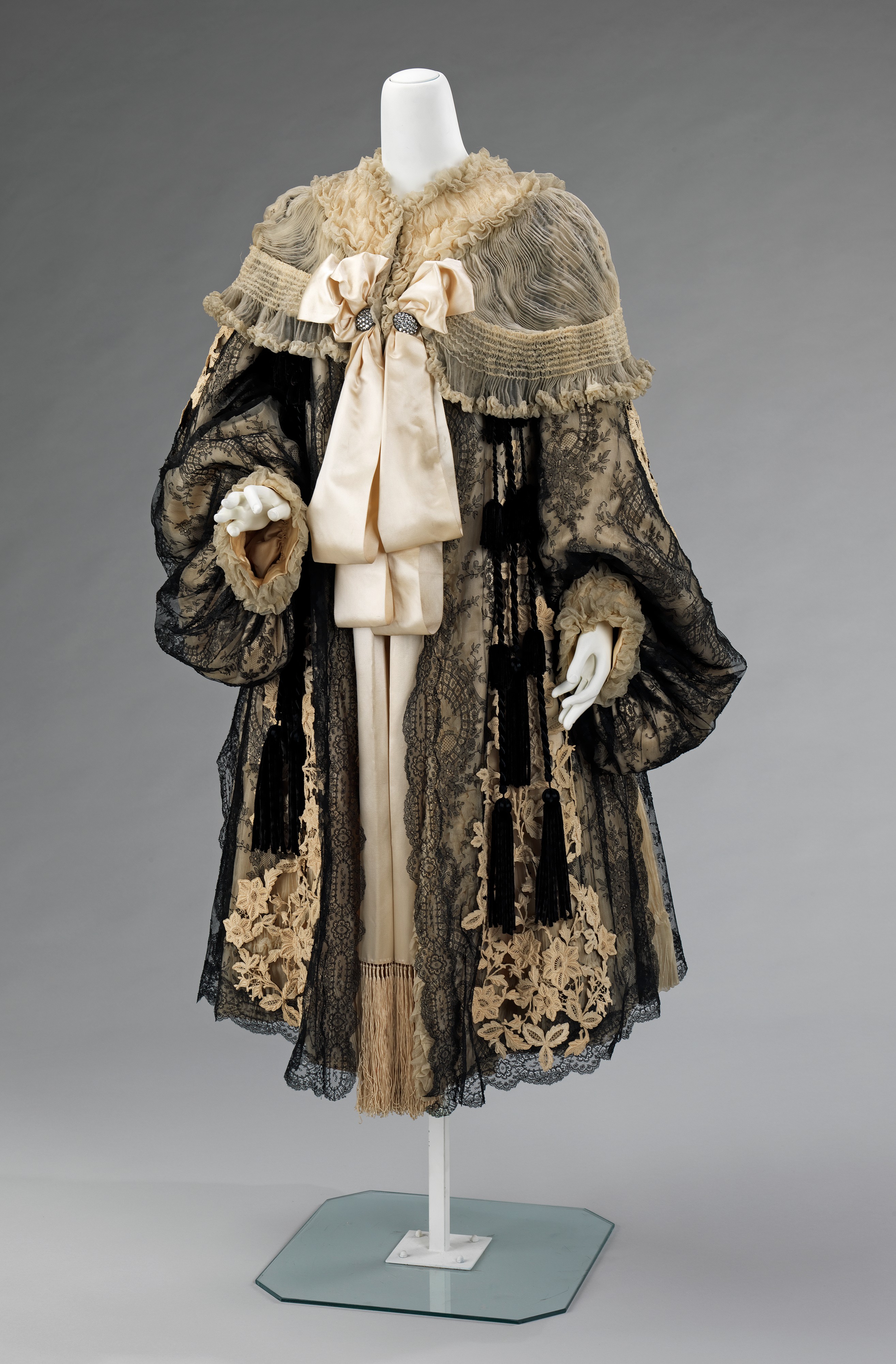
Archaeology of Opulence: The Evening Coat as a Hermeneutic Object
Within the rarefied archive of French Haute Couture, the evening coat stands as a singular hermeneutic object—a garment whose very structure articulates a complex dialogue between public presentation and private luxury, between architectural form and fluid movement. For Natalie Fashion Atelier, an isolated aesthetic archaeology of this masterpiece is not an exercise in nostalgia, but a critical methodology for extracting the foundational codes of timeless elegance. By deconstructing a specific archetype—a late-1930s coat in duchesse silk, meticulously encrusted with rhinestone palettes—we unearth a material and philosophical lexicon that directly informs the silhouette intelligence for the 2026 luxury client. This artifact, analyzed not as a relic but as a system of principles, reveals that the future of high-end silhouettes lies in the strategic synthesis of architectural purity, tactile materiality, and calculated luminosity.
Deconstructing the Classical Canon: Architecture, Drape, and Aura
The classical evening coat of the pre-war era, particularly as perfected by houses like Vionnet and Grès, was an exercise in paradoxical construction. Its elegance was derived from a rigorous architectural framework—often a minimally darted torso or a precise kimono-cut shoulder—that served as a silent armature for the most expressive of materials. The silk, specifically the heavyweight duchesse satin, was selected not for passive drape but for its sculptural memory and cascade coefficient. It held a sharp lapel, defined a clean princess line, and then released into a fluid train with a deliberate, gravity-informed rhythm. This dichotomy is the first principle for 2026: silhouette must be engineered from the inside out. The 2026 interpretation moves beyond literal replication to embrace biomorphic armatures—internal structures inspired by ergonomic mapping or lightweight technical meshes—that create a personalized, dynamic architecture. The coat’s outer shell, while appearing effortlessly fluid, will be precisely calibrated to interact with this hidden framework, creating movement that is both intentional and organic.
The Rhinestone as a Textural Language: From Ornament to Information
The application of rhinestones on the archival piece was never mere decoration; it was a sophisticated language of light manipulation and textural coding. Unlike the all-over scintillation of the flapper era, the late-30s approach was one of austerity and emphasis. Rhinestones were deployed in strategic palettes—clustered at the clavicle to frame the face, tracing the seam of a sleeve to articulate movement, or gathering at the small of the back to create a focal point of retreating glamour. This transforms the rhinestone from ornament to informational node. For 2026, this principle evolves into a doctrine of tactile data and luminous wayfinding. We foresee rhinestones and their technological successors—ceramic micro-prisms, bonded crystal matrices, even programmable LED-embedded facets—being used to create a garment’s "light map." This map can highlight structural intersections, trace the wearer’s gait through responsive luminosity, or even modulate opacity. The materiality of silk provides the essential silent ground for this luminous information; its matte, light-absorbing depth creates a necessary contrast, ensuring the light points are legible, sophisticated, and never garish.
Silencing the Spectacle: The 2026 Silhouette of Calculated Restraint
The overarching lesson from the archive is one of authority through omission. The coat’s power lies in what it does not do: it does not constrict, it does not shout, it does not obey transient trends. It commands space through the confidence of its line and the intelligence of its detail. The 2026 luxury silhouette, informed by this, will be defined by a monastic severity of line punctuated by moments of hyper-sensorial or technological intimacy. We project a movement toward the "enveloping silhouette"—coats, cape-dresses, and wide-leg architectures that create a personal micro-environment. The duchesse silk principle translates to advanced material hybrids: silk-fused technical wovens that offer thermo-regulatory properties, or silk-coated memory textiles that can alter their drape coefficient in response to environment. The rhinestone’s role becomes one of subtle interface, perhaps embedded at the cuff to interact with personal devices, or clustered at the neckline in a pattern that only becomes coherent under specific lighting conditions, creating a narrative of reveal for the wearer alone.
Ultimately, the isolated archaeology of the silk and rhinestone evening coat provides Natalie Fashion Atelier with a non-negotiable core for 2026: that true luxury is a dialectic of restraint and intensity. The future silhouette is not a radical break, but a deepened understanding of these historical truths. It is an architecture that prioritizes experiential comfort and personal space. It is a materiality where heritage fabrics are re-engineered for contemporary performance. It is a decorative strategy where light and information become one. By mastering this synthesis, the Atelier does not look backward, but forward—crafting a 2026 elegance that is as intelligently constructed, as sensorially rich, and as quietly powerful as the masterpiece that inspired it. The archive, therefore, is not a source of forms, but a perpetual generator of first principles for the future.