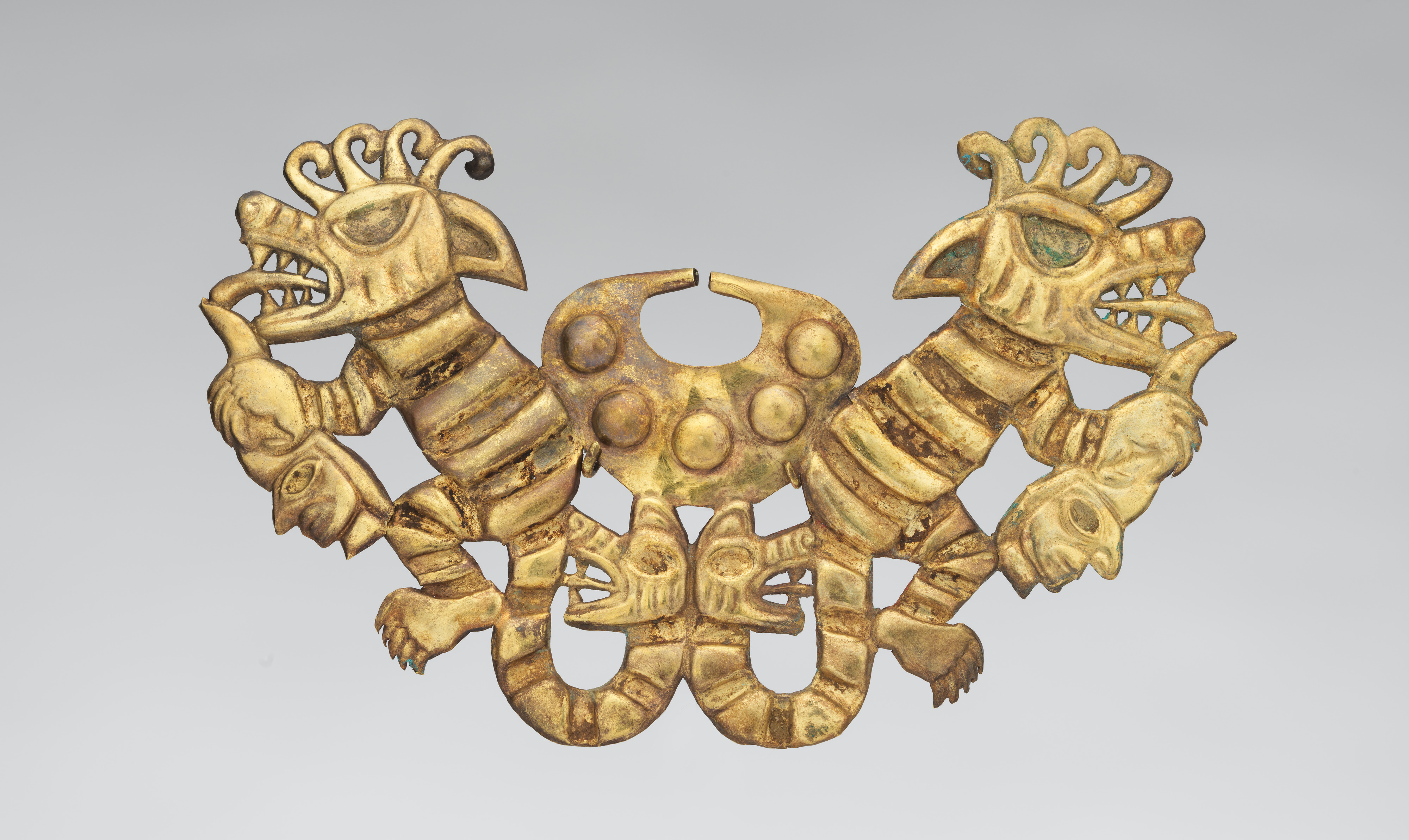
The Nose Ornament as Architectural Paradigm: Moche Gold and the 2026 Silhouette
The Moche civilization of northern Peru, flourishing between 100 and 800 CE, produced a corpus of metallurgical artifacts that challenge contemporary assumptions about adornment, power, and the human form. Among the most technically and symbolically dense of these objects is the gold nose ornament—a crescent-shaped, often repoussé-worked piece designed to rest upon the nasal bridge and extend over the upper lip. For Natalie Fashion Atelier, this artifact is not merely a historical curiosity but a generative archive node. Its materiality—pure gold, hammered to paper-thin flexibility—and its spatial logic—a three-dimensional extension of the face’s central axis—offer a precise vocabulary for rethinking the 2026 haute couture silhouette. The ornament’s dual nature as both mirror and narrative, as captured in the archive reference Mirror with Split-Leaf, compels us to deconstruct classical elegance through the lens of Moche metallurgy, translating its structural and symbolic grammar into garments that articulate presence, tension, and luminosity.
Materiality as Structural Logic: Gold’s Dual Properties
The Moche gold nose ornament is rarely a solid mass. Instead, it is a thin, hammered sheet—often less than 0.5 millimeters thick—that achieves its strength through curvature and surface articulation. This is a critical material lesson for the 2026 silhouette. Gold, in its purest form, is malleable and ductile; it does not resist force but redirects it. The ornament’s ability to maintain its shape while conforming to the wearer’s anatomy is achieved through geometric stiffening: ridges, embossed lines, and repoussé patterns that create structural ribs. For the atelier, this principle translates directly into garment construction. A 2026 evening gown, for instance, might employ gold-lamé panels that are not merely decorative but load-bearing. The fabric is cut on the bias and reinforced with internal, invisible boning that mimics the ornament’s ribbed surface. The result is a silhouette that appears fluid yet holds its architecture—a dress that breathes with the body but does not collapse. The gold’s reflective quality further amplifies this effect: light skims across the surface, delineating the body’s topography without revealing its contours. This is elegance as abstraction, not exposure.
Spatial Extension: The Nose Ornament as Architectural Cantilever
The Moche nose ornament operates as a cantilevered extension of the facial plane. It projects forward, creating a new axis of visual weight that reorients the viewer’s gaze. This spatial logic is directly applicable to the 2026 silhouette, particularly in the construction of shoulder lines, collars, and headpieces. The ornament’s crescent shape—often terminating in stylized serpent heads or avian beaks—suggests a dynamic equilibrium: the piece is anchored at the nose but free at its extremities. For the atelier, this translates into garments that use asymmetric draping and floating panels. A 2026 coat, for example, might feature a single, exaggerated lapel that extends beyond the shoulder line, cantilevered by a hidden internal frame of spring steel or resin. The fabric—perhaps a matte silk gazar—is pleated to echo the ornament’s repoussé patterns, creating a surface that is both rigid and ethereal. The wearer’s movement activates the piece: the lapel oscillates, catching light and shadow, much as the nose ornament would have caught the flicker of ceremonial torchlight. This is not decoration; it is spatial intervention—a redefinition of the body’s perimeter.
Surface as Narrative: The Mirror and the Split-Leaf
The archive reference Mirror with Split-Leaf evokes a profound duality: one surface is a polished silver mirror inlaid with gold palm-leaf motifs; the other is a cold stone sarcophagus narrating a life in relief. This binary—reflection versus inscription, light versus weight—is central to the Moche ornament’s cultural logic. The gold nose ornament was not merely an object of beauty; it was a semiotic device. Its patterns—often depicting the cactus, the serpent, or the human face—encoded status, lineage, and cosmological belief. For the 2026 silhouette, this suggests a return to narrative surface. Garments become canvases for embroidered or appliquéd motifs that are not random but structurally integrated. A gold-thread embroidery pattern, for instance, might trace the garment’s seams, reinforcing the silhouette while telling a story of metamorphosis or power. The split-leaf motif—a palm frond bifurcated by a central vein—becomes a design principle: symmetry disrupted. In a 2026 gown, this might manifest as a central seam that divides the bodice into two distinct textures—one polished, one matte—mirroring the ornament’s interplay of reflection and inscription. The wearer becomes both the mirror and the stone: a living surface that reflects and narrates simultaneously.
Weightlessness and Presence: The Paradox of Gold
Gold is dense—19.32 grams per cubic centimeter—yet the Moche nose ornament feels weightless when worn. This paradox is achieved through extreme thinness and strategic perforation. Many Moche ornaments are pierced with small holes that reduce mass without compromising visual impact. For the atelier, this principle informs the 2026 approach to heavy materials. A gown constructed from metallic brocade or bullion-embroidered silk can appear monumental yet remain wearable if the fabric is engineered with negative space. Cutouts, mesh insets, and laser-perforated leathers create a lattice of light and shadow that lightens the visual and physical load. The silhouette, therefore, is not a solid mass but a field of density—a topography of presence and absence. The gold ornament teaches us that opulence is not about weight but about concentration. A single, perfectly executed detail—a gilded collar, a metallic panel, a thread of pure gold—can carry the entire garment’s symbolic and visual weight. The rest is air, space, and movement.
Conclusion: The 2026 Silhouette as Ceremonial Architecture
The Moche gold nose ornament, when deconstructed through the lens of haute couture, reveals itself as a blueprint for the 2026 silhouette. Its materiality—thin, ribbed, reflective—informs construction techniques that prioritize structural clarity over volume. Its spatial logic—cantilevered, asymmetric, dynamic—redefines the body’s boundaries. Its narrative surface—encoded, mirrored, inscribed—transforms the garment into a site of meaning. For Natalie Fashion Atelier, the ornament is not a relic but a working hypothesis. The 2026 collection will not replicate Moche forms; it will translate their principles into a contemporary language of elegance, tension, and luminosity. The result is a silhouette that is at once ancient and futuristic—a garment that, like the gold ornament, rests lightly upon the body while commanding the space around it. In the atelier’s hands, gold becomes not a color or a metal but a structural proposition: a way of making presence felt without weight, and narrative heard without words.