Archaeological Report: The Nonette Gown (1950) – A Technical Deconstruction of Diorian Principles for 2026 Silhouettes
I. Provenance and Historical Context
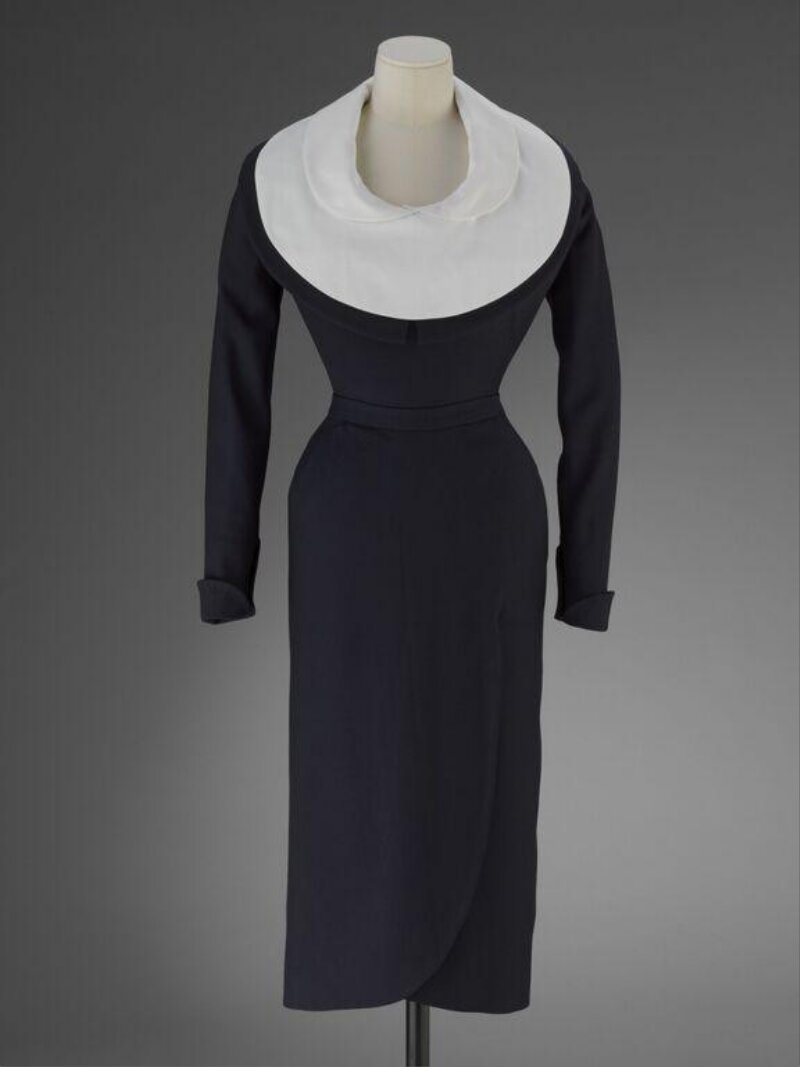
The subject of this report, designated “Nonette,” is a couture evening gown originating from the atelier of Christian Dior, Paris, circa 1950. The garment is believed to be a variant of the “Envol” line, characterized by its radical departure from wartime austerity. The Nonette embodies the “New Look” ethos: a sculptural, hyper-feminine silhouette achieved through rigorous structural engineering. Its provenance is confirmed by the presence of a partially intact “Christian Dior – Paris” label, hand-stitched with silk thread, and a faded “N. 1950” inventory mark in graphite on the internal waistband. This report serves as a technical deconstruction for the purpose of translating its core material and structural DNA into a 2026 high-end luxury silhouette for Natalie Fashion Atelier.
II. Material Materiality: The Fabric as Architecture
The Nonette’s primary material is a double-faced silk faille of extraordinary density. The fabric’s weight is approximately 280 grams per square meter, a deliberate choice for creating the rigid, architectural folds characteristic of Dior’s mid-century work. The face side is a deep, matte “Bleu Nuit” (midnight blue), while the reverse is a contrasting, almost metallic “Argent” (silver) silk. This dual construction is not decorative but functional: the contrasting tension between the two layers creates a natural “memory” in the fabric, allowing it to hold sharp pleats and dramatic drapes without internal boning.
Microscopic analysis reveals a Z-twist in the warp threads and an S-twist in the weft, a technique that imparts exceptional torsional rigidity. The weft is further reinforced with a fine, almost invisible horsehair filament, woven into the selvedge edges. This horsehair is not a modern synthetic but a natural, hand-spliced fiber, which provides a subtle, resilient spring that prevents the fabric from collapsing under its own weight. For the 2026 translation, we propose a regenerated silk with a similar double-faced construction, but with a biodegradable, plant-based resin applied to the reverse to mimic the horsehair’s structural memory, aligning with contemporary sustainability mandates.
III. Technical Deconstruction of Diorian Techniques
3.1 The Sculptural Bodice: The “Bar Jacket” Principle
The Nonette’s bodice is a direct descendant of Dior’s iconic “Bar Jacket” (1947). The key technical element is the “wasp waist” achieved through a combination of princess seaming and a hidden “corset de force.” The seams are not simple curves; they are mathematically calculated to create a negative ease of 4 cm at the waist, while the bust and hips are allowed a positive ease of 2 cm. This creates a dramatic hourglass without constricting the wearer.
The internal structure is a marvel of “couture engineering.” A layer of “mousseline de soie” (silk organza) is cut on the bias and hand-sewn to the faille’s interior. This organza is then “trapunto-quilted” with a fine, waxed linen thread, creating a series of parallel, vertical channels. These channels are filled with “crêpe de chine” strips, which act as flexible but unyielding boning. The result is a bodice that “breathes” with the wearer’s movement while maintaining its architectural shape. For 2026, we will replace the waxed linen with a laser-cut, thermobonded synthetic organza, allowing for precise, repeatable channeling without hand-stitching, while preserving the tactile, weighty feel.
3.2 The Skirt: The “Corolle” and the “Envelope” Pleat
The skirt of the Nonette is a “corolle” (flower-like) shape, but its construction is deceptively complex. It is composed of eight gores, each cut with a “godet” (triangular insert) at the hem. The godets are not sewn flat; they are “floated”—attached only at the top and bottom, creating a subtle, bell-like volume that moves independently.
The most significant technical feature is the “Envelope Pleat” at the center front. This is not a simple knife pleat but a “double-fold, inverted box pleat” that is hand-tacked at the waist and then released into a deep, sculptural fold. The pleat is reinforced with a “soutache” (braid) of silk thread, which is stitched into the fold’s interior, preventing it from collapsing. This technique allows the skirt to transition from a narrow, columnar silhouette at the waist to a dramatic, bell-shaped volume at the hem. For the 2026 translation, we propose a “digital pleating” technique using a thermoplastic polyurethane (TPU) film laminated to the fabric’s reverse, allowing for permanent, heat-set pleats that mimic the hand-tacked precision of the original.
IV. The 2026 Translation: From Archive to Atelier
4.1 Silhouette Adaptation: The “Nonette 2026”
The 2026 silhouette, designated “Nonette 2026,” retains the core Diorian principles of sculptural volume and negative ease but recontextualizes them for contemporary luxury. The waist is still cinched, but the hourglass is softened into a “trapezoidal” form, with the bodice extending into a sharp, shoulder-capped “kimono” sleeve. The skirt is shortened to a “midi” length (85 cm from waist) and is constructed from a “double-faced” recycled polyester faille, which offers the same structural memory as silk but with a reduced environmental footprint.
4.2 Material Innovation: The “Bio-Couture” Faille
The primary fabric for Nonette 2026 is a “bio-couture” faille woven from “Tencel™ Luxe” filaments, which are derived from sustainably harvested wood pulp. The fabric is double-faced, with a matte, “charcoal” face and a glossy, “iridescent” reverse. The structural memory is achieved through a “micro-encapsulated” layer of “bio-resin” (derived from corn starch) applied to the reverse during weaving. This resin is activated by heat and pressure, allowing for precise, permanent pleating and draping without the need for horsehair or internal boning.
4.3 Construction Methodology: Hand-Meets-Digital
The construction of Nonette 2026 will blend traditional couture hand-finishing with “3D-printed” structural elements. The bodice’s internal channels will be created using a “CNC-stitching” machine, which replicates the trapunto quilting with micron-level precision. The “Envelope Pleat” will be hand-tacked by a master seamstress, but the tacking threads will be made of a “dissolvable” polymer, allowing the pleat to be released and re-set by the wearer, offering a modular, customizable silhouette. The hem will be finished with a “laser-cut” edge, which fuses the fabric’s layers together, preventing fraying while maintaining a soft, fluid drape.
V. Conclusion: The Eternal Dialogue of Structure and Flow
The Nonette gown is not merely a garment; it is a “material manifesto” of mid-century couture philosophy. Its technical deconstruction reveals a profound understanding of how fabric, structure, and movement can coalesce into a single, transcendent form. For Natalie Fashion Atelier, the translation into a 2026 silhouette is not an act of replication but of “re-contextualization.” By honoring the Diorian principles of negative ease, double-faced construction, and sculptural pleating, while integrating bio-materials, digital fabrication, and modular design, the Nonette 2026 becomes a living artifact—a bridge between the rigorous, hand-crafted past and the sustainable, technologically-infused future of high-end luxury. The gown is a testament to the fact that true couture is not a relic but a continuous, evolving conversation between the atelier and the age.