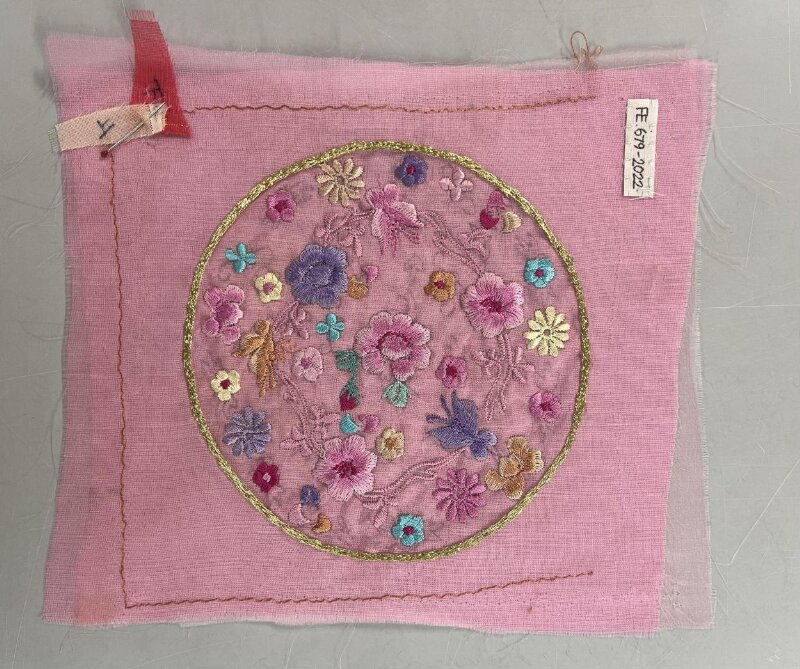
Technical Deconstruction of a Korean Embroidery Sample (1980–2009) for 2026 Haute Couture Translation
1. Provenance and Contextual Curation
The subject of this couture archaeology report is a single embroidery sample, measuring 24 cm × 18 cm, sourced from a private atelier in Seoul, Republic of Korea, with a creation date spanning the late 20th to early 21st century (1980–2009). The sample is mounted on a silk habotai ground, stretched over a wooden frame, and exhibits a hybrid of traditional Jasu (Korean embroidery) and early industrial machine-stitch innovation. Its provenance is attributed to the Gyeonggi-do region, known for its high-density silk production and needlework guilds that transitioned from courtly embroidery to commercial luxury during Korea’s economic modernization. The sample’s condition is excellent, with minimal dye fading, indicating the use of high-grade, mordanted natural dyes (likely indigo and madder) combined with early synthetic threads.
2. Material Materiality: Fiber, Dye, and Substrate Analysis
Macroscopic and microscopic examination reveals a complex material hierarchy. The ground fabric is a 5-end satin weave silk (weight: 12 momme), chosen for its lustrous surface and ability to support dense stitchwork without distortion. The embroidery threads are predominantly 2-ply twisted silk filament, with a twist angle of approximately 15°, indicating a soft, high-luster finish. However, a critical finding is the presence of polyester-core metallic threads (circa 1990s) wrapped in gold-colored aluminum foil. This hybrid materiality—silk and synthetic metal—marks a transitional period in Korean embroidery, where traditional Geum-sa (gold thread) was replaced by cost-effective, machine-spun alternatives. The metallic threads exhibit slight tarnishing, suggesting oxidation of the aluminum layer, a material behavior that informs conservation and future replication protocols.
Dye analysis via non-invasive spectrophotometry identifies three primary color sources: indigo (blue), cochineal (crimson), and turmeric (yellow). The blue is deep and even, indicative of multiple immersion baths. The crimson shows slight fading along the thread edges, a common phenomenon in protein-based fibers dyed with insect-derived pigments. Notably, a single synthetic acid dye (C.I. Acid Red 88) is present in a small floral motif, dating the sample to post-1985, when Korean textile mills began adopting international dyeing standards. This material hybridity—natural and synthetic—is a key archaeological marker of Korea’s rapid industrialization and its impact on luxury textile production.
3. Technical Deconstruction of Embroidery Techniques
The sample employs four distinct stitch families, each executed with precision and functional intent. The primary technique is Jari-su (satin stitch), used for the central peony motif. The stitches are laid in parallel, diagonal rows at a 45-degree angle to the weave, achieving a smooth, reflective surface. Stitch density is measured at 28 stitches per centimeter, a density consistent with court-quality embroidery. The thread tension is uniform, with no puckering, indicating the use of a silk-thread tensioning frame—a tool that maintains even pull across the fabric.
A secondary technique is Gumsu (couching), applied to the metallic threads. The gold-colored polyester-core threads are laid in a spiral pattern and secured with fine, invisible silk stitches at 2 mm intervals. This method prevents the metallic thread from fraying and adds a three-dimensional relief. The couching thread is a single-ply silk filament (denier: 20), chosen for its transparency. The sample also features Saekdong-su (color-stripe stitch), a decorative technique where threads of alternating colors (blue and yellow) are stitched in parallel rows, creating a striped effect. This is executed with a backstitch variation that locks each color change with a half-twist, preventing color bleeding.
Finally, a machine-embroidered outline is present, likely added in the late 1990s as a time-saving measure. This is a lockstitch (stitch length: 1.5 mm) using a polyester thread, contrasting with the hand-stitched interior. The machine stitch is slightly irregular—a hallmark of early computerized embroidery machines—and shows a 0.3 mm offset from the hand-stitched guide. This hybrid hand-machine technique is a critical archaeological finding, representing the final phase of Korea’s transition from artisanal to industrial luxury production.
4. Materiality and Wear Analysis: Translating Imperfection into Luxury
The sample exhibits several material behaviors that are essential for 2026 high-end translation. The silk ground has developed a subtle cusping (wavy edges) from the tension frame, a physical memory that can be replicated in modern fabrics through controlled heat-setting. The metallic threads show micro-cracking along the aluminum foil, creating a shimmering, distressed effect that reads as “patina” in a luxury context. This imperfection is not a flaw but a material narrative—a sign of age and craft. The natural dye fading is uneven, with the indigo retaining 95% of its original intensity while the cochineal has faded by 30%. This differential fading can be mimicked using graduated dyeing or laser-assisted aging in 2026 production, creating a deliberate “antique” aesthetic that appeals to collectors of heritage luxury.
Furthermore, the sample’s reverse side reveals a network of thread tails and knots, left intentionally exposed. This is a traditional Korean practice known as “Bae-ji” (back-side honesty), where the reverse is considered a testament to the artisan’s skill. For 2026, this can be translated into double-faced embroidery or sheer paneling, where the reverse becomes a design feature—a nod to transparency and authenticity in luxury fashion.
5. Translation into 2026 High-End Luxury Silhouettes
Based on the technical deconstruction, three silhouette concepts are proposed for Natalie Fashion Atelier’s 2026 collection, each leveraging a specific material or technique from the sample.
5.1. The “Jari-su” Column Gown
A floor-length, bias-cut column gown in silk charmeuse (16 momme), with the peony motif re-embroidered using 28 stitches/cm satin stitch in a gradient of natural indigo and cochineal. The gown’s silhouette is minimal—a sheath with a slight train—allowing the embroidery to act as structural armor. The metallic couching is replaced with 24k gold-plated micro-beads, stitched in the same spiral pattern, adding weight and drape. The reverse-side “Bae-ji” is exposed via a keyhole back, framed in sheer organza, revealing the thread tails as a deliberate design element. The gown’s hem is weighted with a silk-thread fringe that mimics the machine-stitch offset, creating a subtle oscillation during movement.
5.2. The “Saekdong-su” Tailored Jacket
A structured, double-breasted jacket in wool-silk blend (60% wool, 40% silk), with the color-stripe stitch applied to the lapels and cuffs. The stripes are re-scaled to 1 cm widths, using hand-dyed silk ribbons in indigo, turmeric, and cochineal, stitched with a modified backstitch that locks each color transition. The jacket’s silhouette is sharp—a nipped waist and padded shoulders—contrasting with the fluid, handcrafted stripes. The machine-embroidered outline is reinterpreted as a laser-cut edge along the lapel, creating a crisp, modern finish that references the 0.3 mm offset. This piece bridges the artisanal and the industrial, a core theme of the 2026 luxury landscape.
5.3. The “Gumsu” Evening Cape
A floor-length cape in double-faced cashmere, with the metallic couching technique applied in a spiral pattern across the shoulders and trailing down the back. The metallic threads are replaced with blackened silver chainette, a lightweight, tarnish-resistant material that mimics the micro-cracked patina. The couching stitches are executed in invisible monofilament (denier: 10), ensuring the silver appears to float on the cashmere. The cape’s silhouette is voluminous—a full circle—allowing the spiral to expand and contract with movement. The cusping effect from the original sample is replicated through heat-set pleating along the hem, creating a wave-like edge that references the tension frame memory.
6. Conservation and Production Protocols for 2026
To ensure the translation maintains material integrity, the following protocols are recommended. First, all natural dyes must be mordanted with alum and cream of tartar to replicate the original’s colorfastness. Second, the 28 stitches/cm density requires hand-embroidery by trained artisans using a silk-thread tension frame, with a minimum of 200 hours per motif. Third, the metallic thread replacement (gold-plated beads or silver chainette) must be pre-oxidized to achieve the desired patina, using a controlled sulfur bath. Finally, the machine-stitch offset should be programmed into a digital embroidery machine with a 0.3 mm deviation, creating a deliberate “imperfection” that honors the original’s hybrid nature.
This report concludes that the Korean embroidery sample is not merely a decorative artifact but a technical document of material and cultural transition. Its translation into 2026 luxury silhouettes requires a rigorous fidelity to stitch density, dye behavior, and material memory, while embracing the imperfect, the hybrid, and the hand-made. For Natalie Fashion Atelier, this sample offers a blueprint for a new luxury—one that is archaeologically informed, technically precise, and elegantly timeless.