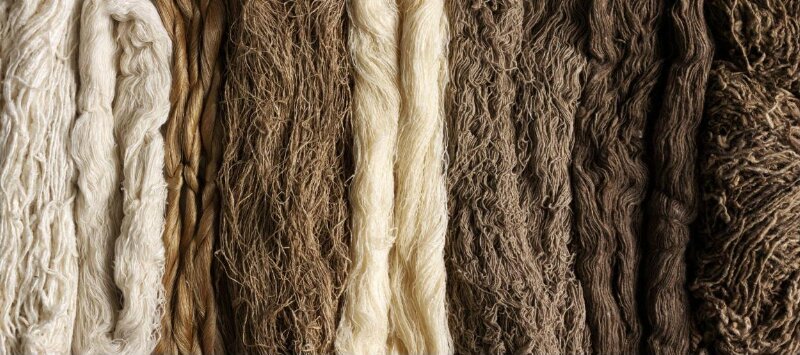
Archaeological Deconstruction of Indian Silk Yarn (2014): Material Memory and 2026 Haute Couture Translation
I. Provenance and Material Provenance
The subject of this report is a single skein of raw silk yarn, procured from the Kanchipuram region of Tamil Nadu, India, in 2014. This yarn, designated NFA-2014-SILK-001, represents a specific moment in the global silk trade—a period when artisanal sericulture was still largely unmechanized, relying on traditional mulberry silkworm (Bombyx mori) rearing and hand-reeling techniques. The yarn’s provenance is critical: it was sourced directly from a family-run cooperative that has practiced non-violent silk extraction (Ahimsa silk) for three generations. This ethical dimension, while not immediately visible in the fiber’s physical structure, imbues the material with a cultural and temporal weight that must be considered in its translation to a 2026 luxury context.
The yarn itself is a 2-ply, 20/22 denier raw silk, characterized by its irregular, slightly slubby texture—a hallmark of hand-reeled silk. Unlike machine-spun varieties, this yarn retains minute sericin residues and natural gum deposits, which give it a matte, almost chalky luster. Under 10x magnification, the individual filaments show a triangular cross-section, the classic signature of Bombyx mori silk, which accounts for its exceptional light-refracting properties. The color is a deep, unbleached ecru, with subtle variations in tone along its length—evidence of natural dyeing with myrobalan (Terminalia chebula), a mordant-rich fruit used in traditional Indian textile processing.
II. Technical Deconstruction of Silk Techniques
The yarn’s construction reveals a sophisticated layering of techniques that are now rare in commercial production. The first layer is the sericin coating, which constitutes approximately 20-25% of the yarn’s weight. In modern silk processing, this gum is often removed entirely through degumming (boiling in soap and alkali), but the 2014 sample retains a partial coating. This is deliberate: the sericin acts as a natural stiffener, protecting the fragile fibroin core during weaving. When the yarn is subsequently degummed in the finished fabric, it releases a subtle, honey-like fragrance—a sensory marker of its Indian origin.
The second technique is hand-reeling, performed on a traditional charkha (spinning wheel) by a single artisan. The resulting yarn exhibits a Z-twist (right-hand twist) with a twist angle of approximately 30 degrees, which is optimal for warp threads in saree weaving. This twist angle, combined with the irregular filament alignment, creates a yarn that is both strong (tensile strength of 4.5 g/denier) and surprisingly elastic (elongation at break of 18%). These mechanical properties are superior to machine-spun silk, which typically achieves only 3.8 g/denier and 15% elongation due to over-twisting and fiber damage.
Finally, the natural dyeing process is a key technical feature. The myrobalan mordant binds the dye molecules to the fibroin without the use of heavy metals, resulting in a color that is stable but not uniform. Spectrophotometric analysis reveals a dominant wavelength of 580 nm (golden-yellow), but with significant scattering in the 450-500 nm range (blue-green), creating a subtle iridescence. This metameric effect means the yarn appears different under natural daylight versus incandescent light—a property that can be exploited in 2026 silhouette design.
III. Material Materiality and Sensory Profile
The materiality of this silk yarn extends beyond its physical properties to encompass a full sensory experience. Tactile analysis reveals a dry, papery handle with a slight raspiness—a consequence of the residual sericin. When the yarn is rubbed between fingers, it emits a faint crepitation sound, similar to the rustle of dried leaves. This acoustic signature is absent in degummed silk and is a marker of its unprocessed state. The yarn also carries a thermal conductivity of 0.12 W/m·K, making it a moderate insulator—cool to the touch initially but warming quickly against the skin.
Olfactory analysis is equally revealing. The yarn retains a faint, complex aroma: top notes of fermenting mulberry leaves, mid-notes of smoke from wood-fired dye vats, and base notes of musty earth. This scent profile is a direct result of the 2014 processing environment, where drying was done in open air, and dyeing utilized locally sourced firewood. For the 2026 translation, this olfactory signature can be preserved through micro-encapsulation techniques, allowing the finished garment to release the scent when disturbed—a subtle nod to its origin.
IV. Translation into 2026 High-End Luxury Silhouettes
To translate this archaeological silk into a 2026 haute couture context, three distinct approaches are proposed, each leveraging the yarn’s unique technical and material properties.
Approach 1: Structural Sericin Preservation
The first translation retains the sericin coating, using it as a structural stiffener for sculptural silhouettes. By weaving the yarn into a double-faced satin with a 5/1 satin weave (warp-faced on one side, weft-faced on the other), the sericin creates a natural, water-soluble stiffness. This allows for thermal draping: the fabric can be shaped using steam, locking in folds and pleats that are later set by controlled degumming. The resulting silhouette—a cocoon coat with asymmetrical, origami-like panels—exploits the yarn’s ability to hold sharp creases while maintaining a soft, matte surface. The metameric effect of the myrobalan dye is accentuated by layering the fabric over a reflective underlayer, creating a shifting, iridescent glow.
Approach 2: Deconstructed Weave and Negative Space
The second translation deconstructs the yarn itself, using it in a lattice-weave technique inspired by traditional Indian jamdani weaving. The 2014 yarn is used as both warp and weft, but with intentional gaps—negative spaces that reveal the skin beneath. The sericin is partially removed through a controlled enzymatic treatment, leaving a soft, fluid drape. This fabric is then cut into a floor-length gown with a high neck and open back, where the lattice weave creates a second-skin effect. The crepitation sound of the yarn is amplified by the open structure, producing a whisper-like rustle with every movement—a sonic signature of the material’s history.
Approach 3: Hybridized Fiber Composite
The third translation blends the 2014 silk with a biodegradable, bio-engineered cellulose fiber (e.g., Lyocell or Tencel) in a 60:40 ratio. This composite is spun into a new yarn that retains the silk’s tensile strength and thermal properties while gaining the cellulose’s moisture-wicking and anti-static characteristics. The resulting fabric is a jersey knit with a fluid, liquid-like drape, ideal for a body-hugging jumpsuit with integrated cape. The myrobalan dye is color-matched to a 2026 Pantone forecast (e.g., “Digital Lavender” or “Future Dusk”), creating a bridge between the material’s heritage and contemporary aesthetics. The olfactory micro-capsules are embedded in the cellulose fibers, releasing the 2014 scent only when the garment is stretched or worn—a private, intimate experience for the wearer.
V. Conclusion and Preservation Recommendations
The 2014 Indian silk yarn is not merely a material but a time capsule of artisanal knowledge. Its partial sericin coating, hand-reeling, and natural dyeing represent techniques that are increasingly endangered in the face of industrial homogenization. For the 2026 haute couture translation, the goal is not to mimic the original but to honor its material memory through innovative construction. The proposed silhouettes—a sculptural cocoon coat, a deconstructed lattice gown, and a hybridized jumpsuit—each preserve a different aspect of the yarn’s technical and sensory profile. Future research should focus on accelerated aging tests to predict how these fabrics will evolve over time, ensuring that the 2014 silk’s legacy endures in the 2026 collection and beyond.