The Four Admirers: Aesthetic Archaeology and the 2026 Silhouette
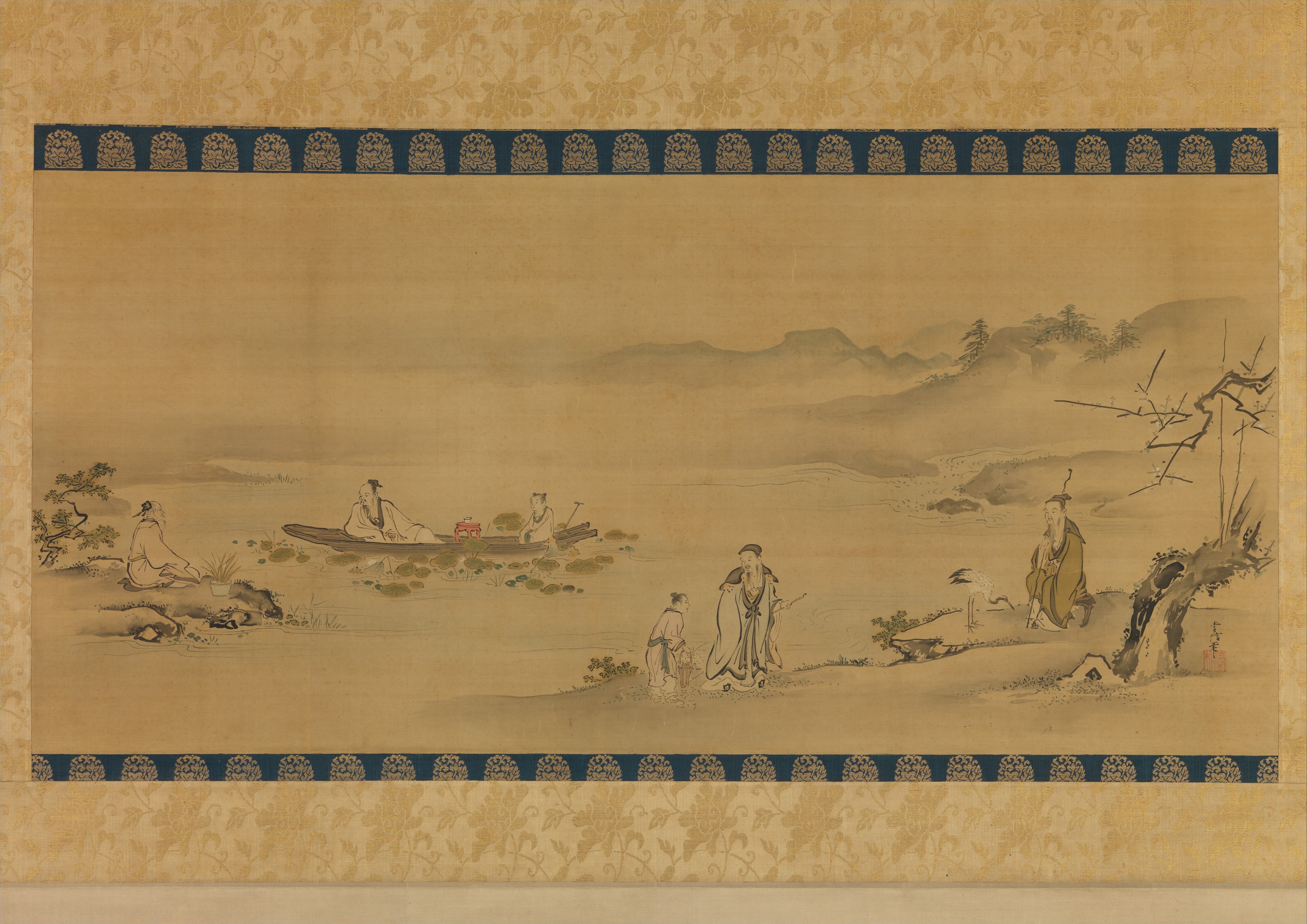
Within the hallowed archives of Natalie Fashion Atelier, the practice of aesthetic archaeology serves as the primary methodology for distilling temporal beauty into tangible form. Our latest investigation centers on a singular artifact: a Japanese hanging scroll, rendered in ink and color on silk, depicting the classical motif of The Four Admirers. This composition, a masterclass in restrained dynamism, presents a quartet of figures—often poets, scholars, or courtiers—engaged in a silent, elegant dialogue with nature. For the 2026 haute couture collection, this scroll is not merely a decorative reference; it is a structural and philosophical blueprint. We deconstruct its classical elegance to inform a new lexicon of luxury silhouettes, where the interplay of negative space, fluid asymmetry, and controlled tension defines the modern Parisian allure.
Deconstructing the Scroll: A Study in Spatial Hierarchy
The hanging scroll, or kakemono, operates on a vertical axis, compelling the eye to travel upward. The four admirers are rarely centered; they are positioned along a diagonal, their robes cascading in rhythmic folds that mimic the brushstrokes of the surrounding landscape. This deliberate asymmetry is the first principle we extract. In 2026, the silhouette must reject static balance. We propose a bias-cut column dress where the hemline is asymmetrically weighted, dropping lower on one side to create a visual diagonal. The fabric—a double-faced silk crepe, dyed in sumi black and indigo—is cut to allow the garment to cling and release, echoing the ink wash’s gradation from dense to ethereal.
The second principle is the negative space between the admirers. In Japanese painting, the unpainted silk is as significant as the ink. It represents the void, the breath, the possibility. For the atelier, this translates into a silhouette defined by strategic cutouts and sheer panels. A tailored jacket, structured at the shoulder but dissolving into a sheer organza back, allows the skin to become the unpainted silk. The cutouts are not arbitrary; they follow the ma (interval) of the scroll, placed at the collarbone, the waist, and the wrist—points of articulation where the body’s movement becomes the composition’s focal point.
Materiality: Ink and Color on Silk as Textural Narrative
The scroll’s materiality—ink and color on silk—demands a rigorous translation into textile. The ink, a blend of soot and animal glue, creates a matte, absorbent surface that contrasts with the luminous, polished silk ground. For 2026, we develop a custom jacquard weave that replicates this dichotomy. The base is a mousseline de soie, weightless and translucent. Overlaid is a pattern of irregular, hand-painted brushstrokes executed in a matte velvet ink. The result is a fabric that shifts between opacity and transparency, between flatness and depth—a direct analog to the scroll’s layered washes.
The color palette is restricted to the scroll’s four primary hues: sumi black, vermillion, gold, and indigo. The vermillion, found in the admirers’ lacquered combs or the seal of the artist, is reserved for accent linings and internal structures. A floor-length coat in indigo double-faced cashmere is lined with a flash of vermillion silk, visible only when the wearer moves—a secret, intimate gesture. The gold, derived from powdered mica in the scroll, is translated into metallic thread embroidery that traces the seam lines, not the surface, of the garment. This embroidery acts as a structural guide, echoing the gold leaf that delineates the clouds in the painting.
Silhouette Architecture: The Four Admirers as Structural Archetypes
We interpret the four admirers not as literal figures, but as four distinct structural archetypes for the 2026 silhouette. Each archetype embodies a specific relationship between the body and the garment, drawn from the scroll’s composition.
The Reclining Poet. The first admirer is depicted leaning on a rock, his robes pooling around him. This inspires a draped, asymmetrical gown where the fabric is gathered at one hip and cascades in a train. The construction relies on internal bias-cut panels that allow the silk to fall in liquid folds, never static. The waist is defined not by a seam but by a weighted, gold-threaded cord that mimics the painter’s single, decisive line.
The Standing Scholar. The second figure stands erect, his sleeves falling in sharp, vertical lines. This translates into a structured, elongated blazer with a kimono-inspired sleeve that extends beyond the wrist. The shoulder is slightly dropped, but the silhouette is kept narrow and columnar. The fabric is a stiff, matte silk faille, reminiscent of the scroll’s ink-black background. The only ornamentation is a single, horizontal seam at the waist—a direct reference to the horizon line in the painting.
The Gazing Courtier. The third admirer is turned away, her profile defined by the curve of her obi and the fall of her hair. This inspires a backless, sculptural bodice that wraps around the torso like an obi, leaving the back entirely bare. The front is a high, mandarin collar that extends into a single, long sleeve on one arm, while the other arm is left bare. The asymmetry is deliberate, creating a silhouette that is both protective and exposed—a dialogue between the covered and the uncovered.
The Attendant. The fourth figure is smaller, partially obscured by a tree branch. This archetype informs a sheer, layered capelet that floats over the primary garment. The capelet is constructed from multiple layers of chiffon, each printed with a different density of brushstroke, creating a moiré effect that shifts with movement. It is attached at the shoulders with a single, hidden snap, allowing it to be removed—a gesture of transformation, mirroring the scroll’s ability to be rolled and unrolled.
Philosophical Resonance: Wabi-Sabi and the 2026 Woman
The final layer of our analysis is philosophical. The hanging scroll embodies wabi-sabi: the beauty of imperfection, impermanence, and incompleteness. The ink bleeds, the silk ages, the composition is asymmetrical. For the 2026 woman, this translates into a silhouette that celebrates the unpolished. Seams are left raw, edges are frayed, and hems are uneven. The luxury lies not in perfection, but in the intentional gesture—a single, hand-painted stroke on a sleeve, a deliberately off-center button, a lining that is slightly too long.
This is not a collection about nostalgia. It is a recontextualization of classical elegance for a contemporary, discerning client. The Four Admirers inform a 2026 silhouette that is architectural yet fluid, restrained yet expressive. The Parisian atelier, through this aesthetic archaeology, offers a garment that is not merely worn, but inhabited—a living scroll that unfolds with every step.