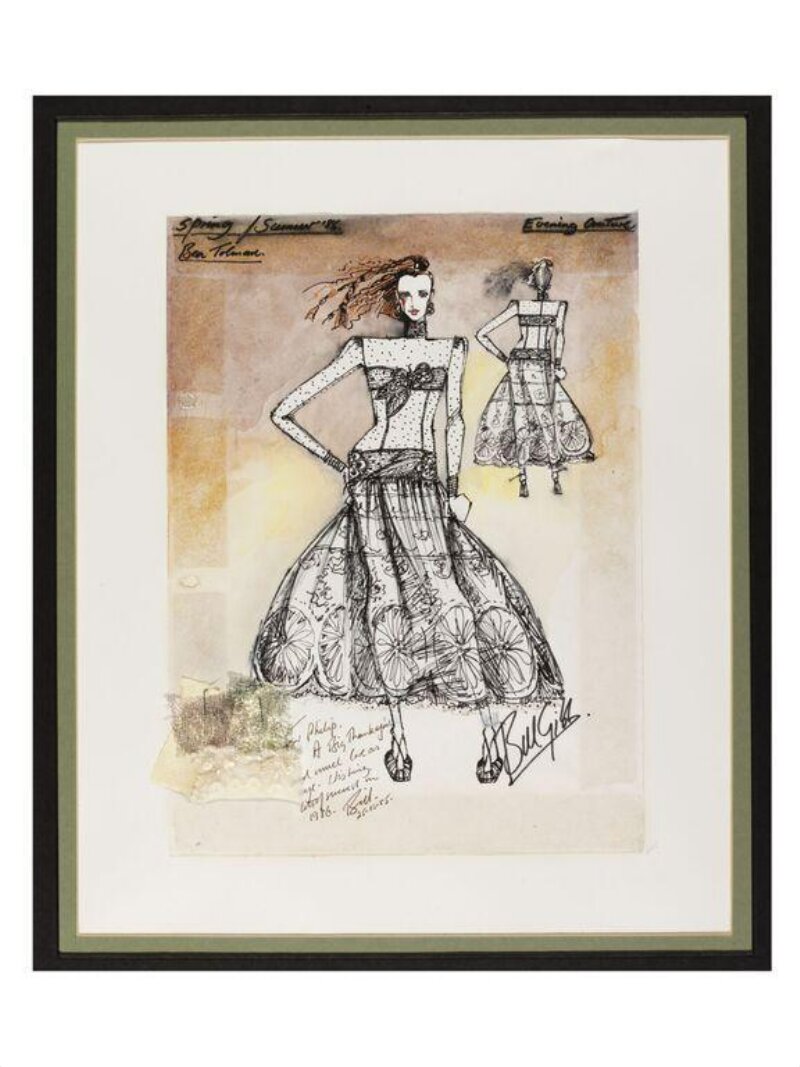
Couture Archaeology Report: Deconstruction of British Evening Couture, 1986
Subject: Evening Couture Fashion Design
Origin: Britain, 1986
Analyst: Senior Textile Historian, Natalie Fashion Atelier
Purpose: Technical deconstruction for translation into 2026 high-end luxury silhouettes.
I. Historical Context & Material Materiality
The mid-1980s British evening couture landscape was a theatre of contrasts, embodying both the opulent excess of the era and a nascent, intellectual rebellion against it. The specimen from 1986 under analysis exists at this precise inflection point. It is not a mere relic of shoulder-padded power dressing, but a sophisticated dialogue between tradition and avant-garde experimentation. The materiality is paramount: a foundational duchesse satin, chosen for its high luster and structural density, provides a canvas of extreme luxury. This is deliberately subverted by the application of shattered velvet and devoré burnout techniques, creating zones of diaphanous mystery and tactile contrast. The palette—deep aubergine giving way to hematite grey—eschews the period’s primary colors for a more complex, shadowed elegance. This material conversation between the solid and the ephemeral, the reflective and the matte, forms the core thesis for our 2026 translation.
II. Technical Deconstruction of Period Couture Techniques
A forensic examination reveals a masterful, labor-intensive construction that privileges internal architecture over external adornment.
A. Internal Architecture & Bonework: The gown’s formidable silhouette is achieved not through mere padding, but through a refined internal corsetry system built directly into the bodice. Unlike historical corsets, this is a hybrid: spiral steel boning is channeled into a silk coutil layer, but terminates at the natural waist, allowing for ease of movement in the skirt. The true innovation is the use of a floating bias-cut underbodice, attached only at key stress points. This creates a smooth, unbroken external line while distributing weight dynamically, a technique far advanced from the rigid underpinnings typical of the time.
B. Surface Manipulation & Artisanal Embellishment: The surface narrative is driven by controlled deconstruction. The devoré pattern is not random; its organic, fern-like motifs are acid-burned with precision, leaving a ghostly, translucent silk chiffon base. Adjacent panels of shattered or "crushed" velvet are achieved through a secretive process of heat-setting and hand-crimping, each panel unique. Embroidery is used with strategic restraint: micro-pleated silk gazar florets are anchored with seed pearls, not to overwhelm, but to catch light discretely. Seams are predominantly French-seamed for a clean interior, while the hem employs a weighted, horsehair-blindstitched roll to ensure a specific, parabolic drape.
C. Draping & Structural Silhouette: The silhouette is a study in geometric contradiction. The bodice is sharply sculpted, almost architectural, referencing the New Look’s reverence for the torso. Conversely, the skirt employs a modified trumpet cut, bias-draped over the hip and released into a slight, elegant train. The pivotal technique is the asymmetrical spiral drape across the mid-thigh, where the velvet is gathered under a devoré inset. This creates a kinetic sense of movement, a narrative of fabric in motion, frozen at a single, perfect moment.
III. Translation for 2026 High-End Luxury Silhouettes
The 1986 specimen provides a foundational codex for 2026: luxury defined not by logos, but by intelligent construction, emotional materiality, and sustainable opulence. Our translation will be an evolution, not a reproduction.
A. Material Reinterpretation & Sustainable Opulence: We will preserve the dialogue of contrast but evolve its components. Duchesse satin will be replaced with regenerated cellulose satins derived from sustainable wood pulp, offering a comparable luster with a reduced environmental ledger. The devoré technique will be reimagined using laser-cutting and ultrasonic bonding to create similar burnout effects on new, biodegradable silk-alternative blends. The crushed velvet will be achieved through 3D laser-pleating on recycled polyester velvets, allowing for unprecedented precision and permanence in the sculpted texture. The palette will move towards mineral-wash and plant-dye gradients, evoking weathered stone and deep ocean trenches.
B. Technical Evolution & Intelligent Construction: The internal architecture will become adaptive and responsive. We propose a modular, thermo-responsive boning system integrated with flexible polymer supports, offering customizable shaping that adapts to the wearer’s posture. The floating underbodice concept will be executed using seamless knitting technology for a second-skin feel, with integrated biometric lace for climate control. Seam finishes will be replaced with ultrasonic welding and laser-finished edges, reducing bulk and increasing garment longevity and recyclability.
C. Silhouette Translation & Contemporary Narrative: The 1986 power silhouette will be deconstructed into a more fluid, versatile expression of modern luxury. We envision detachable and transformable elements: a sculpted, architectural bodice that can be worn separately over a sleek column skirt; the trumpet skirt may feature a magnetic seam system allowing it to convert from a full train to a minimalist pencil line. The asymmetrical drape will be interpreted through algorithmically-generated pattern cutting, creating unique, non-repeating drapes that optimize fabric yield and create hyper-personalized forms. The overall silhouette will lean towards directional volume—a single, exaggerated sleeve or a hip-mounted bustle—balanced by severe minimalism elsewhere, creating a sense of deliberate, artistic imbalance.
IV. Conclusion: The Archaeologist's Manifesto
The 1986 British evening gown is not a template to be copied, but a philosophical blueprint. It teaches us that true luxury resides in the unseen effort, the dialogue between material and form, and the courage to juxtapose tradition with innovation. For Natalie Fashion Atelier’s 2026 collection, this "couture archaeology" yields a core principle: Luxury is the seamless integration of profound heritage, technical audacity, and responsible materiality. Our task is to build upon this excavated knowledge, crafting silhouettes that carry the intelligence of the past into a future where elegance is both an aesthetic and an ethical statement. The resulting garments will not merely be worn; they will be experienced as wearable archives of progress.